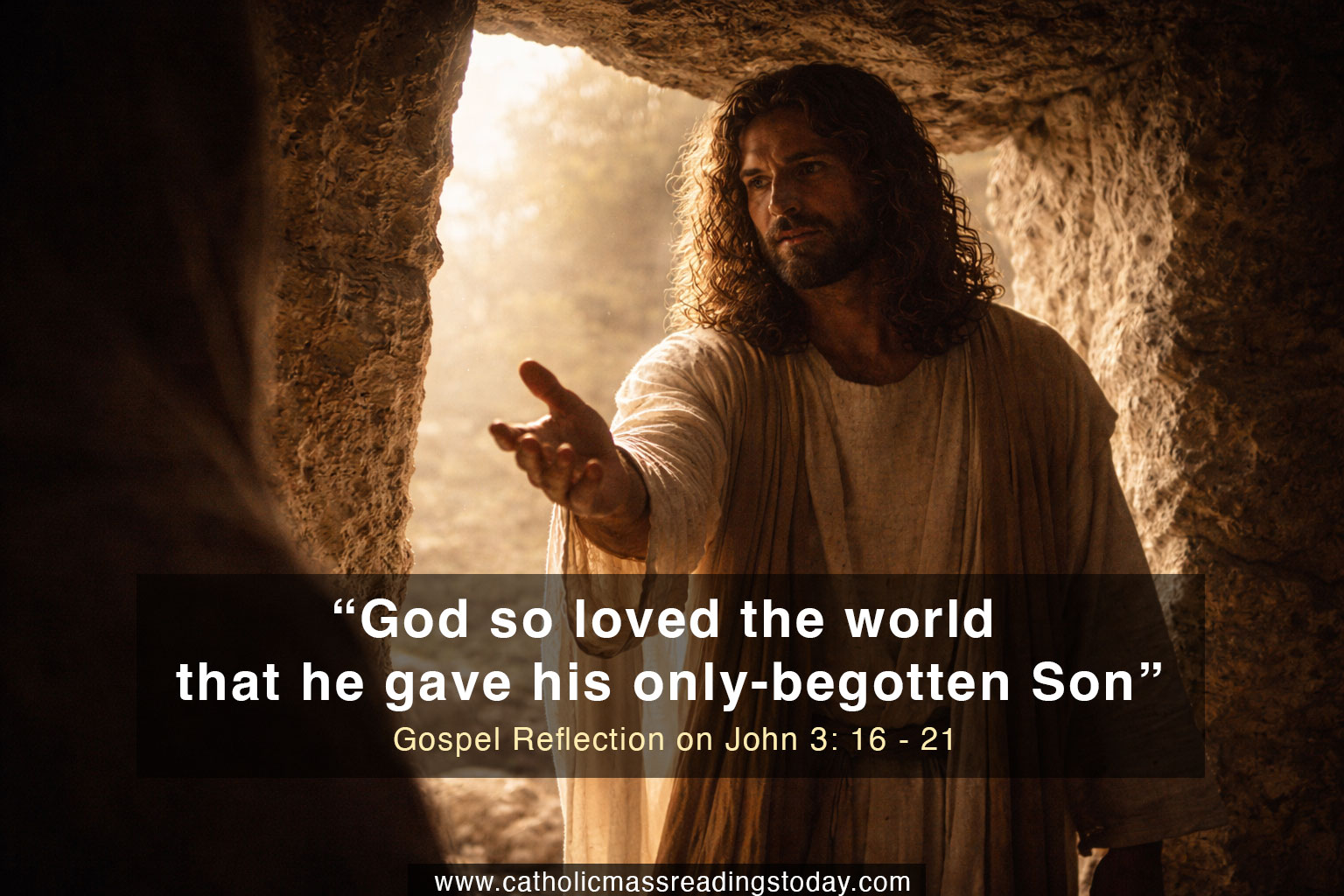
There are few passages in all of Scripture as familiar as this one, and yet, when we slow down and truly listen, it reveals something that is both simple and overwhelming: God loves the world.
Not an ideal world, not a perfect people, but this world as it is, with all its wounds, confusion, and brokenness. And the measure of that love is not words, but a gift: “He gave his only-begotten Son.” In the heart of the Easter season, we understand this more clearly. The Son who was given is the Son who was crucified and who has now risen. Love has gone to the very end, and beyond.
What stands out in today’s Gospel is that God’s intention is not condemnation, but salvation. That is something we need to hear again, especially in a world that often feels quick to judge, quick to divide, and slow to show mercy. Christ did not come to expose us just to shame us; He came to bring us back, to restore what had been lost.
And yet, the Gospel does not ignore the reality of human freedom. There is a quiet but serious truth here: the light has come, but not everyone chooses it. Sometimes, we prefer the shadows, not because we do not know the light, but because stepping into it requires honesty, change, even repentance. It asks something of us.
In the life of the Church, this movement from darkness to light is at the heart of conversion. It is what we renew every time we examine our conscience, every time we approach the Sacrament of Reconciliation, every time we choose truth over comfort. The light of Christ does not destroy us, it reveals us, heals us, and leads us into freedom.
In our world today, this Gospel speaks with urgency. We live in a time of deep moral confusion, where truth is often blurred and where what is good can be redefined to suit convenience. There is also a great deal of suffering, wars, injustice, broken families, quiet personal struggles that no one sees. In the midst of all this, Christ does not withdraw. He steps into it as light.
But light does something, it reveals. It calls things by their name. It invites us not just to observe from a distance, but to respond. To believe in Christ is not simply to accept Him intellectually; it is to choose to walk in His light. It is to allow His truth to shape our lives, even when it challenges us.
This is not always easy. There are moments when coming into the light means facing parts of ourselves we would rather avoid. But this is where grace meets us. Because the same God who reveals also forgives. The same Christ who calls us out of darkness also walks with us into new life.
Easter reminds us that darkness does not have the final word. The light has already overcome it. The question is whether we are willing to step into that light fully, not halfway, not occasionally, but with trust.
Perhaps today, this Gospel is asking each of us a quiet question: Where am I still holding onto the shadows? And what would it mean for me to step into the light of Christ?
And so we pray:
Lord Jesus,
You are the light that has come into the world.
You did not come to condemn us, but to save us.
Give us the courage to step out of every darkness from sin, from fear, from anything that keeps us from You.
Help us to live in truth, to walk in Your light,
and to trust in Your mercy.
In a world that is often divided and uncertain,
make us witnesses of Your love and truth.
Amen.