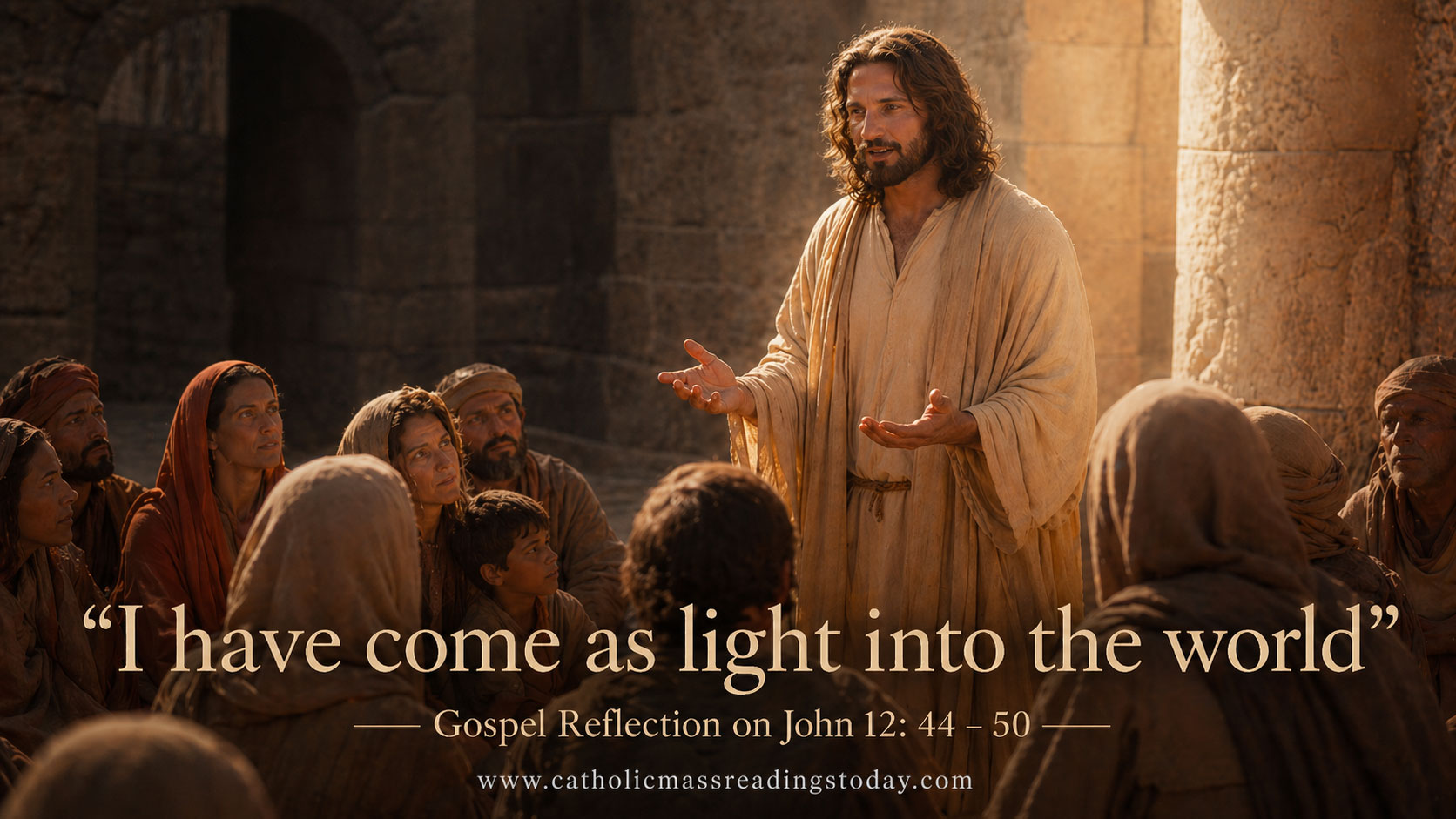
In this Gospel, the voice of Jesus is not quiet or hesitant. Saint John tells us that Jesus cried out. He does not whisper this truth as though it were one opinion among many. He proclaims it with the force of divine love: “I have come as light into the world.” These are not only words of revelation. They are words of rescue. Christ speaks because humanity was not made for darkness. Man was not created to remain in confusion, in fear, in sin, in the sadness that comes when the heart loses its way. He came that we might not remain there.
There is a difference between passing through darkness and choosing to remain in it. Every human life knows shadows. We know suffering, disappointment, grief, weakness, temptation. We know the pain of uncertainty and the fatigue of carrying burdens that others do not see. The Lord does not speak as One who is indifferent to this. He enters the world precisely because He sees what sin and darkness do to the human heart. He does not come merely to observe our condition, nor simply to instruct us from afar. He comes as light. That is to say, He comes personally, actively, mercifully. He comes to reveal the Father, to heal what is wounded, and to show us the way that leads to life.
When Jesus says, “He who sees me sees him who sent me,” He gives us one of the most beautiful truths in the whole Gospel. The Father is not hidden behind Christ as though Jesus were only a messenger passing on information. In Jesus, the face of the Father shines forth. To look upon Christ is to see the mercy of the Father. To hear Christ is to hear the voice of the Father. To receive Christ is to receive the love by which all things were made. This is why the Church never tires of leading the faithful back to Jesus. She does so not because she wishes to narrow our vision, but because in Him everything opens. In Him, God is no longer distant. In Him, the Father has drawn near.
And yet the Gospel is also painfully honest. Light can be offered, and still be refused. The problem is not that the light is weak. The problem is that the human heart can become accustomed to dimness. There is a kind of darkness that begins outside us, in the troubles of the world, but there is also a darkness that can settle within us: a refusal to hear, a resistance to conversion, a habit of placing our own judgment above the word of God. Christ says with remarkable tenderness, “I did not come to judge the world but to save the world.” These words should console us deeply. The first movement of God toward humanity is not condemnation, but salvation. The first desire of the Heart of Christ is not to cast away, but to gather in. He comes not to extinguish the smoldering wick, but to rekindle it.
Still, the Lord also speaks a sober truth: the word He has spoken will judge on the last day. This is not a contradiction. It is the seriousness of love. God respects human freedom. He does not force open the heart. The light that saves also reveals. It shows us what is true. It uncovers what we would rather leave hidden. It asks for an answer. In this sense, the judgment is not something arbitrary imposed from the outside. The judgment is the truth itself. The question is whether we have welcomed the truth, loved the truth, allowed ourselves to be changed by the truth.
For us as Catholics, this Gospel touches the whole shape of Christian life. We do not believe in Christ only with the lips. We believe in Him by allowing His light to enter every room of the soul. We believe in Him when we bring our sins to Confession and stop pretending that darkness is harmless. We believe in Him when we receive the Eucharist with reverence, knowing that the Light of the world gives Himself to us as food for the journey. We believe in Him when we let His word correct us, even when it is difficult, even when it wounds our pride, even when it calls us to change our habits, our ambitions, or our treatment of others.
Many people in our time are not openly hostile to Christ; they are simply distracted from Him. The darkness of our age is not always dramatic. Sometimes it is quieter. It is the darkness of endless noise, of hearts too busy to pray, of consciences formed more by trends than by truth, of lives surrounded by information but starved of wisdom. The light of Christ is not merely an emotional comfort in such a world. It is a necessity. Without Him, we lose the measure of what it means to be human. Without Him, freedom becomes confusion, truth becomes opinion, and love becomes sentiment without sacrifice. But with Him, even difficult paths become clear. With Him, suffering is not emptied of meaning. With Him, the human person rediscovers dignity, purpose, and hope.
Notice also that Jesus says, “I know that his commandment is eternal life.” The commandments of God are not burdens placed upon us to diminish us. They are paths given to us because God desires our life. This is one of the lies of darkness: that God’s will limits us. In reality, it is sin that narrows us, falsehood that blinds us, selfishness that imprisons us. The commandment of the Father leads to eternal life because it is the law of love, truth, and communion. Christ does not merely announce that life exists. He opens it before us and leads us into it.
This Gospel therefore asks each of us a very personal question:
Where in my life am I still choosing dimness over light?
- Perhaps it is an unforgiven wound.
- Perhaps it is a habit I defend even though I know it is not of God.
- Perhaps it is a fear of surrender.
- Perhaps it is spiritual laziness, where prayer has become occasional and the word of God unfamiliar.
The Lord does not ask this question to shame us. He asks it to save us. The light of Christ is never cruel. It is clear, but it is merciful. It reveals in order to heal.
To remain in the light is not a once-for-all achievement. It is the daily work of discipleship.
- We remain in the light when we pray faithfully, even without consolation.
- We remain in the light when we form our conscience according to the Gospel and the teaching of the Church.
- We remain in the light when we choose charity over bitterness, chastity over disorder, truth over convenience, humility over vanity.
- We remain in the light when we allow Christ to be Lord not only of our devotions, but of our decisions.
And there is one more thing. Light is never meant to be hoarded. The Christian who has encountered Christ cannot be content merely to be illuminated privately. We are called to become, by grace, witnesses of that same light. Not by drawing attention to ourselves, but by reflecting Him. In a family, this may mean patience where there has been harshness. In society, it may mean courage to speak truth without hatred. In the parish, it may mean fidelity, generosity, and quiet service. In every place, it means allowing others to glimpse, through us, that Christ is alive and that His presence still makes all things new.
The world does not need Christians who have learned to live comfortably in the twilight. It needs disciples who know the Light, love the Light, and are not ashamed to walk in it. Christ did not come so that we might manage our darkness more successfully. He came so that we might leave it behind.
Let us ask, then, not only to admire His light, but to welcome it. Not only to speak of it, but to live by it. Not only to receive consolation from it, but to be transformed by it.
For the One who says, “I have come as light into the world,” is the same Lord who still stands before every human heart and says, in effect: do not be afraid to come into the light, because the light is mercy.
Let us Pray
Lord Jesus Christ,
Light of the world and image of the Father,
shine into the darkness of our hearts.
Where we are confused, give us truth.
Where we are wounded, give us healing.
Where we are afraid to change, give us courage.
Where we are tempted to remain in darkness, draw us gently into Your light.
Teach us to hear Your word with faith,
to receive Your mercy with humility,
and to walk each day as children of the light.
May our lives reflect Your presence,
so that others, seeing the peace You give,
may come to know the Father who sent You.
For You live and reign for ever and ever.
Amen.