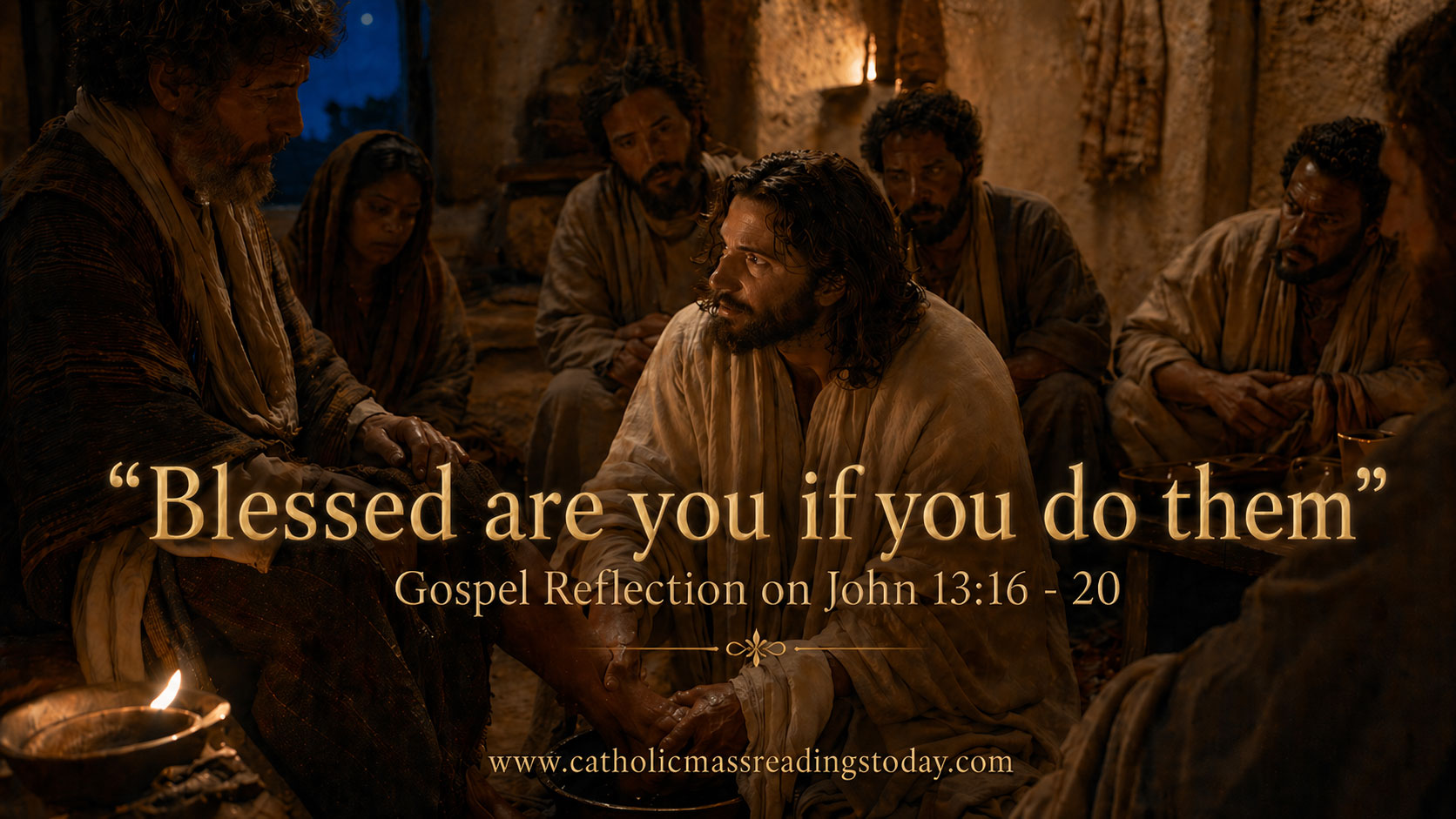
This Gospel comes to us just after one of the most striking moments in the life of Christ: the Master has bent down to wash the feet of His disciples. The One through whom all things were made has taken the place of a servant. And then, having done this, He speaks words that go straight to the heart of Christian discipleship: “A servant is not greater than his master.”
The Lord is not merely giving a lesson in humility. He is revealing the very pattern of divine love. In Jesus, greatness is not shown in domination, but in self-gift. Authority is not exercised through distance, but through closeness. The Son of God does not cling to privilege; He stoops in love. And in doing so, He shows us not only who He is, but who we are called to become.
There is a great temptation in every age to want the glory of Christ without the humility of Christ. We want the dignity of being His followers, but not always the cost of following His way. Yet Jesus leaves no room for illusion. If the Master has chosen the path of service, then the disciple cannot choose the path of pride. If He has lowered Himself in love, then we cannot claim to belong to Him while refusing to humble ourselves for the good of others.
This is a challenging word for the Church, but it is also a liberating one. The Christian life is not a competition for importance. It is not about being seen, praised, or placed above others. It is about becoming available to God. Holiness is not found in self-exaltation, but in quiet fidelity. Very often, the most Christ-like souls are not the loudest, but the ones who love faithfully, serve generously, and remain humble even when no one notices.
Jesus then says, “If you know these things, blessed are you if you do them.” This is a sentence we should not pass over too quickly. There is a difference between admiring the Gospel and obeying it. It is possible to speak beautifully about humility and still resist it in daily life. It is possible to praise service and yet avoid the hidden sacrifices that real love requires.
The Lord does not say we are blessed if we understand these things only, or if we discuss them well, but if we do them. Christianity is not merely a matter of ideas; it is a way of life. The Gospel must take flesh in our choices, our speech, our relationships, our use of authority, our treatment of the vulnerable, and our willingness to forgive. In this sense, the washing of feet is not a scene to be remembered once a year only; it is a pattern meant to shape the whole of Christian existence.
And yet this Gospel also carries a shadow. Jesus speaks of betrayal. He speaks of one who has eaten His bread and lifted his heel against Him. Even in the circle of intimacy, there is infidelity. Even where love has been offered, it can be refused. This should sober us. It reminds us that closeness to sacred things is not enough by itself. One may be near Jesus outwardly and still resist Him inwardly. One may hear His words, receive His gifts, and yet keep a divided heart.
This is why the Christian life always requires conversion. We should not hear this Gospel and think only of Judas in the abstract. We should ask more personally: where is my own resistance to Christ? Where do I prefer my will to His? Where do I speak of love, but hold back from sacrifice? Where do I receive His gifts without allowing them to change me?
At the same time, the Gospel does not end in fear, but in mission. Jesus says, “He who receives any one whom I send receives me; and he who receives me receives him who sent me.” Here the horizon widens. The disciple is not only one who serves; the disciple is one who is sent. And this mission is not something secondary. Christ binds Himself so closely to those He sends that to receive them is to receive Him.
This gives immense dignity to the vocation of the Church. The Church does not go into the world bearing merely human opinions or private inspiration. She is sent by Christ. Her preaching, her sacraments, her witness of charity, her works of mercy, her fidelity to truth, all of these flow from the One who sends her. To receive the authentic witness of Christ’s disciples is to encounter something greater than them. It is to encounter Christ Himself, and through Him, the Father.
This should deepen both our humility and our responsibility. We are not the source; Christ is. We are not masters of the message; we are servants of it. And yet we must carry it faithfully, because people are meant to meet the Lord through the lives of His disciples. That is a beautiful and fearful calling. Beautiful, because it shows the trust Christ places in His Church. Fearful, because it means our lives must not obscure the One we claim to serve.
In the world today, this Gospel is painfully relevant. We live in a time that prizes self-promotion, power, and public image. Humility is often mistaken for weakness. Service is admired in words but avoided in practice. At the same time, many people are suspicious of authority because they have seen it abused. Against all this, Jesus offers another way: authority purified by service, truth expressed in love, mission rooted in communion with the Father.
The Church will speak credibly to the world only when she reflects the face of her Lord, the face of the One who kneels to wash feet, who speaks truth without compromise, who loves even in the presence of betrayal, and who sends His disciples not to dominate the world, but to bear His presence into it.
So this Gospel invites us to examine ourselves with honesty.
- Do I truly believe that no service done in love is beneath me?
- Do I receive others in the name of Christ with reverence and generosity?
- Do I understand my own vocation, whether in family life, work, parish life, consecrated life, or ordained ministry as a call to represent Christ humbly in the world?
The Lord has shown us the way. Blessed are we if we do it.
Let us Pray
Lord Jesus Christ,
You humbled Yourself to serve those You loved,
and You taught us that the servant is not greater than the master.
Free us from pride, from self-seeking, and from every desire
to be important in the eyes of the world.
Teach us the holiness of hidden service,
the strength of humility,
and the beauty of obedience to Your will.
Keep our hearts faithful,
that we may never betray Your love by lives that contradict Your Gospel.
And since You have sent Your disciples into the world,
make us worthy to bear Your presence with truth, charity, and courage.
May all who encounter us
receive something of Your gentleness,
Your truth, and Your peace.
For You live and reign with the Father
in the unity of the Holy Spirit,
God for ever and ever.
Amen.