There are moments in the Gospel when the words of Christ seem to fall upon the soul like balm. This passage is one of them. The Lord speaks to His disciples at a moment of uncertainty. He knows their hearts are troubled, even before they can fully name their fear. He knows that the Cross is near, that confusion will deepen, and that their faith will be tested. And yet He begins not with a demand, but with consolation: “Let not your hearts be troubled.”
These are not shallow words. Jesus does not say that suffering is unreal, nor does He dismiss the burden carried by the human heart. Rather, He invites His disciples into something deeper than fear: trust. He points them away from self reliance and toward faith. “Believe in God, believe also in me.” This is the heart of the Christian response to anxiety. Not denial. Not pride. Not the illusion that we can control everything. But faith in the Lord who remains sovereign even when the road ahead is hidden.
How greatly the world needs to hear these words again. Many hearts today are troubled. They are troubled by war and instability, by sickness and grief, by uncertainty about the future, by the moral confusion of our age, by loneliness, and by the quiet exhaustion that comes from trying to carry life without resting in God. Christ does not promise a life without trials, but He does promise that fear need not govern the heart of the believer.
The reason He can say this is because He opens before them a horizon larger than present sorrow: “In my Father’s house are many rooms.” What a beautiful image this is. Jesus reminds them that their life is not enclosed within the narrow boundaries of earthly struggle. There is a home prepared for them. The destiny of the human person is not abandonment, but communion. Not emptiness, but the Father’s house.
This is one of the great consolations of Christian hope. Heaven is not a vague sentiment or a poetic symbol. It is real. It is the fulfillment of the promises of God. It is the place where love is not lost, where truth is not obscured, where every faithful tear is gathered into eternal joy. And our Lord speaks of it with tenderness and certainty: “I go to prepare a place for you.”
Notice how personal this is. He does not say merely that there is a place. He says that He prepares a place for you. Every believer may hear these words with reverence. Christ knows us. He does not save humanity as an abstraction. He calls persons. He prepares for persons. He loves each soul with a love that is both intimate and divine. In a world where many feel forgotten, displaced, or without a true home, this promise should be treasured deeply.
But then Thomas speaks, and his question is one of the most human in all of Scripture: “Lord, we do not know where you are going; how can we know the way?” Thomas is not being rebellious. He is being honest. He speaks the confusion that often remains hidden in us as well. We too would like clearer maps, more certainty, fewer mysteries. We would like faith without obscurity.
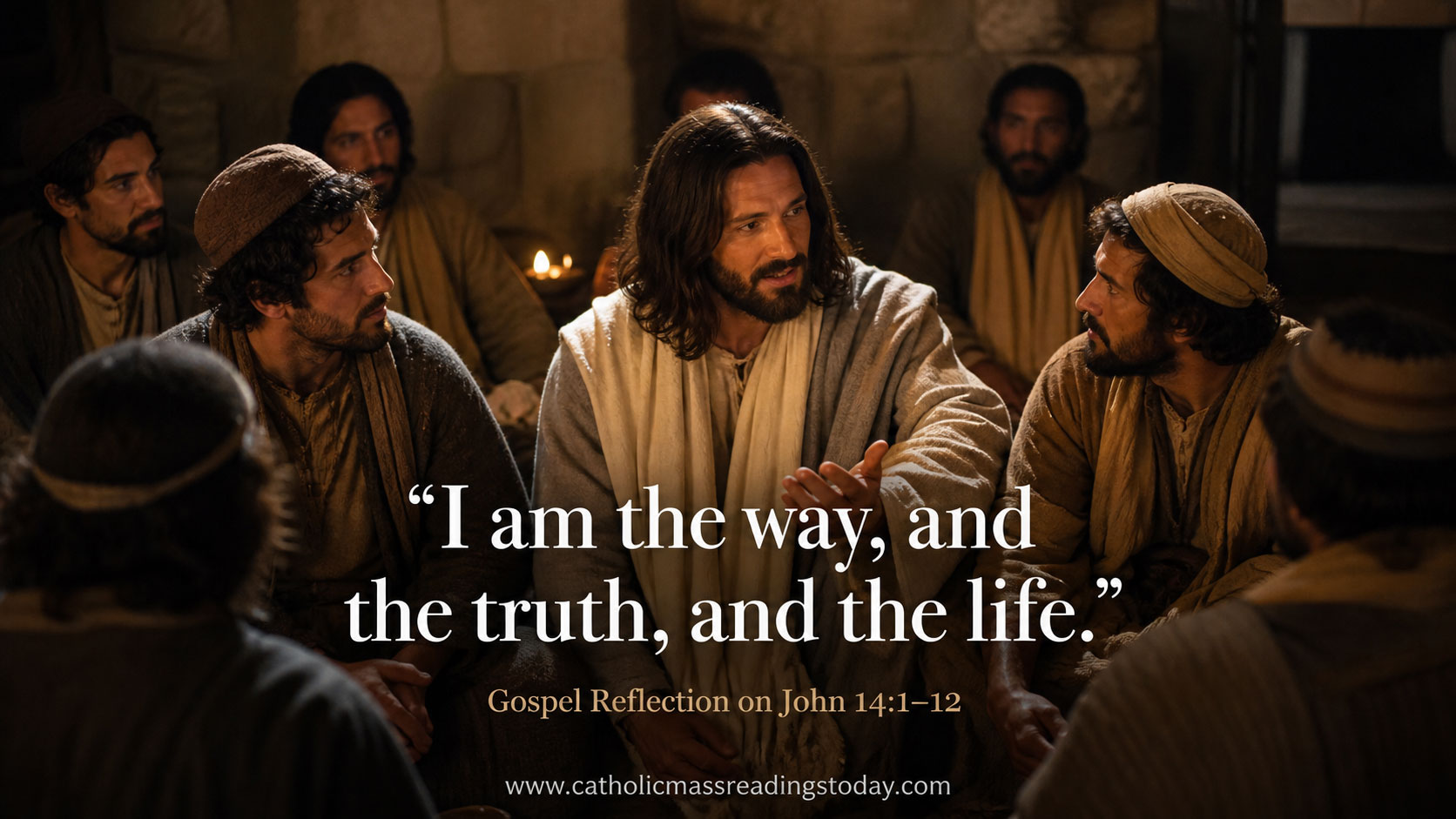
And it is precisely in response to this question that Jesus gives one of His most solemn declarations: “I am the way, and the truth, and the life.”
Here we stand at the center of the Gospel.
Jesus does not say that He merely teaches a way, as though He were one guide among many. He does not say that He points toward truth from a distance, or offers one path among several. He says: I am. The way is not ultimately a method. The truth is not an abstract system. The life is not an earthly success. All are found in Him.
This is why Christianity is not first a philosophy, nor merely a moral vision, nor a set of devotions. It is a living relationship with the Person of Jesus Christ. He is the way because in His humanity the road to the Father has been opened. He is the truth because in Him the deepest reality of God and of man is revealed. He is the life because He alone overcomes sin and death, and alone communicates divine life to the soul.
These words are both consoling and demanding.
They are consoling because they tell us that the road to God is not hidden behind impossible riddles. We are not left to invent our own way. The Son Himself comes to lead us. We need not wander endlessly through false paths. Christ is near.
But they are also demanding, because if He is the way, then there are paths that are not His. If He is the truth, then falsehood cannot be embraced as though it were harmless. If He is the life, then what leads us away from Him leads ultimately toward spiritual death. The Gospel is merciful, but never vague.
Our age is often uncomfortable with such clarity. There is a temptation to reduce Jesus to a wise teacher whose role is to affirm whatever we already desire. But the Lord does not allow this. He presents Himself as the unique mediator between God and man: “No one comes to the Father, but by me.” These words are not given to nourish arrogance, but humility. We do not save ourselves. We are not redeemed by our own brilliance, virtue, or effort. Salvation is gift, and the gift has a name: Jesus Christ.
The Gospel then moves deeper still. Philip says, “Lord, show us the Father, and we shall be satisfied.” Again, this is the cry of the human heart. Behind every lesser longing is this deeper desire: to see God, to know Him, to rest in Him. Man will not be satisfied with the world alone. He is made for more.
And Jesus answers with astonishing directness: “He who has seen me has seen the Father.”
Here we touch one of the deepest mysteries of revelation. Jesus does not merely represent God from afar. He makes the Father known in His very Person. In His words, the Father speaks. In His works, the Father acts. In His mercy, the Father is revealed. To know Christ truly is to begin to know the Father. This is not a poetic exaggeration; it is the very heart of Christian faith.
For this reason, the Church never tires of preaching Christ. She does not preach Him because He is one helpful spiritual figure among others, but because in Him the face of the invisible God has become visible to us. The Father whom humanity has longed to know is made known in the Son.
This has immense consequences for our spiritual life. If we wish to know what God is like, we must look at Jesus. If we wish to know whether God is merciful, we look at Jesus. If we wish to know whether God cares for the poor, forgives sinners, weeps with the suffering, and loves to the end, we look at Jesus. He is not merely a messenger from God. He is the Son who reveals the Father.
And then the Lord adds words that may seem almost overwhelming: “He who believes in me will also do the works that I do; and greater works than these will he do, because I go to the Father.”
These words should fill the Church with both humility and courage. Humility, because any good work done by Christians is not their private achievement, but Christ working through them. Courage, because the Lord entrusts His mission to those who believe in Him. Through the gift of the Holy Spirit, through the sacraments, through the Church, Christ’s saving work continues in history.
The “greater works” do not mean greater in holiness than the works of Christ Himself. Rather, they refer to the astonishing fruitfulness of the risen Lord acting through His Body, the Church, across the nations and across time. Hearts converted, sins forgiven, the poor served, the Gospel preached to the ends of the earth, lives transformed by grace, these are indeed great works, and they are possible only because Christ has returned to the Father and poured out the Spirit upon His people.
This should awaken in us a serious question: do we believe strongly enough in the power of Christ working through the Church? Or have we become timid, inward-looking, and resigned? The Lord’s words do not permit a passive Christianity. Faith in Him is living, missionary, fruitful. The Christian is not called merely to admire Christ, but to become available to His action.
In practical terms, this means that every life lived in Christ can become a channel of grace. A mother teaching her child to pray, a priest faithfully preaching the Gospel, a religious hidden in contemplation, a worker living with integrity, a young person remaining pure in a confused world, a Christian forgiving an enemy, a parish caring for the poor, these too are the works of Christ continued in history.
This Gospel therefore offers us both profound peace and profound mission.
- It gives peace, because Christ prepares a place for us and asks that our hearts not be troubled.
- It gives direction, because He Himself is the way.
- It gives certainty, because He is the truth.
- It gives hope, because He is the life.
- It gives vision, because in seeing Him we see the Father.
And it gives courage, because He wills to continue His works through those who believe.
The Christian life is not the anxious search for an unknown road. It is the steady following of a known Lord.
If we remain close to Him in prayer, in Scripture, in the sacraments, and in the life of the Church, then even in a troubled world, our hearts may rest in this: the way is not lost to us. The truth is not beyond us. The life we seek has already come near.
Let us Pray
Lord Jesus Christ,
when our hearts are troubled, draw us into Your peace.
When the path ahead seems unclear, remind us that You are the Way.
When confusion darkens the mind, keep us faithful to You who are the Truth.
When we are weary in soul and body, renew us with Your life.
Teach us to know the Father more deeply
by contemplating Your face,
listening to Your word,
and remaining in Your love.
Strengthen Your Church
to continue Your works in the world
with humility, courage, and holiness.
Prepare us for the place You have promised,
and keep our hearts fixed on the Father’s house,
where You live and reign forever and ever.
Amen.