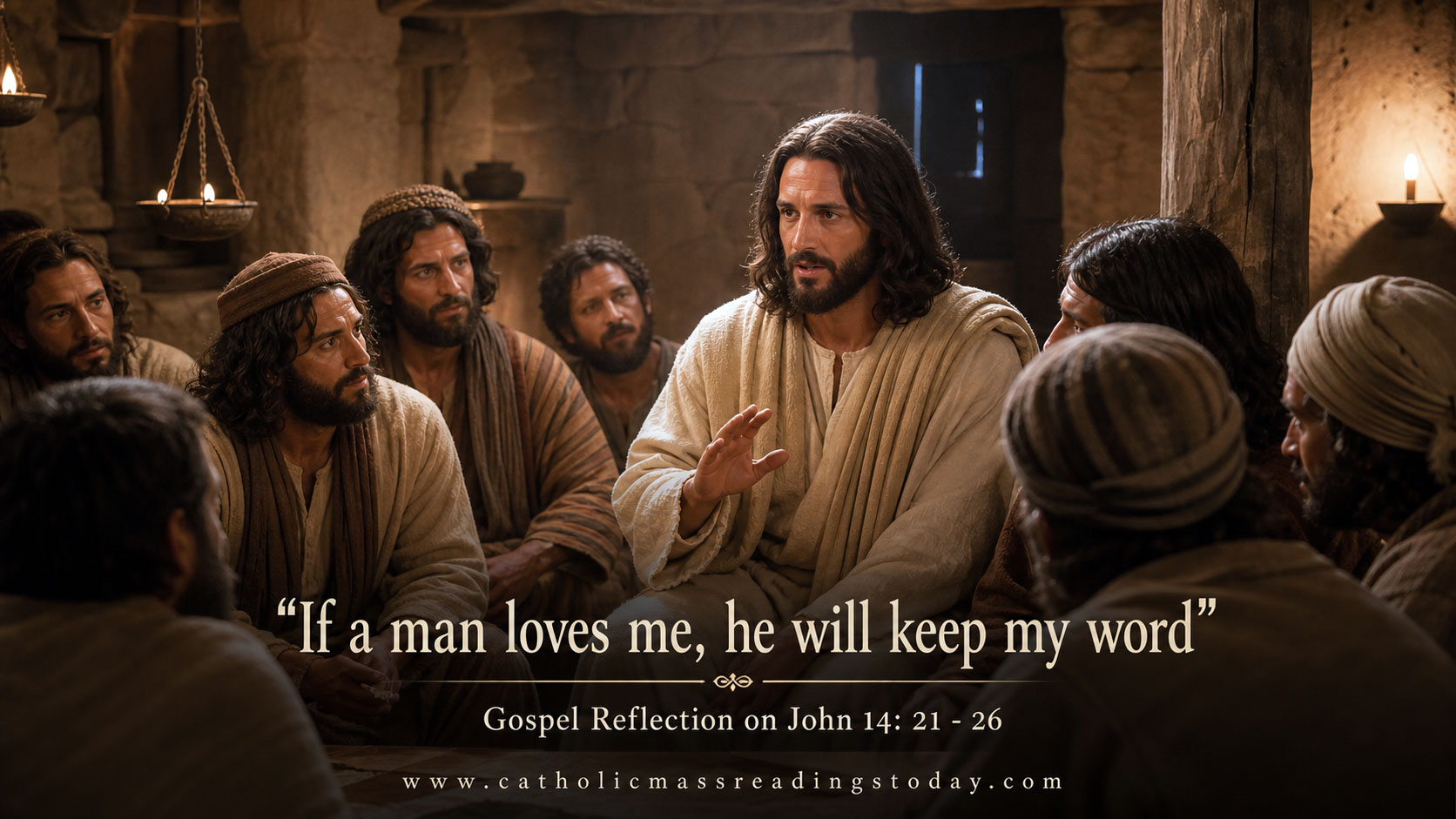
In this Gospel, the Lord speaks to His disciples with a tenderness that is at once intimate and demanding. He is preparing them for His departure, but He does not leave them with fear. Instead, He draws them deeper into the mystery of love, obedience, and divine indwelling. His words are not merely instruction; they are invitation. They reveal what it means to live in true communion with God.
Jesus begins with a statement that should remain in the heart of every disciple: “He who has my commandments and keeps them, he it is who loves me.”
In our time, love is often spoken of as though it were only feeling, impulse, or sincerity of intention. But the Gospel purifies our understanding. For Jesus, love is not vague affection, nor is it a passing emotion that rises and falls with circumstance. Love is fidelity. Love is obedience. Love is the willingness to shape one’s life according to the word of the Beloved.
This is not because God needs our obedience in order to feel secure. It is because obedience is the form that love takes when it is real. If we claim to love Christ and yet resist His word, hold His commandments lightly, or set aside His teaching when it becomes costly, then our love remains incomplete. The Lord does not say this to burden us, but to bring us into truth. A love that does not transform our life is not yet the love to which He calls us.
And yet the promise that follows is filled with immense consolation: “He who loves me will be loved by my Father, and I will love him and manifest myself to him.” Here we begin to see the beauty of the Christian life. Obedience to Christ is not sterile duty. It opens the soul to deeper communion. When the disciple keeps the word of Jesus, he does not simply become morally improved; he becomes a place of encounter. Christ manifests Himself to the soul that loves Him faithfully.
Judas (not Iscariot) asks a question that is very understandable: “Lord, how is it that you will manifest yourself to us, and not to the world?” It is as if he is expecting something grander, more public, more obvious. And in this question he resembles many hearts today.
We often ask, either explicitly or silently:
- Why does God not reveal Himself in more undeniable ways?
- Why does He not force the world to recognize Him?
- Why does His presence often seem hidden?
The Lord’s answer is striking. He does not speak of spectacle. He does not promise a display of power that compels belief. He speaks instead of love, obedience, and indwelling: “If a man loves me, he will keep my word, and my Father will love him, and we will come to him and make our home with him.”
What a profound mystery. God does not simply visit the faithful soul from time to time. He makes His home there. The Father and the Son come to dwell within the one who lives in faithful love. This is one of the most beautiful truths in all of Christian revelation: that the human heart, cleansed by grace and formed by obedience, becomes a dwelling place of God.
Here we touch the doctrine of sanctifying grace in all its beauty. The Christian life is not merely external conformity to a law. It is participation in divine life. Through grace, God is not distant from us; He lives within us. This is why sin is so tragic, not only because it breaks a rule, but because it resists communion. And this is why holiness is so beautiful, not only because it is virtuous, but because it makes room for God.
The Lord continues with sobering clarity: “He who does not love me does not keep my words.” In these words there is no harshness, only truth. Love cannot be separated from fidelity. The disciple is not judged by enthusiasm alone, nor by religious appearance, but by whether the word of Christ has truly taken root in life.
This is a necessary correction for every age, including our own. It is possible to speak much about spirituality and yet live at a distance from the commandments of God. It is possible to use the language of love while resisting truth. But the Gospel does not allow us to divide what Christ has joined. Love of Jesus and obedience to His word belong together. They are not rivals. They are signs of the same grace at work in the soul.
Then the Lord turns our gaze toward the great gift that will sustain the Church after His visible departure: “The Counsellor, the Holy Spirit, whom the Father will send in my name, he will teach you all things, and bring to your remembrance all that I have said to you.”
Here the heart of the Church is revealed. The Christian life is not lived by human memory alone, nor by human strength alone. The disciples will not be abandoned to confusion. The Holy Spirit will be given. He will teach, remind, illuminate, strengthen, sanctify, and guide.
This promise has immense importance for Catholic faith. The Church does not stand in history by her own wisdom. She is upheld by the Holy Spirit. The Spirit preserves the words of Christ in the living memory of the Church. He deepens understanding of revelation. He gives courage in persecution, discernment in confusion, and fidelity in times of trial. Without the Holy Spirit, the Church would become merely an institution among institutions. With the Holy Spirit, she remains the living Body of Christ, continually renewed from within.
The Spirit “teaches all things,” not by replacing Christ, but by leading us more deeply into Christ. He does not reveal another Gospel. He opens our hearts to the Gospel already given. He takes the words of Jesus and presses them more deeply into memory, conscience, and life. This is why the Spirit is never opposed to the teaching of Christ or the faith of the Church. He is the divine bond who keeps the Church rooted in the truth of her Lord.
In the personal spiritual life, this promise is also full of hope. Many Christians know what it is to feel weak, forgetful, distracted, or uncertain. We hear the word of God, and yet so often our hearts are slow, our memory poor, and our fidelity inconsistent. How reassuring, then, to know that the Holy Spirit is not a distant doctrine, but a living helper. He teaches us from within. He brings to mind what we most need to remember. He gives light when our thoughts are clouded. He strengthens us when our resolve is fragile. He makes possible what would otherwise remain beyond our strength.
This Gospel also helps us understand the deeper shape of Christian maturity. To grow in holiness is not simply to accumulate information about religion. It is to become more obedient in love, more interiorly recollected, more open to the presence of God, and more docile to the Holy Spirit. A mature Christian is not merely one who knows many things about the faith, but one in whom the Father and the Son have found a home, and in whom the Spirit is free to teach and guide.
How needed this is in our own moment. We live in a restless age, an age of noise, reaction, and surface. Many are spiritually exhausted, yet do not know why. Many desire peace, yet seek it in places where it cannot be found. Many want God, but without obedience; they want spirituality, but without surrender. The Gospel offers a different path: keep the word of Christ, love Him in truth, welcome His presence, and live under the guidance of the Holy Spirit.
The Church must also hear this Gospel as a call to deeper interiority. We cannot offer the world only arguments, structures, or activity. We must offer what comes from communion. A Church that does not keep the word of Christ cannot credibly speak His name. A disciple who does not make room for God within will have little to offer beyond himself. But where Christ is loved, where His commandments are kept, where the Spirit is welcomed, there something of heaven begins already on earth.
So this passage is at once simple and inexhaustible. Love Christ. Keep His word. Welcome the indwelling of God. Trust the Holy Spirit. That is the path of the Christian soul.
And there is great peace in this. We are not left alone to figure out holiness. We are taught from within. We are accompanied. We are inhabited by grace. God does not merely command from above; He comes near. He makes His home with us.
Let us Pray
Lord Jesus Christ,
You have taught us that to love You
is to keep Your word.
Give us a faithful and obedient heart,
not content with passing feelings,
but rooted in truth, perseverance, and love.
May the Father’s love rest upon us,
and may our hearts become a dwelling place
for the life of the Holy Trinity.
Send upon us anew the Holy Spirit,
the Counsellor and Teacher,
to remind us of all that You have spoken,
to strengthen us in weakness,
and to guide us into all truth.
In times of confusion, give us light.
In times of struggle, give us courage.
In times of dryness, remain near.
Teach us to live in such a way
that Your word is not only heard by us,
but seen in us.
For You live and reign with the Father
in the unity of the Holy Spirit,
God for ever and ever.
Amen.