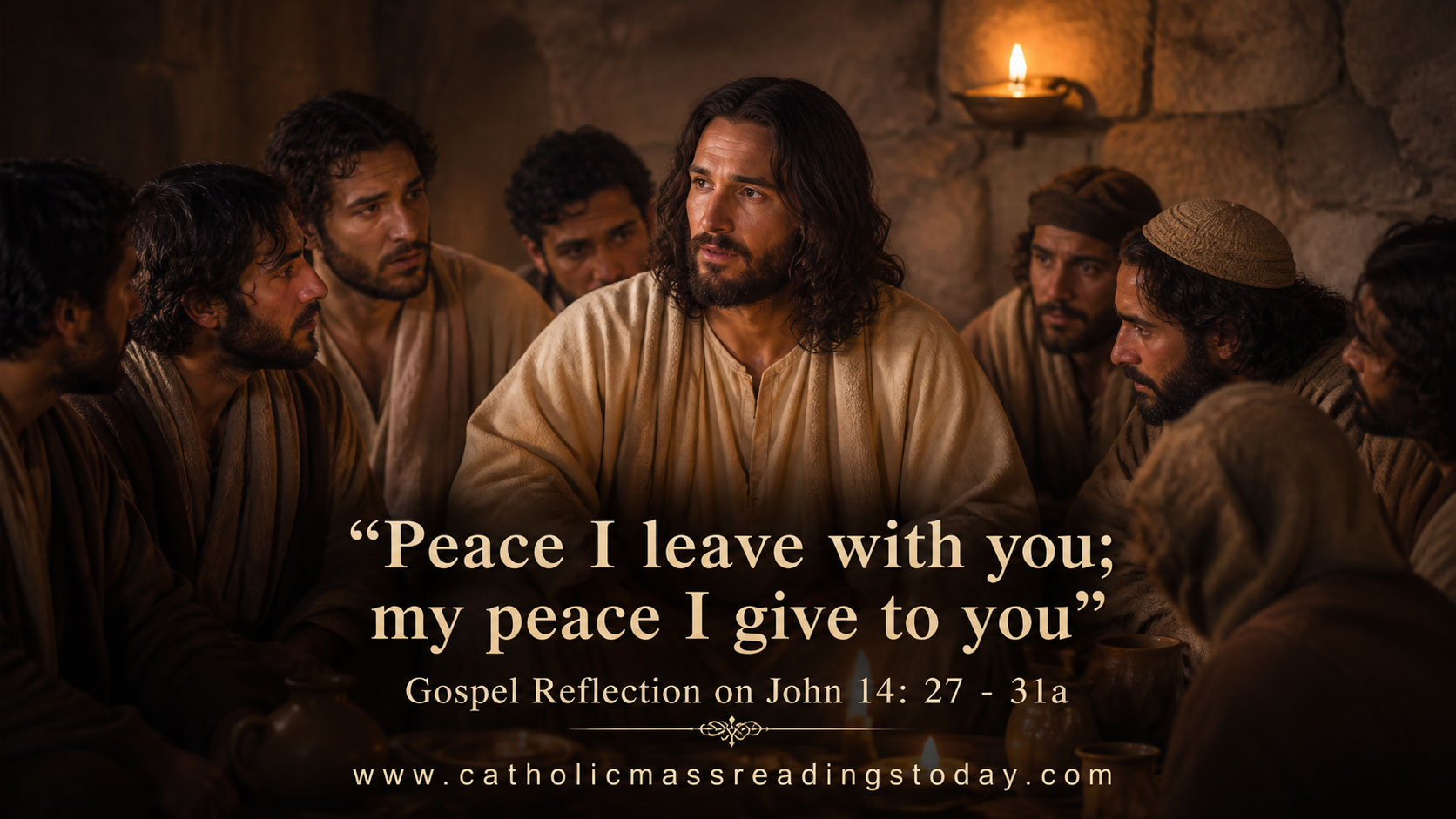
In this Gospel, the Lord speaks to His disciples on the eve of His Passion. These are not casual words. They come from the heart of the One who knows what is about to unfold. He knows betrayal is near. He knows suffering is near. He knows the Cross stands before Him. And yet what He chooses to give His disciples at that moment is not fear, not bitterness, not anxiety, but peace.
“Peace I leave with you; my peace I give to you.”
There is something profoundly moving in this. The world often speaks of peace as the absence of conflict, the easing of tension, the securing of circumstances, the restoration of what feels manageable. But the peace Jesus gives is not like that. He says so Himself: “Not as the world gives do I give to you.” This means that as Christian, our peace is not built on favorable conditions. It is not dependent on outward calm. It is not the fragile peace that disappears the moment suffering enters the room.
The peace of Christ is deeper. It comes from communion with the Father. It is the fruit of perfect trust, perfect obedience, and perfect love. It is the peace of the Son who knows where He comes from, to whom He belongs, and for what He is giving Himself. Even as the hour of suffering approaches, nothing within Him is divided. He remains wholly turned toward the Father.
This is why His peace can endure even in the shadow of the Cross.
And this is the peace He desires to place within the hearts of His disciples.
How much this word is needed in our own age. So many hearts are troubled. Some are troubled by personal suffering, by illness, by grief, by uncertainty, by loneliness, by the burden of responsibility, by the hidden wounds carried for years. Others are troubled by the condition of the world, by war, violence, injustice, the weakening of family life, the confusion of moral truth, the loss of faith, the instability of the future. Many live with a restlessness that they can scarcely name.
Into all of this, the Lord speaks with astonishing directness: “Let not your hearts be troubled, neither let them be afraid.”
These are not merely comforting words meant to soothe emotion for a moment. They are a summons to faith. Jesus does not say that there is nothing to fear in life from a human point of view. He does not deny that suffering is real. Rather, He commands the heart not to surrender itself to fear, because He Himself remains Lord even when darkness seems near.
Fear has a way of narrowing the soul. It makes us look inward, protect ourselves, and imagine that everything depends on our own strength. The peace of Christ does the opposite. It opens the heart again to trust. It teaches us that our life is held by Another. It tells us that even when the road is hard, the Father has not ceased to govern history, nor has the Son ceased to accompany His own.
The Lord goes on to say, “If you loved me, you would have rejoiced, because I go to the Father.” At first, these words can sound surprising. How could the disciples rejoice when Jesus is speaking of going away? But here again the Lord is drawing them beyond human attachment into the deeper truth of divine love. His departure is not defeat. It is not loss in the final sense. He is returning to the Father in obedience, through the mystery of the Cross, Resurrection, and Ascension. What appears as the darkening of the hour is, in truth, the glorification of the Son.
Love, then, must learn to trust even when it does not fully understand. This is an important word for our soul as Christians. Often we love Christ sincerely, but we still cling to our own expectations of how He should act, when He should act, and what His presence should feel like. Yet true discipleship means allowing Him to lead us even into mysteries we cannot yet comprehend. The disciples must learn that Christ’s going is not abandonment, but the opening of the way for something greater.
So too in our lives. There are moments when God seems to remove a consolation, close a door, permit a trial, or lead us through a season we would never have chosen. At such times, the temptation is to believe that His love has diminished. But the Gospel teaches otherwise. Sometimes the Lord leads us through what feels like loss in order to bring us into deeper communion, deeper trust, and deeper life. As Christians, we are asked not only to believe when the road is clear, but also when the path passes through mystery.
Jesus then says, “I have told you before it takes place, so that when it does take place, you may believe.” Here we see His tenderness as teacher and shepherd. He prepares them in advance, not to spare them all suffering, but so that when suffering comes, they may not fall into despair. He wants their faith to endure the shock of what is coming.
This too is part of the mercy of God. He does not always remove the trial, but He gives the word beforehand. He speaks so that when the hour arrives, faith may still stand. Many believers discover this only in hindsight: a word of Scripture remembered in suffering, a truth of the faith returning in confusion, a prayer once learned becoming an anchor in grief. The Lord knows what lies ahead, and He prepares His own.
This is why as Christians we must remain close to the word of God. We do not know what trial may come tomorrow. But if the word of Christ lives within us today, it will sustain us when the hour comes. The soul that is nourished by Scripture, by prayer, by the sacraments, is not spared all storms, but it is not left defenseless within them.
Then the Lord speaks with solemn clarity: “The ruler of this world is coming. He has no power over me.”
In these words, the Gospel reveals the spiritual drama hidden beneath visible events. Evil is real. The power of darkness is not imaginary. There is resistance to God in the world, and there is a personal enemy who seeks to oppose the work of God. The Christian faith is never naïve about this. Yet neither does it surrender to fear. Jesus does not speak as one threatened or cornered. He speaks as one utterly free. The ruler of this world approaches, but he has no claim on Christ.
Why? Because Christ is without sin. Because He belongs entirely to the Father. Because His heart is undivided. Evil can afflict, tempt, and attack, but it cannot master the One who remains perfectly obedient in love.
This is a source of great hope for the Church. The forces opposed to God may rage in history. They may appear strong. They may wound, deceive, persecute, and confuse. But they do not possess ultimate power. Christ remains Lord. His victory is not fragile. The Cross itself will become the place where the false power of evil is unmasked and overthrown.
And the Lord adds: “I do as the Father has commanded me, so that the world may know that I love the Father.”
Here we reach the heart of the matter. The Passion of Christ is not merely something He endures. It is something He embraces in love. His obedience is not mechanical submission. It is filial love made visible. He goes to the Cross because He loves the Father, and because in loving obedience He redeems the world.
This teaches us something essential about our Christian life. Obedience, in the biblical and Catholic sense, is not humiliation. It is love in action. To obey God is to say with one’s life: I trust You. I belong to You. Your will is good, even when it is costly. Christ reveals that the deepest freedom is found not in self assertion, but in self gift. The world often imagines freedom as autonomy, as the refusal of limits, as the triumph of one’s own will. But Jesus shows another kind of freedom: the freedom of perfect union with the Father.
This is the peace He gives. Not the peace of control, but the peace of surrender. Not the peace of ease, but the peace of belonging. Not the peace that avoids sacrifice, but the peace born of love that trusts the Father completely.
For Catholics, this peace is not only an idea to admire. It is a gift to receive. It is given in prayer, nourished by the sacraments, deepened in Eucharistic communion, strengthened in confession, and guarded by fidelity to the Gospel. The Christian who remains near Christ will not become untouched by pain, but he will gradually learn a different way of carrying it. The heart becomes steadier. Fear loses some of its tyranny. The soul begins to rest more in God than in circumstance.
This Gospel therefore invites us to examine ourselves gently and honestly.
- Where is my heart troubled?
- Where have I allowed fear to speak more loudly than faith?
- Where am I still seeking the world’s peace instead of Christ’s peace?
- Where is the Lord asking me to trust the Father more deeply?
- Where is He inviting me to obey, not in cold duty, but in love?
These are not small questions. They touch the deepest movements of the soul. But the Gospel does not leave us alone with them. Christ speaks first. Christ gives first. Christ remains first. Before He asks us to trust, He gives peace. Before He calls us to endure, He reveals His own fidelity. Before the disciples are scattered by trial, He places His peace in their hands.
And He does the same for us.
The world cannot give what He gives.
Circumstances cannot secure what He offers.
Fear cannot cancel what His love bestows.
- His peace is real.
- His presence is faithful.
- His victory is certain.
And therefore as Christians, even in a troubled world, we need not live with a troubled heart.
Let us Pray
Lord Jesus Christ,
You spoke peace to Your disciples
when the shadow of the Cross was near.
Speak that same peace into our hearts today.
When fear rises within us,
teach us to trust in You.
When our thoughts are restless,
draw us back to the Father.
When the weight of life feels heavy,
remind us that Your peace is deeper than every trial.
Free us from the false peace of the world,
which depends on comfort, control, and passing security.
Give us instead Your peace,
born of obedience,
rooted in love,
and sustained by communion with the Father.
Strengthen us to follow You faithfully,
even when the road is difficult.
Keep us close to Your word,
firm in faith,
and unafraid before the powers of darkness.
May our lives show the world
that to love the Father
is to trust Him completely.
You who live and reign with the Father
in the unity of the Holy Spirit,
God for ever and ever.
In the name of the Father, and of the Son, and of the Holy Spirit – Amen.