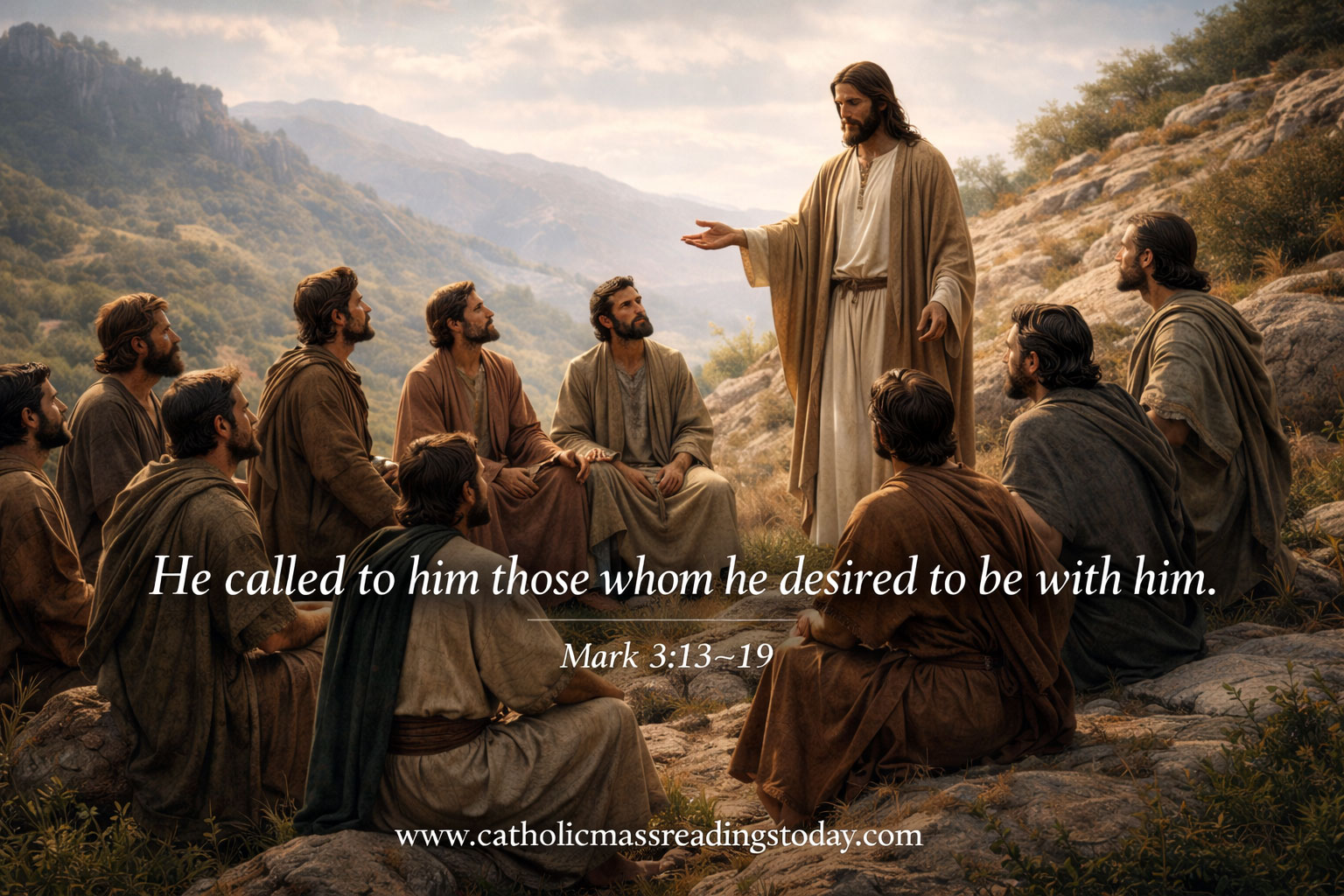
This Gospel reveals something profoundly personal about Jesus’ mission: before He sends, He first calls; before He gives authority, He invites relationship.
1. Jesus Calls Whom He Desires, Not the “Perfect”
Jesus goes up the mountain a biblical place of divine encounter and calls those He desires. The Twelve are not chosen for their holiness, education, or social status. Among them are fishermen, a tax collector, zealots, ordinary men, and even Judas, who would later betray Him.
👉 Catholic teaching reminds us: vocation is not earned; it is grace.
God does not wait for perfection, He forms it.
Today’s lesson:
In a world obsessed with qualifications, influence, and visibility, Christ still calls the humble, the broken, and the willing. Your weaknesses do not disqualify you from God’s call; they often become the place where His grace works most powerfully.
2. “To Be With Him” Comes Before “To Work for Him”
The Gospel says Jesus appointed the Twelve first “to be with him”, and then to be sent out.
This order is crucial.
Before preaching, before authority, before miracles, there is communion.
👉 Catholic spirituality teaches that discipleship begins with intimacy:
- prayer before action
- listening before speaking
- presence before performance
Today’s lesson:
Many people are busy doing things for God but rarely being with God.
This Gospel calls us back to:
- daily prayer
- Scripture
- the Eucharist
- silence before God
Without this, ministry becomes noise, activism becomes burnout, and faith becomes shallow.
3. Authority Comes From Union With Christ
Jesus gives the Twelve authority to preach and cast out demons, not from their own strength, but from their union with Him.
👉 In Catholic teaching, authority flows from:
- Christ → Apostles → Church
This is the foundation of apostolic succession and the Church’s sacramental life.
Today’s lesson:
True spiritual authority is not dominance, popularity, or loudness. It is faithfulness.
In families, workplaces, leadership, and society, authority rooted in humility and truth heals rather than wounds.
4. God Works Through Human Frailty
This list of apostles includes:
- Peter, who would deny Jesus
- James and John, ambitious and fiery
- Matthew, once despised
- Judas, the betrayer
Yet Christ still chooses them.
👉 Catholic hope is born here: God’s plan is never stopped by human weakness.
Today’s lesson:
Do not give up on yourself, the Church, or others because of failure. God continues to work through imperfect people. The Gospel assures us that failure is not the end when repentance is present.
5. A Call for Every Baptized Person
While this passage refers specifically to the Twelve, the Church teaches that every baptized person shares in Christ’s mission:
- to witness
- to love
- to proclaim the Gospel by life and word
Today’s lesson:
You may not preach from a pulpit, but:
- your kindness preaches
- your forgiveness evangelizes
- your faith in suffering proclaims Christ
You are called, not accidentally, but intentionally.
Final Message for Today
This Gospel reminds us that Christianity is not first a set of rules or tasks, but a relationship with Christ that transforms life and sends us into the world with purpose.
Christ still goes up the mountain today.
He still calls.
And He still desires to be with you.
Lets Pray
Lord Jesus Christ,
You called those whom You desired to be with You,
not because they were perfect,
but because they were willing.
Call us again today,
draw us into deeper friendship with You,
and teach us to remain with You in prayer,
so that all we do may flow from Your love.
Strengthen us in our weaknesses,
humble us in our successes,
and make us faithful witnesses of Your Gospel
in our families, our work, and our communities.
Send us forth with hearts rooted in You,
that we may bring hope, healing, and truth to the world,
and glorify the Father in all things.
We ask this through Christ our Lord.
Amen.