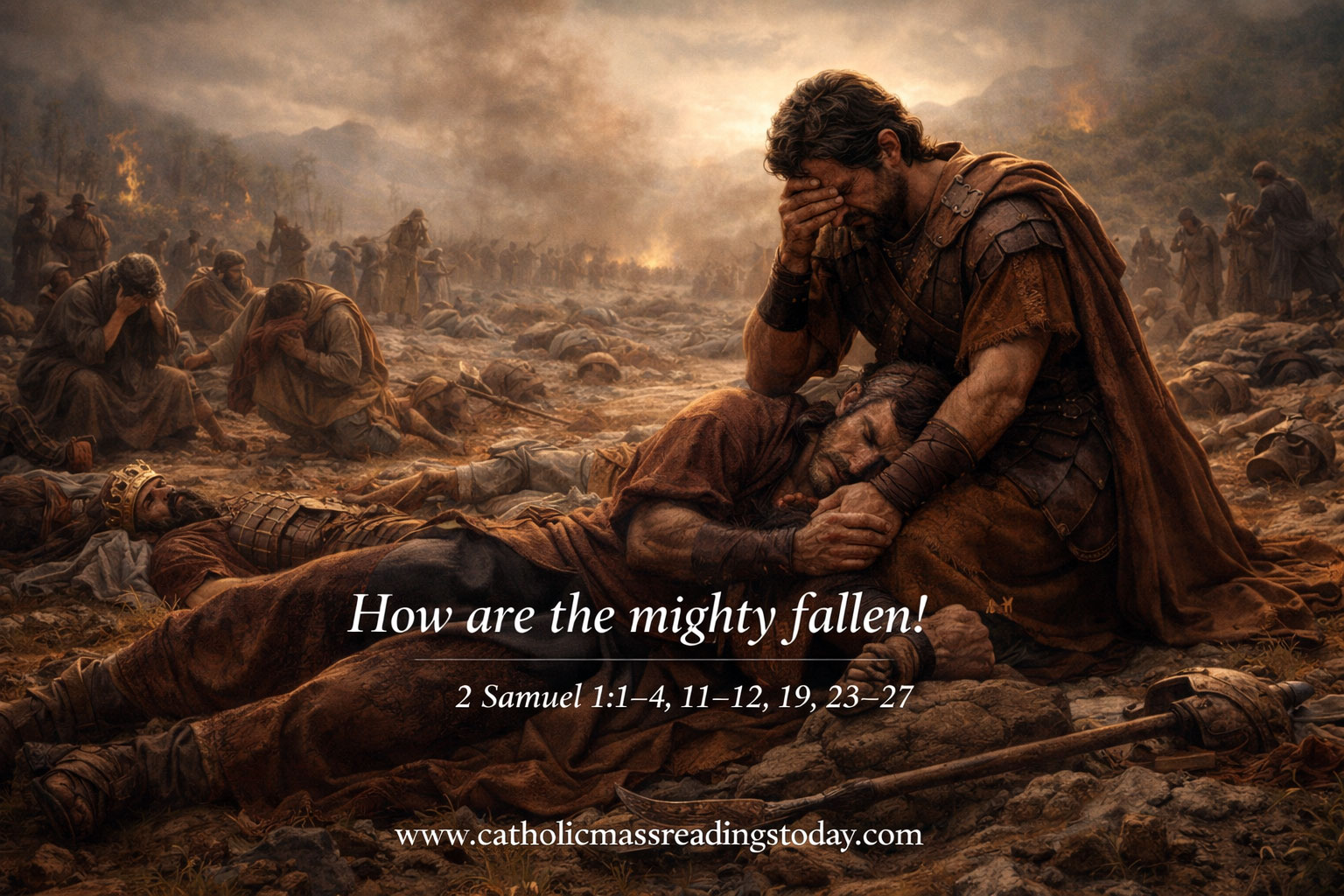
“How are the mighty fallen!”
This powerful reading opens not with victory, but with mourning. David, the anointed future king of Israel, hears of the death of Saul, the very man who persecuted him, and of Jonathan, his beloved friend. The expected human reaction might have been relief, triumph, or even silent satisfaction. Instead, Scripture shows us something profoundly countercultural: David weeps.
1. Grief Without Hatred: The Heart of a Righteous Man
David tears his garments, fasts, and mourns, not only for Jonathan, but also for Saul. This is extraordinary. Saul sought David’s life repeatedly, yet David refuses to rejoice at his enemy’s fall.
This reveals a core Catholic teaching:
The dignity of every human life does not disappear because of sin or conflict.
David sees Saul first as God’s anointed, not merely as his enemy. In doing so, David prefigures Christ, who teaches us:
“Love your enemies, pray for those who persecute you” (Matthew 5:44).
In today’s world that is marked by political rivalry, tribalism, online hostility, and personal grudges, this reading challenges us deeply. As Catholics, we are called not to celebrate the downfall of others, but to respond with mercy, restraint, and prayer, even when wounds are real.
2. Honoring the Good, Even in Imperfect People
David’s lament does not deny Saul’s failures. Instead, it chooses to remember what was noble:
- Saul clothed Israel in splendor
- He defended the people
- He shared a bond of courage with Jonathan
Catholic teaching urges us to practice justice tempered by charity. We are not called to rewrite history or ignore wrongdoing, but neither are we permitted to reduce people to their worst moments.
In a culture quick to cancel, shame, and condemn, this reading reminds us:
We must never forget the good God has worked through flawed vessels.
This applies in families, marriages, workplaces, churches, and nations. Healing begins when we learn to honor truth without hatred.
3. Covenant Friendship and Selfless Love
David’s grief for Jonathan is deeply personal and profoundly pure:
“Your love to me was wonderful, passing the love of women.”
This is a biblical expression of covenant friendship and faithful, self giving, rooted in God, not possession. The Catholic Church upholds such friendships as signs of God’s love in the world.
In a society that often misunderstands or cheapens love, this passage teaches us that:
- True love is faithful
- True love seeks the good of the other
- True love is not erased by death
Jonathan stood between David and Saul, choosing righteousness over power. His example calls us to be people of moral courage, even when it costs us comfort or approval.
4. “How Are the Mighty Fallen?” A Call to Humility
This repeated cry is not mockery, it is sorrow. It reminds us that no human strength is permanent. Kings fall. Heroes die. Glory fades.
For Catholics today, this is a sobering invitation:
- Do not place ultimate trust in power, success, or influence
- Remember that all authority is temporary
- Place hope in God alone
As Psalm 146 warns:
“Put not your trust in princes, in mortal men in whom there is no help.”
5. A Prophetic Foreshadowing of Christ
David’s lament points forward to Christ Himself:
- Innocent suffering
- Love extended beyond betrayal
- Grief borne without vengeance
Jesus, like David, would weep not over His enemies’ defeat, but over Jerusalem’s hardness of heart.
Teaching for Today’s Catholic Life
This reading calls us to:
- Mourn sin without celebrating destruction
- Speak with charity, even when wronged
- Honor the dignity of others, even in disagreement
- Practice forgiveness before it feels deserved
- Trust God’s justice rather than taking revenge
In a divided world, this passage invites Catholics to become peacemakers, witnesses of mercy, and people whose hearts remain tender even when life is harsh.
Closing Thought
True greatness in God’s eyes is not shown in triumph over others, but in faithfulness, humility, and love that refuses to harden.
“How are the mighty fallen” is not the end of hope but a reminder that God alone is mighty, and His mercy endures forever.
Lets Pray
Lord God of mercy and truth,
You who see the hearts of all Your children,
teach us to love as You love.
When we are wounded, give us the grace to forgive.
When pride tempts us to rejoice in the fall of others,
remind us that every life belongs to You.
Grant us hearts like David’s
hearts that mourn sin without hatred,
that honor the good even in imperfect people,
and that choose humility over vengeance.
Strengthen us to be faithful friends,
courageous witnesses of truth,
and instruments of peace in a divided world.
May we trust not in power or victory,
but in Your everlasting mercy and justice.
Keep our eyes fixed on Christ,
who transforms suffering into redemption
and death into new life.
We ask this through Christ our Lord.
Amen.