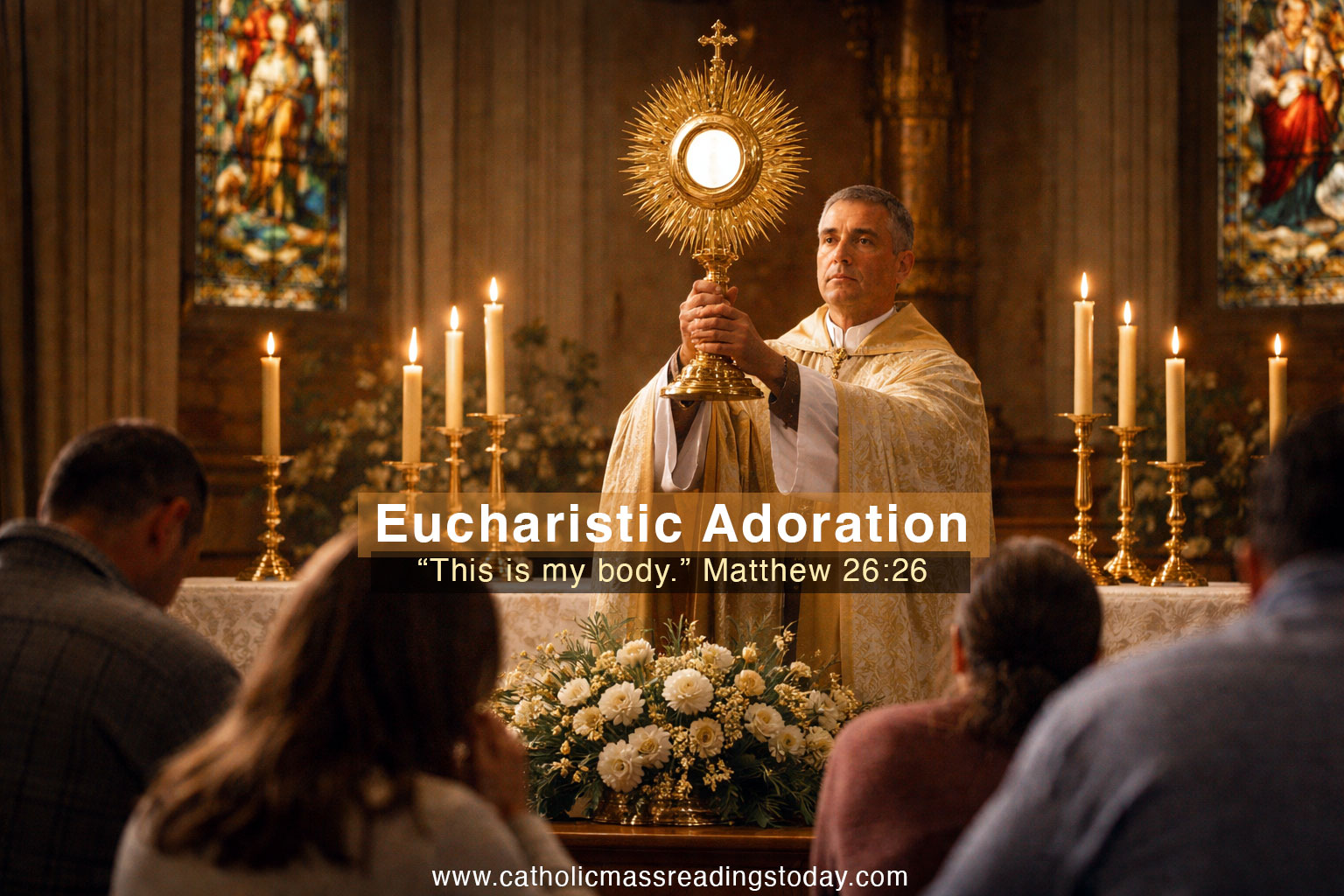
Most cherished devotions in the Catholic Church
Eucharistic Adoration is one of the most cherished devotions in the Catholic Church and a central expression of belief in the Real Presence of Jesus Christ in the Holy Eucharist. Eucharistic Adoration, also called Adoration of the Blessed Sacrament, is one of the most profound and intimate forms of prayer in the Catholic Church. It is a sacred encounter in which the faithful come before Jesus Christ truly present Body, Blood, Soul, and Divinity in the Holy Eucharist, and remain with Him in silence, prayer, love, and reverence.
In a world marked by noise, speed, and distraction, Eucharistic Adoration is the Church’s quiet answer: Come and be still before the Lord. Over many years of priestly ministry, I have seen lives healed, vocations clarified, marriages restored, and hearts converted simply because someone chose to sit before Jesus in the Blessed Sacrament.
What Is Eucharistic Adoration?
Definition of Eucharistic Adoration in the Catholic Church
Eucharistic Adoration is the act of worshipping Jesus Christ present in the consecrated Host, outside of the Mass. The Host is usually placed in a sacred vessel called a monstrance and set upon the altar for the faithful to adore.
The Church teaches that after the consecration at Mass, the bread and wine are no longer symbols they become Christ Himself. Because this presence endures, the Eucharist may be adored with the same worship given to God alone (latria).
As the Catechism of the Catholic Church states:
“In the Blessed Sacrament of the Eucharist, the Body and Blood, together with the Soul and Divinity, of our Lord Jesus Christ and, therefore, the whole Christ is truly, really, and substantially contained.” (CCC 1374)1
History of Eucharistic Adoration in the Catholic Church
Early Church Roots
From the earliest centuries, Christians held the Eucharist in the highest reverence. The consecrated Hosts were reserved to be brought to the sick and imprisoned, and believers would pray in their presence.
Development in the Middle Ages
Eucharistic Adoration developed more explicitly between the 11th and 13th centuries as the Church deepened her theological understanding of the Real Presence. Public exposition of the Blessed Sacrament became common, especially after the Feast of Corpus Christi was instituted in 1264.
Saints and Adoration
Many saints were ardent lovers of Eucharistic Adoration:
- St. Francis of Assisi called the Eucharist “the humility of God.”
- St. Alphonsus Liguori wrote extensively on visits to the Blessed Sacrament.
- St. Thérèse of Lisieux drew strength from silent adoration.
- St. John Paul II said, “The Church and the world have a great need of Eucharistic Adoration.”
Today, perpetual adoration chapels exist across the world, where Jesus is adored day and night.
Biblical Foundations of Eucharistic Adoration (Scriptural Basis)
While the term “Eucharistic Adoration” is not explicitly found in Scripture, its foundation is deeply biblical:
- John 6:51 – “I am the living bread that came down from heaven.”
- Matthew 26:26 – “This is my body.”
- Luke 22:19 – “Do this in remembrance of me.”
- Matthew 28:20 – “I am with you always, until the end of the age.”
- Revelation 7:9–10 – Heavenly worship before the Lamb.
Adoration flows naturally from belief in Christ’s abiding presence among us.
What Happens During Eucharistic Adoration?
How Eucharistic Adoration Is Practiced
The Process
- Exposition – A priest or deacon places the consecrated Host in the monstrance.
- Adoration – The faithful pray silently or with hymns, Scripture, or guided prayers.
- Benediction (optional) – The priest blesses the people with the Blessed Sacrament.
- Reposition – The Eucharist is returned reverently to the tabernacle.
Adoration may last minutes, hours, or even continue perpetually.
When Is Eucharistic Adoration Usually prayed?
Common Times for Eucharistic Adoration
- After daily or Sunday Mass
- On Thursdays (in remembrance of the Last Supper)
- During Holy Hours
- During Forty Hours Devotion
- During retreats and parish missions
- In perpetual adoration chapels
There is no restriction: Jesus is always ready to receive us.
Who Can Participate in Eucharistic Adoration?
Who Is Invited to Eucharistic Adoration
Eucharistic Adoration is open to all the faithful:
- Lay men and women
- Priests and religious
- Families and children
- The elderly and the sick
Even those struggling with faith are welcome. One does not need eloquent words only a willing heart.
The Spiritual Power and Benefits of Eucharistic Adoration
The Church firmly believes in the transforming power of Eucharistic Adoration. Not because of emotional experience, but because we are in the presence of Christ Himself.
Through adoration:
- Hearts are converted
- Vocations are born
- Inner wounds are healed
- Peace is restored
- Faith is strengthened
- The Church is renewed
As St. Mother Teresa said:
“The time you spend with Jesus in the Blessed Sacrament is the best time you will spend on earth.”
Frequently Asked Questions About Eucharistic Adoration
Do I have to pray aloud?
No. Silence is often the most powerful prayer.
How long should I stay?
As long as you can. Even five minutes offered with love is precious.
What if I feel nothing?
Faith, not feelings, is what matters. God is still at work.
Widely Prayed Eucharistic Adoration Prayers (Catholic Tradition)
Prayer of St. Alphonsus Liguori
My Lord Jesus Christ,
who for the love which You bear to men,
remain night and day in this Sacrament,
full of compassion and love,
awaiting, calling, and welcoming all who come to visit You,
I believe that You are present in the Sacrament of the Altar.
I adore You from the abyss of my nothingness,
and I thank You for all the graces You have bestowed upon me,
especially for having given me Yourself in this Sacrament,
for having bestowed upon me Mary, Your most holy Mother, as my advocate,
and for having called me to visit You in this church.
I salute this day Your most loving Heart,
and I give You thanks for three things:
first, for having given me Your Body, Blood, Soul, and Divinity in this Sacrament;
second, for having given me Mary, Your most holy Mother, as my advocate;
and third, for having called me to visit You in this church.
I now recommend to You all my dear ones,
all sinners, and my own poor soul.
Receive them all into the ocean of Your mercy.
Finally, my dear Savior,
I desire to receive You into my soul.
Since I cannot now receive You sacramentally,
come at least spiritually into my heart.
I embrace You as already there,
and unite myself wholly to You;
never permit me to be separated from You.
Amen.
Anima Christi
Anima Christi (Soul of Christ)
Soul of Christ, sanctify me.
Body of Christ, save me.
Blood of Christ, inebriate me.
Water from the side of Christ, wash me.
Passion of Christ, strengthen me.
O good Jesus, hear me.
Within Your wounds, hide me.
Permit me not to be separated from You.
From the evil one, protect me.
At the hour of my death, call me.
And bid me come to You,
That with Your saints I may praise You
Forever and ever.
Amen.
Act of Spiritual Communion
My Jesus, I believe that You are present in the Most My Jesus,
I believe that You are present in the Most Holy Sacrament.
I love You above all things,
and I desire to receive You into my soul.
Since I cannot at this moment receive You sacramentally,
come at least spiritually into my heart.
I embrace You as if You were already there
and unite myself wholly to You.
Never permit me to be separated from You.
Amen.
Prayer Before the Blessed Sacrament
O Sacrament Most Holy, O Sacrament Divine, all praise and all thanksgiving be every moment Thine.
Amen.
Why Eucharistic Adoration Matters Today
Eucharistic Adoration is not an optional devotion for a few, it is a treasure of the whole Church. In adoration, we do not simply look at the Host; we allow Christ to look at us.
In the silence of the Blessed Sacrament, the soul learns to listen, to trust, and to love. If you wish to grow in faith, deepen your prayer life, or simply rest in God’s presence come to Eucharistic Adoration.
Jesus is waiting.
“Come to me, all you who labor and are burdened, and I will give you rest.” (Matthew 11:28)
📖 Catechism of the Catholic Church 1374 (CCC 1374)
CCC 1374 refers to paragraph 1374 of the Catechism of the Catholic Church, and it’s one of the most important teachings on the Eucharist.
📖 Catechism of the Catholic Church 1374
“The mode of Christ’s presence under the Eucharistic species is unique. It raises the Eucharist above all the sacraments as ‘the perfection of the spiritual life and the end to which all the sacraments tend.’ In the most blessed sacrament of the Eucharist ‘the body and blood, together with the soul and divinity, of our Lord Jesus Christ and, therefore, the whole Christ is truly, really, and substantially contained.’ This presence is called ‘real’—by which is not intended to exclude the other types of presence as if they could not be ‘real’ too, but because it is presence in the fullest sense: that is to say, it is a substantial presence by which Christ, God and man, makes himself wholly and entirely present.”