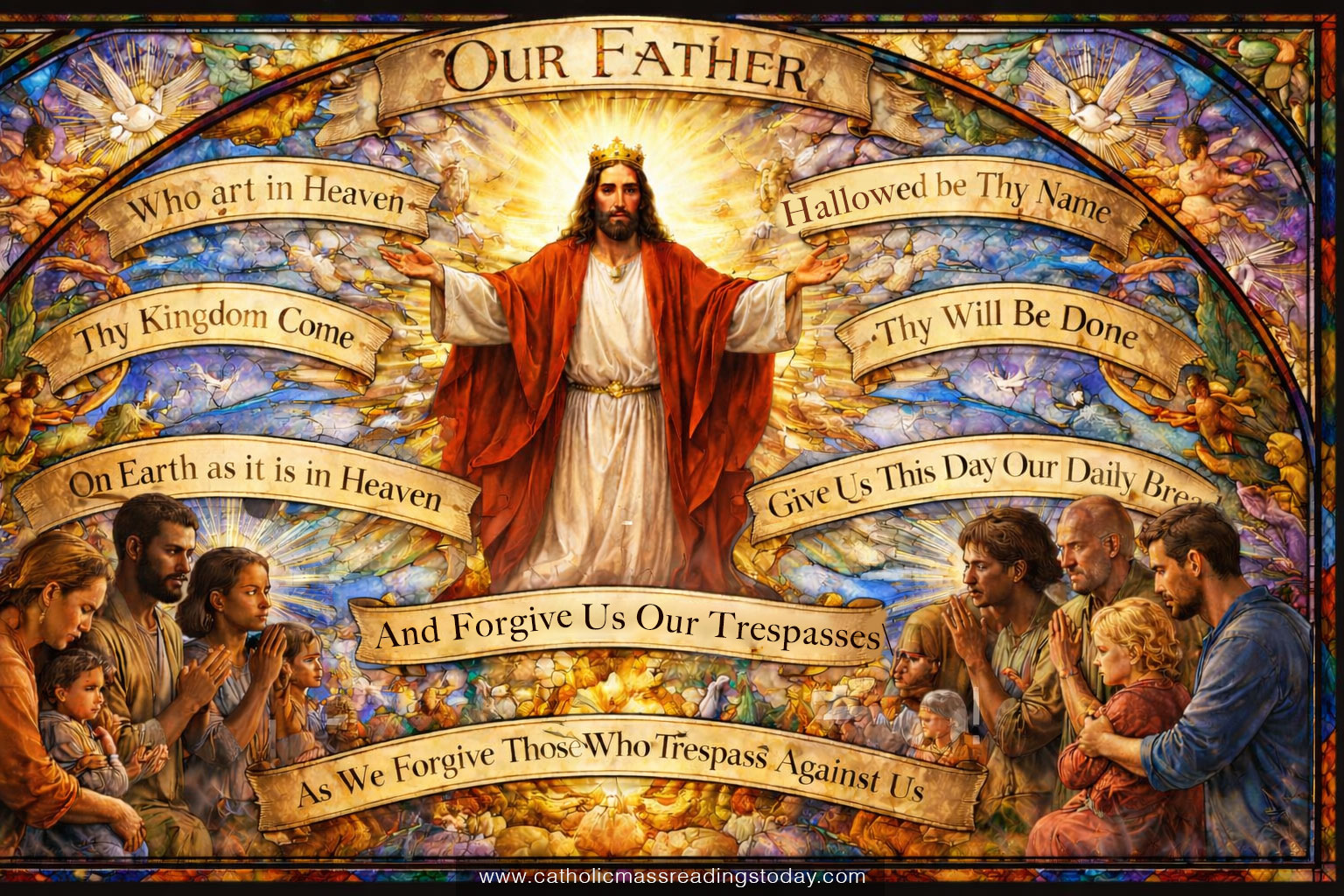
“Pray then like this.”
As we humble our hearts during Lent, the Church places before us the most sacred teaching on prayer, not a way devised by saints, not a devotion born of private revelation, but the very prayer placed on our lips by the Lord Himself. When Jesus says, “Pray then like this,” He is not just giving us words; He is giving us His own relationship with the Father.
Lent is a season of purification, we fast to discipline our body, we give alms to detach ourselves from selfishness, and we pray to return ourselves to be intimate with God. In today’s Gospel, Our Lord gently corrects our tendency to complicate prayer. He warns against “heaping up empty phrases,” reminding us that the Father already knows what we need. This is profoundly consoling, prayer is not about persuading God but about trusting Him and it may also be a moment we have genuine one on one conversation with our Lord.
“Our Father”
The very first word transforms everything: Our.
Jesus does not teach us to say “My Father,” though He alone is the eternal Son, He invites us into His own sonship. By grace, we are adopted into the family of God. When we say “Our Father,” we are acknowledging that we do not stand before God alone. We stand as brothers and sisters.
This word destroys selfish prayer and widens our hearts to always be more inclusive of our brothers and sisters. When I pray “Our Father,” I pray for my family, my parish, my country, the poor, the sick, even those who have hurt me. I pray for the Church in suffering lands and for the souls in purgatory. The prayer itself forces charity upon us.
In Lent especially, this matters as we are reminded that salvation is not individualistic. We walk together toward Easter and are reminded if one member suffers, then we all suffer, if one of us rejoices, then we all rejoice. The word “Our” in the Lord’s prayer teaches communion.
“Who art in heaven”
Here we are taught reverence and perspective. God is our Father, intimate, loving and always at our reach. Yet He is also “in heaven” transcendent, sovereign, holy beyond comprehension. Lent restores this balance. We bow our heads in humility, acknowledging that we are creatures, dependent and small before His majesty.
To call Him our heavenly Father is to recognize both closeness and authority. He is not a distant force, not indifferent, He is our Father, our provider, our protector and the source of our life.
“Hallowed be Thy name”
Before we ask for anything, we adore Him. True prayer begins with worship and in Lent, the Church invites us to examine whether God’s name is truly honored in our lives. Does my words, my business dealings, my private thoughts give glory to His name? Or do I live in a way that shows disrespect?
To pray this sincerely is to ask that my life become an offering.
“Thy kingdom come, Thy will be done”
This part of the Lords prayer teaches us to stop resisting and submit to God’s authority. The Christian life is not about bending God’s will to ours, but aligning our will to His. In fasting, we practice this surrender in small ways by denying ourselves so that we may say more fully, “Thy will be done.”
Lent is training in obedience reminding ourselves of every sacrifice, “Your kingdom, Lord… not mine.”
“Give us this day our daily bread”
Again, we see the word us. Not give me, but give us. We ask for the needs of all by entrusting ourselves and our neighbor to Divine Providence.
“Daily bread” speaks of material needs which may be food, shelter, work and similar daily needs. As Catholics, our daily bread also points to something deeper: the Bread of Life, the Holy Eucharist. Each Mass is the fulfillment of this petition where we are fed with Christ Himself.
To pray for our daily bread is an act of deep trust and a quiet rejection of anxiety. Each time we say those words, we are confessing that our Father is truly our provider and that what sustains us comes not merely from our labor, but from His loving hand.
During Lent, when we freely embrace hunger through fasting, something within us is reordered. We begin to see that every meal is not an entitlement, but a gift. I remember the first time I undertook a serious fast. When it was finally time to eat, my meal was simple. A plate of cooked kales and maize meal, a combination I had never particularly loved. Yet the moment I took that first bite, something humbling stirred within me. The freshness of the vegetables, the warmth of the food, the quiet satisfaction of hunger being relieved, all of which felt different. I was deeply aware that this was not just food; it was mercy. It was God’s provision.
I found myself savoring each bite with gratitude and was amazed that what I once considered ordinary became extraordinary. That experience changed the way I see food even today. It taught me to slow down, to appreciate, to give thanks and to remember that nothing on my table is there by chance.
Since then, each meal has carried a quiet reminder that Our Father provides. He provides faithfully, quietly and lovingly often in ways we overlook. When we pray, “Give us this day our daily bread,” we are placing our hunger, our needs, and our trust entirely into His hands.
“Forgive us our trespasses, as we forgive…”
Here the prayer becomes demanding. We ask for mercy but we bind ourselves to mercy. This is not some poetic language but a binding relational agreement between God and us, characterized by faithfulness, shared obligations, and love. We are asking God to forgive us in the same measure that we forgive others.
During Lent, this line pierces the heart. Is there someone I refuse to forgive? A resentment I nurture? If so, I cannot pray these words casually.
Forgiveness is not weakness but a participation in the Cross. It is choosing mercy over vengeance for when we forgive, we resemble the Father whose mercy sustains us.
“Lead us not into temptation, but deliver us from evil”
By praying to God to lead us not into temptation, but deliver us from evil we are acknowledging the spiritual warfare. Lent makes us more aware of it as we strive to grow in holiness, temptations often intensify. We are not to rely on our own strength, by this prayer we ask for protection and to be delivered from the Evil One.
This final petition expresses humility reminding ourselves that without grace, we fall and with grace, we persevere.
The Power of the Lord’s Prayer
The Our Father prayer may indeed be the most powerful prayer, not because of it’s poetic beauty alone, but because it was given to us directly by Christ. It is the prayer of the Church, the prayer of the saints, the prayer whispered at hospital bedsides and proclaimed at every Mass before the Holy Communion.
In it, we find adoration, surrender, petition, trust, repentance, forgiveness, and spiritual vigilance with nothing essential missing in it.
During this first weeks of Lent, perhaps we should slow down when we pray it. Do not rush through it, do not recite it mechanically but let each word shape the heart.
When we say “Our Father,” we are reminded we are his children.
When we say “Give us,” we remember we are dependent on Him.
When we say “Forgive us,” we remember we are sinners and need forgiveness.
When we say “Deliver us,” we remember we are pilgrims on our way to heaven.
May this Lent deepen our trust in the Father, enlarge our love for our brothers and sisters, and make our prayer less about many words and more about surrendered hearts.
Remember, may we not merely recite the Lord’s Prayer, but truly live it trusting in our heavenly Father, seeking His will above our own, forgiving as we have been forgiven, and depending daily on His providence and grace.
Let us now pray the very words our Savior gave us, slowly and with faith:
Let us Pray
Our Father, who art in heaven,
hallowed be thy name.
Thy kingdom come,
thy will be done,
on earth as it is in heaven.
Give us this day our daily bread,
and forgive us our trespasses,
as we forgive those who trespass against us;
and lead us not into temptation,
but deliver us from evil.
Amen.