In the name of the Father and of the Son and of the Holy Spirit, Amen. The Lord be with you.
Today we remember Saints Cyril, Monk, & Methodius, Bishop.
Memorial of Saint Cyril (Monk) & Saint Methodius (Bishop)
February 14
Saints Cyril and Methodius were brothers from Thessalonica (9th century). They grew up in a Christian family deeply rooted in prayer and were highly educated through scholarship. They became great missionaries to the Slavic peoples of Central and Eastern Europe. Cyril (originally named Constantine) became a monk and brilliant theologian, Methodius became a monk and later was ordained as a bishop. Together, they are known as the “Apostles to the Slavs.”
Saints Cyril, Monk, & Methodius, Bishop’s Mission
In 863, they were sent by the Byzantine Emperor and the Patriarch of Constantinople to evangelize the Slavic peoples of Great Moravia (modern-day Czech Republic and Slovakia).
Their are hugely remembered for Creating the Glagolitic alphabet which later developed into Cyrillic, Translating the Bible and the liturgy into the Slavonic language and for Celebrating the liturgy in the local tongue. During this time, many believed only in Latin, Greek, and Hebrew as the acceptable liturgical languages. The Apostles to the Slavs defended the idea that every people should praise God in their own language showing profound respect for culture while remaining faithful to the Catholic unity.
Challenges and Fidelity
Saints Cyril, Monk, & Methodius, Bishop faced huge opposition from those who resisted using the Slavic language in worship. They traveled to Rome to defend their mission, where the Pope approved their translations and missionary work. In 869 Cyril died in Rome, Methodius continued the mission as Archbishop, enduring persecution and imprisonment for the faith.
Their perseverance in their work demonstrated obedience to the Church and deep missionary zeal.
Why they matter
The Church honors Saints Cyril, Monk, & Methodius, Bishop because they embody, Missionary courage, Inculturation of the Gospel, Unity between East and West and Fidelity to the Holy See
In 1980, Pope John Paul II declared them Co-Patrons of Europe, recognizing their foundational role in Christianizing the continent.
Spiritual lesson for us
Saints Cyril and Methodius teach us, the Gospel belongs to every culture, unity in the Church should not erase diversity, Evangelization requires both holiness and intellectual effort and true missionaries endure hardship with patience.
Their lives remind us that proclaiming Christ at times needs creativity, courage, and sacrifice.
These are the Catholic mass readings of Saturday, February 14th 2026, fifth week in ordinary time, Year II.
FIRST READING
Jeroboam made two calves of gold.
A reading from the first Book of Kings (1 KINGS 12: 26 – 32; 13: 33 – 34)
In those days: Jeroboam said in his heart, “Now the kingdom will turn back to the house of David; if this people go up to offer sacrifices in the house of the Lord at Jerusalem, then the heart of this people will turn again to their lord, to Rehoboam king of Judah, and they will kill me and return to Rehoboam king of Judah.” So the king took counsel, and made two calves of gold. And he said to the people, “You have gone up to Jerusalem long enough. Behold your gods, O Israel, who brought you up out of the land of Egypt. And he set one in Bethel, and the other he put in Dan. And this incident became a sin, for the people went to the one at Bethel and to the other as far as Dan. He also made houses on high places, and appointed priests from among all the people, who were not of the Levites. And Jeroboam appointed a feast on the fifteenth day of the eighth month like the feast that was in Judah, and he offered sacrifices upon the altar; so he did in Bethel, sacrificing to the calves that he had made. And he placed in Bethel the priests of the high places that he had made. After this incident Jeroboam did not turn from his evil way, but made priests for the high places again from among all the people; any who would, he consecrated to be priests of the high places. And this thing became sin to the house of Jeroboam, so as to cut it off and to destroy it from the face of the earth.
The Word of the Lord.
RESPONSORIAL PSALM
Taken from Psalm 106: 6 – 7ab, 19 – 20, 21 – 22 (R.) 4a
And the response is;
R/. O Lord, remember us with the favour you show to your people.
Like our fathers, we have sinned.
We have done wrong; our deeds have been evil.
Our forebears, when they were in Egypt,
did not grasp the meaning of your wonders. R/.
They fashioned a calf at Horeb,
and worshipped an image of metal,
they exchanged their glory
for the image of a bull that eats grass. R/.
They forgot the God who was their saviour,
who had done such great things in Egypt,
such wonders in the land of Ham,
such marvels at the Red Sea. R/.
GOSPEL ACCLAMATION
Matthew 4: 4b
Alleluia.
Man shall not live by bread alone, but by every word that proceeds from the mouth of God.
Alleluia.
GOSPEL
“They ate, and were satisfied.”
A reading from the holy Gospel according to Mark (MARK 8: 1 – 10)
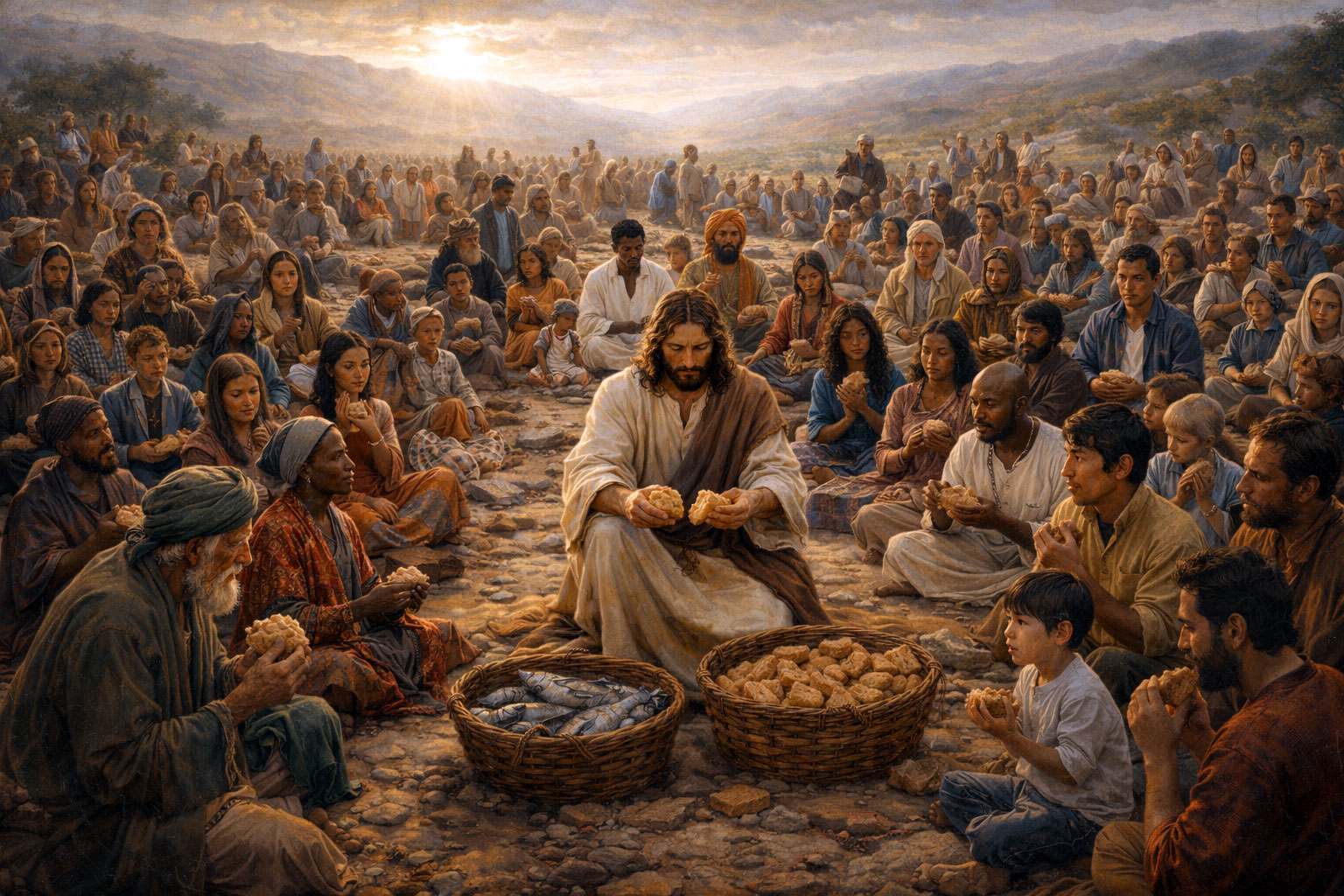
In those days, when again a great crowd had gathered, and they had nothing to eat, Jesus called his disciples to him, and said to them, “I have compassion on the crowd, because they have been with me now three days, and have nothing to eat; and if I send them away hungry to their homes, they will faint on the way; and some of them have come a long way.” And his disciples answered him, “How can one feed these men with bread here in the desert?” And he asked them, “How many loaves have you?” They said, “Seven.” And he commanded the crowd to sit down on the ground; and he took the seven loaves, and having given thanks he broke them and gave them to his disciples to set before the people; and they set them before the crowd. And they had a few small fish; and having blessed them, he commanded that these also should be set before them. And they ate, and were satisfied; and they took up the broken pieces left over, seven baskets full. And there were about four thousand people. And he sent them away; and immediately he got into the boat with his disciples, and went to the district of Dalmanutha.
The Gospel of the Lord.
Reflection and teaching on the Holy Gospel according to Mark 8:1–10
“They Ate, and Were Satisfied”
A Reflection on Mark 8:1–10
In today’s Gospel, we encounter the profound tenderness of the Heart of Christ. The miracle of the multiplication of fish and the loaves in today’s reading is not just about the fish and bread, but compassion, trust, Eucharist, mission, and divine abundance.
1. The Compassion of Christ
The Gospel begins with Jesus saying:
“I have compassion on the crowd…”
The Greek word used for sympathy (splagchnizomai) expresses a deep inward feeling of mercy. Love that moves from the depths of one’s being. This is not distant sympathy. It is the Sacred Heart of Jesus moved by human suffering.
For three days the crowd has been with Jesus. They are tired and hungry, but they still remain because His Word feeds their souls. Jesus does not ignore their physical hunger.
As Catholics we believe God cares for the whole person, body and soul which is a core reflection of Jesus’s caring for his followers.
The Church continues this mission through its Corporal works of mercy by feeding the hungry and spiritual works of mercy teaching, guiding and consoling.
In Christ, we see that spiritual life does not neglect material needs. True Christian love embraces both.
2. The Desert: A place of Testing and Trust
The miracle of the multiplication of bread happens in the desert A biblical symbol of testing of ones’ faith, dependence on God and purification of the heart. The disciples ask “How can one feed these men with bread here in the desert?”
This question is identical to the Israelites in the wilderness. It also echoes our own doubts. Many a times we find ourselves in doubt, asking;
- How can this situation be resolved?
- How can my small efforts make a difference?
- How can God provide in this dryness?
The the Gospel reading the disciples see scarcity but Jesus sees possibility.
Faith begins when we move from calculating what we lack to offering what we have and believing in God to see us through.
3. “How Many Loaves Have You?” The Eucharistic Mystery Revealed
Jesus does not create bread from nothing, he begins with what they already had. The seven loaves and a few fish as per the Gospel He, Took the bread, Gave thanks, Broke it and Gave it.
These four actions by Jesus are not by accident. They are the same actions Jesus performs at the Last Supper, when He introduces the Eucharist on the night before He died. In this miracle, we see a powerful vision of what would later take place in the Upper Room.
How the Eucharist came about
On Holy Thursday, at the Last Supper, Jesus took bread and wine and said:
“This is my Body… This is my Blood.”
Notice, He did not say “This represents.” He said “This is.”
At that moment, Christ introduced the Sacrament of the Eucharist and commanded the apostles:
“Do this in memory of me.”
From that moment onward, the Church has faithfully followed this command. During every Holy Mass, through the ministry of the ordained priest acting in persona Christi (Latin for “in the person of Christ”), the bread and wine truly become the Body and Blood of Christ. This mystery is called transubstantiation. This is the Roman Catholic doctrine that the whole body of bread and wine changes into the actual body and blood of Jesus Christ during the Eucharist consecration, even though the appearances remain the same.
The miracle in the desert prepares us to understand this greater miracle reminding us if Jesus can multiply bread to feed thousands, He can also transform bread into His very Self to feed us all spiritually.
Why it is called “Eucharist”
The word Eucharist comes from the Greek word eucharistia, which means “thanksgiving.”
Notice in the Gospel “He took the seven loaves, and having given thanks…”
Before the miracle happens, Jesus gives thanks. At every Mass, the Catholic Church enters into this same thanksgiving. The Eucharist is first and foremost an act of gratitude to the Father for the gift of salvation in Christ and the Church’s supreme prayer of thanksgiving.
The Mass is therefore a Sacrifice making present Christ’s one sacrifice on Calvary, a Sacred Meal where we are fed with the Bread of Life, an Act of Thanksgiving (Eucharistia) and a Communion union with Christ and His Body, the Church.
“They ate, and were satisfied” Fulfilled at Mass
In the desert, the people ate ordinary bread and were satisfied for a time.
At Mass, we receive the Bread of Heaven Jesus Himself. This nourishment does not merely sustain the body; it strengthens the soul, forgives venial sins, deepens charity, and unites us more intimately with Christ.
Just as the crowd would have fainted on the journey without food, we too would faint spiritually without the Eucharist. The Mass is not simply a weekly obligation; it is our lifeline.
Every time we approach the altar, we are that crowd in the desert and Christ still says “I have compassion.”
4. They ate, and were satisfied
This is powerful, in today’s world we are filled with promises that usually leaves us with feeling of emptiness. Jesus Christ gives satisfaction that overflows. During the miracle, everyone ate, no one was excluded and there were even leftovers out of the seven baskets.
Seven in Scripture symbolizes fullness and perfection. We see God does not give barely enough but He gives abundantly.
This teaches us God’s divine grace is never scarce, God’s mercy exceeds our need and trusting in Him leads to spiritual fullness.
5. A Universal sign
In Mark’s Gospel, this feeding takes place in a predominantly Gentile region. The number four thousand may symbolize universality four corners of the earth.
This miracle points to the Church’s universal mission as Christ feeds all peoples and salvation is for every race, every nation, every culture. The Bread of Life is offered to the whole world.
6. Lessons for our spiritual life
a) Stay with Jesus
The crowd stayed three days without food because they valued His presence more than comfort.
Do we persevere in prayer even when it costs us something?
b) Offer what you have
God multiplies what we surrender and our small acts of love become abundant in His hands. You may be surprised that the ones without will give it all and the ones with plenty will struggle to even give a fraction of what they have.
c) Trust in His providence
Even in the desert moments of life, our financial strain, illness, spiritual dryness Christ sees our need before we speak and he is always there by us to provide and comfort us.
d) Become Bread for others
After Jesus blesses the bread, He gives it to the disciples to distribute. We are called to be instruments of His provision. The Eucharist we receive must become charity we give.
7. The mystery of satisfaction
“They ate, and were satisfied.”
True satisfaction comes not from possession, but from communion, communion with Christ. The deepest hunger of the human heart is not for bread, but for love, meaning, forgiveness and eternal life. These can only come from Christ, He is the only one who satisfies these.
Let us Pray
Lord Jesus Christ,
You who had compassion on the crowd in the desert,
Look with mercy upon us in our hunger.
When we are weary on the journey,
Feed us with Your Word.
When we are weak, nourish us with Your Body and Blood.
When we doubt, increase our faith.
Teach us to trust in Your providence
Even when we see only scarcity.
Take the little we have –
Our time, our talents, our love –
And multiply them for Your glory.
Make us bread broken for others,
So that through our charity
The world may taste and see that You are good.
We ask this through You,
Who live and reign with the Father
In the unity of the Holy Spirit,
God forever and ever.
Amen.