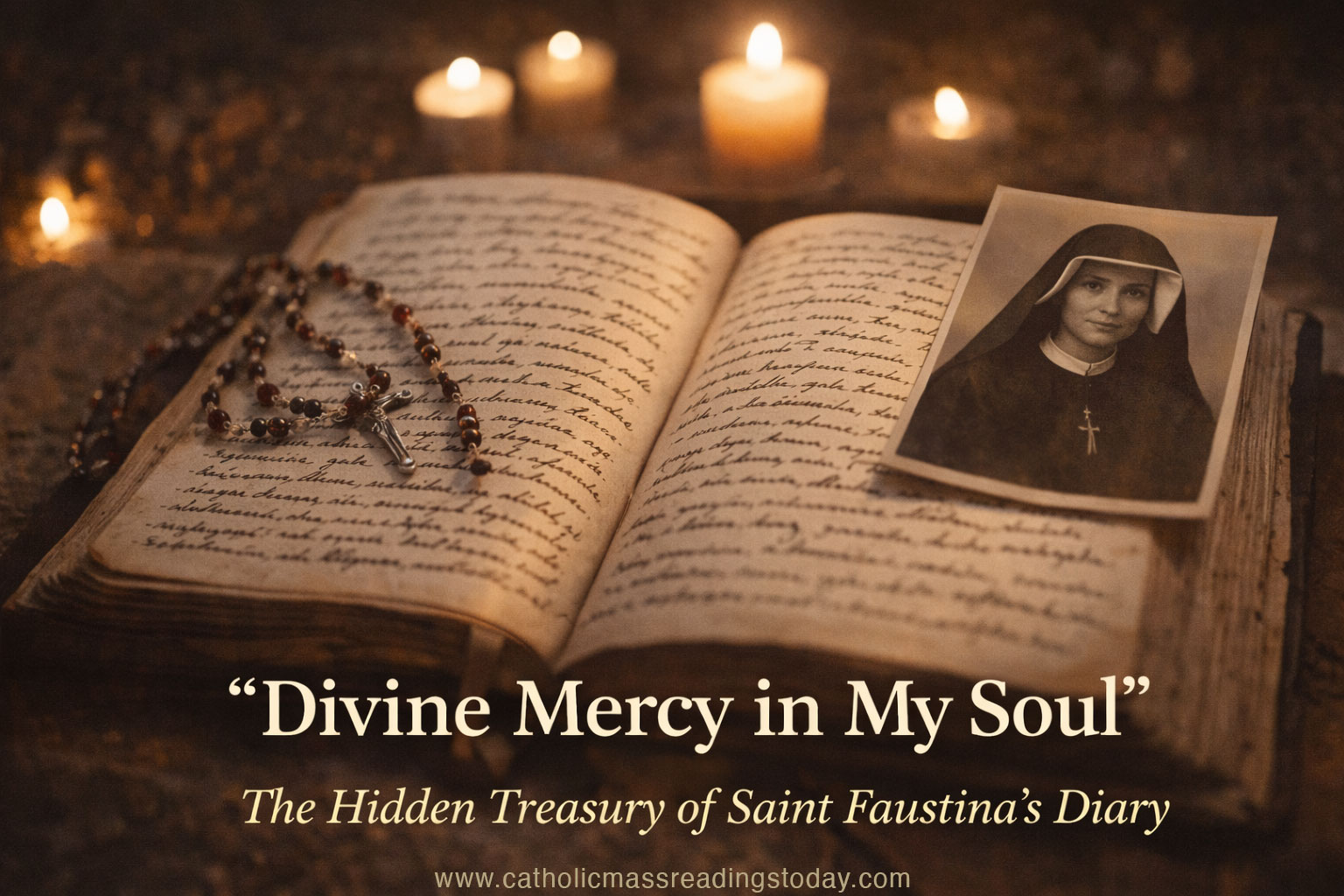
There are few spiritual writings in the life of the Church that have quietly, yet powerfully, shaped the faith of millions across the world. Among them stands the diary of Saint Faustina Kowalska, “Divine Mercy in My Soul.” It is not a theological treatise in the academic sense, nor is it a polished literary work. Instead, it is something far more compelling, a deeply personal record of a soul entrusted with a mission that would echo through the entire Church: to proclaim the boundless mercy of God.
A Diary Born in Obedience
Saint Faustina did not set out to write a book. In fact, she initially resisted the idea. It was only out of obedience, first to her confessor, Blessed Michał Sopoćko, and ultimately to what she understood as the will of Christ that she began recording her experiences.
This is important. The diary was not written for fame or recognition. It was written in humility, often in hiddenness, during ordinary convent life. Faustina wrote in simple Polish, with little concern for style or structure. What emerges, however, is a striking authenticity. There is no sense of performance, only a quiet, faithful effort to record what she believed God was revealing to her.
Structure and Content of the Diary
The diary spans several notebooks and is typically organized into six parts. Within these pages, Faustina recounts her mystical encounters, interior struggles, spiritual growth, and the messages she received regarding Divine Mercy.
At its core, the diary reveals a living relationship between Christ and the soul. It is deeply Christ centered, rooted in Scripture, and consistent with the spiritual tradition of the Church. Yet it carries a unique emphasis: the urgency of trusting in God’s mercy.
Throughout the diary, several key themes and devotions emerge.
The Message of Divine Mercy
The central message entrusted to Saint Faustina is simple, yet profound: God’s mercy is greater than any sin, and the world must come to trust in it.
Jesus repeatedly tells her that humanity is in great need of His mercy, especially in times of moral and spiritual crisis. He speaks not with condemnation, but with longing. Again and again, the diary reveals a heart that desires to forgive, to heal, and to restore.
One of the most repeated calls in the diary is this: “Trust in Me.” It is not enough to know about God’s mercy; one must place complete confidence in it.
The Image of Divine Mercy
One of the most well known elements from the diary is the request for the painting of the Divine Mercy image.
Faustina describes a vision of Jesus clothed in white, with one hand raised in blessing and the other touching His chest, from which flow two rays, one pale and one red. Jesus instructs her that this image is to be painted with the inscription: “Jesus, I trust in You.”
The theological meaning is rich. The rays represent the blood and water that flowed from Christ’s side on the Cross, symbols of the Eucharist and Baptism, the sacraments through which mercy is poured out upon the world.
This image is not merely devotional art; it is a visual proclamation of the Gospel.
The Divine Mercy Chaplet
Within the diary, Jesus teaches Faustina the Divine Mercy Chaplet, a prayer meant to be a powerful intercession for sinners and for the dying.
He promises that those who pray it will receive great mercy, and that it has particular power at the hour of death. The Chaplet is deeply Eucharistic in nature, as it centers on offering Christ’s sacrifice to the Father.
Faustina records how this prayer was given not just for her, but for the entire world, a remedy, as it were, for a humanity in need of reconciliation.
The Hour of Mercy
Another significant element revealed in the diary is the Hour of Mercy 3:00 p.m., the hour of Christ’s death.
Jesus asks that at this hour, souls pause to reflect on His Passion and to implore mercy for themselves and for the world. Faustina writes that even a brief prayer offered at this time carries special graces.
This devotion has since become a deeply rooted practice in the Church, drawing countless faithful into daily remembrance of Christ’s sacrifice.
Divine Mercy Sunday
Perhaps one of the most far reaching elements of the diary is the request for a feast dedicated to Divine Mercy.
Jesus expresses a desire that the Sunday after Easter be celebrated as the Feast of Mercy, a day when the floodgates of grace are opened in a particular way. He promises extraordinary graces to those who approach the sacraments of Confession and the Eucharist with trust.
This request, once met with hesitation, was eventually fulfilled by the Church. In the year 2000, Saint John Paul II officially established Divine Mercy Sunday for the universal Church, confirming what had first been written in the hidden pages of Faustina’s diary.
The Interior Life of Saint Faustina
Beyond the devotions and messages, what makes “Divine Mercy in My Soul” so compelling is its honesty.
Faustina does not present herself as perfect. She writes openly about her struggles, moments of dryness in prayer, misunderstandings from others, physical suffering, and the weight of carrying a mission she often felt unworthy of.
Yet through all this, there is a steady thread of trust. Her holiness is not found in extraordinary achievements, but in her fidelity to God in the ordinary.
Her diary becomes, in many ways, a guide for the spiritual life. It shows that sanctity is not reserved for a few, but is accessible to anyone willing to trust, to surrender, and to persevere.
The Church’s Discernment and Approval
The diary did not immediately gain universal acceptance. In fact, for a time, misunderstandings and translation issues led to restrictions on the spread of the devotion.
However, careful theological examination and the witness of those who knew Faustina eventually led to a deeper understanding of her writings. The Church affirmed that the message of Divine Mercy is fully consistent with Catholic teaching.
Saint John Paul II, who had a deep personal devotion to Divine Mercy, played a significant role in bringing Faustina’s message to the world. Her canonization in 2000 marked not only recognition of her sanctity, but also a confirmation of the importance of her mission.
A Message for Our Time
Reading “Divine Mercy in My Soul” today, one cannot help but feel its relevance.
We live in a world marked by division, uncertainty, and often a loss of hope. Faustina’s diary speaks directly into this reality, not with complicated answers, but with a simple invitation: return to mercy.
It reminds us that no matter how far we may feel from God, the path back is always open.
Conclusion
“Divine Mercy in My Soul” is more than a diary. It is a window into the heart of Christ and a call to every generation.
Its pages carry the quiet voice of a nun who lived and died in obscurity, yet whose faithfulness has touched the entire world. There is nothing exaggerated in her writing, nothing forced, only the steady testimony of someone who encountered the mercy of God and chose to trust it completely.
And perhaps that is why the diary continues to resonate.
Because in the end, it is not about Saint Faustina. It is about the God she points us to, a God who never tires of forgiving, never ceases to love, and never stops calling us back to Himself.