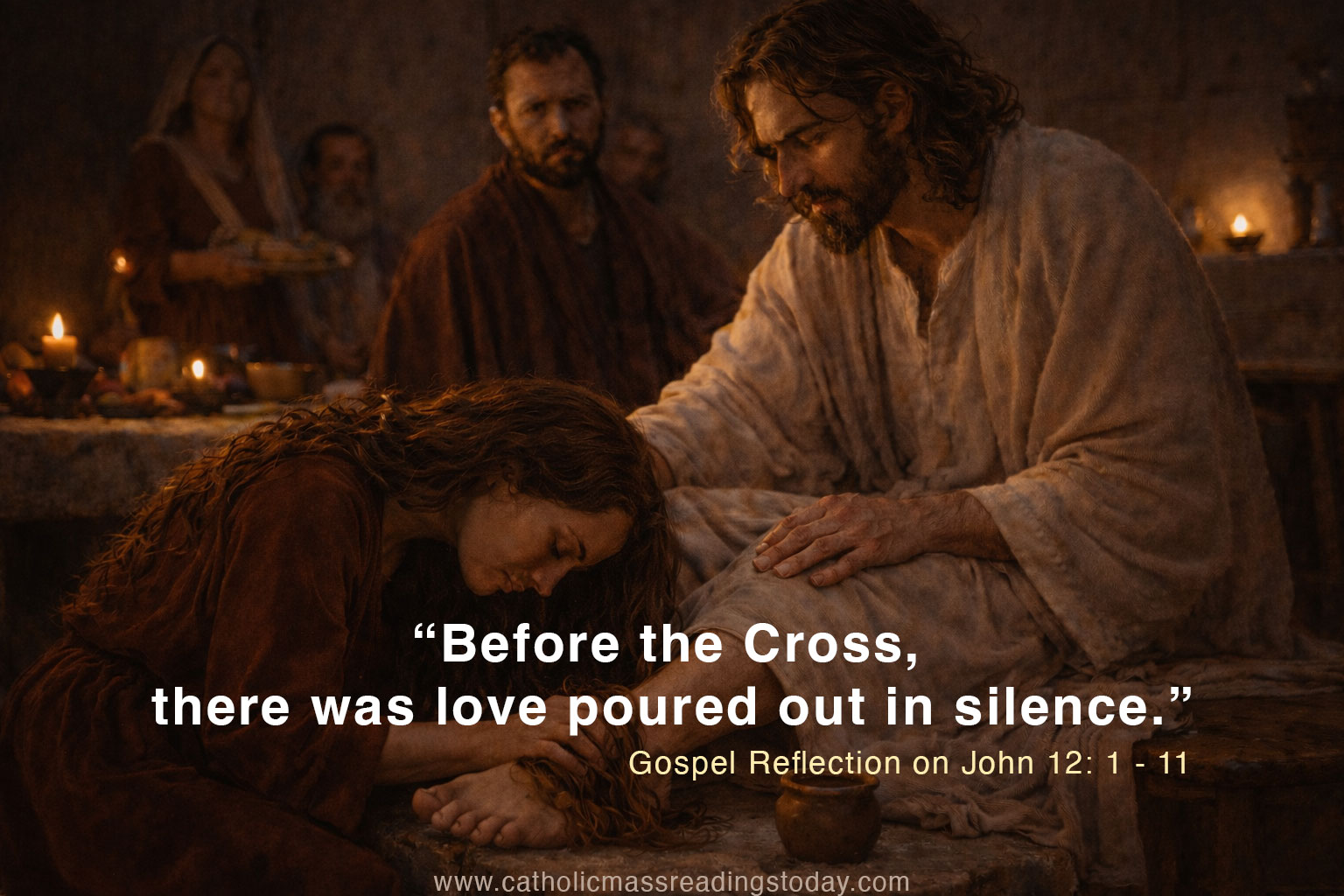
There is something very tender, very intimate, about this Gospel. Holy Week has begun, and before the noise of the trial, the shouting of the crowd, and the pain of the Cross, the Church gives us this scene in Bethany, a home, a meal, a quiet act of love.
Jesus is there with people who know Him personally. Martha is serving, as she often does. Lazarus is at table, a living sign of Christ’s power over death. Mary comes close to Jesus, carrying something precious, and pours it out at His feet. Then she wipes His feet with her hair. It is humble, loving, costly, and deeply personal.
And the Gospel tells us something beautiful: “the house was filled with the fragrance of the ointment.” That line stays with you. True love fills a place. True devotion changes the atmosphere. A sincere offering given to God never remains small. It spreads.
That is the first thing this Gospel places before us: love that does not calculate.
Mary does not ask whether this act will be understood. She does not stop to consider how people will judge her. She does not hold back because the gift is expensive. She sees Jesus, and she pours out what she has.
Judas, of course, sees the same moment in a completely different way. He speaks the language of concern, but his heart is elsewhere. Outwardly, he sounds practical: “Why was this ointment not sold… and given to the poor?” But the Gospel pulls back the curtain and shows us the truth. His words sound charitable, but his motives are not pure.
That part of the Gospel is very important, especially in our own time. Because not every criticism is honest. Not every public concern is sincere. People can sound righteous and still be deeply self serving. They can speak about justice, compassion, and responsibility, while their hearts remain far from God.
We see that in the world today. We live in a time where appearances matter a great deal. People often want to be seen as good more than they want to become good. It is easy to perform concern. It is harder to live with a truly converted heart. Social media especially has trained many people to react quickly, judge quickly, and speak loudly, even when they do not fully understand what is sacred, what is true, or what is happening beneath the surface.
Mary does the opposite, she does not perform, she loves.
And Jesus receives that love, defending her and He understands what even she may not fully understand, that her act is preparing Him for burial. While others still resist what lies ahead, Mary is already responding with the heart of someone who senses that suffering is near. Her love is not abstract but present, embodied and sacrificial.
That is why this Gospel fits so deeply into Monday of Holy Week.
Holy Week is not only about remembering events. It is about learning how to love Jesus rightly. As we move toward the Cross, the question becomes more personal. How do I stand near Him? How do I love Him? Do I keep something back? Do I give Him only what is convenient? Or do I bring Him what is costly, my time, my attention, my repentance, my trust?
Because the truth is, many of us are willing to admire Jesus from a distance, but fewer are willing to pour ourselves out in love.
And yet that is exactly what Holy Week invites us to do.
For some people, the costly perfume may be time set aside for prayer in a busy life. For others, it may be the humility to return to confession after a long absence. For someone else, it may be choosing forgiveness when resentment feels easier. Love for Christ always takes concrete form. It always costs something, but what we offer Him in love is never wasted.
This Gospel also quietly asks us what fills our house, what fills our hearts.
Mary’s act filled the house with fragrance, but Judas fills the moment with suspicion and coldness. One person makes the room more beautiful yet the other makes it smaller.
That too is very real today. Some people bring peace, reverence, honesty, and warmth into a family, a church, a workplace. Others bring bitterness, hidden motives, envy, or cynicism. The Gospel invites us to examine what kind of presence we carry.
When people encounter us, do they meet something of Christ’s fragrance, kindness, faith, humility, truth? Or do they leave burdened by our anger, pride, or selfishness?
Lent has already been asking that question, and Holy Week brings it into sharper focus.
Then there is Lazarus. He does not speak in this passage, but his very life has become a testimony. Because he has been raised, people are coming. Because he is living proof of what Jesus has done, he now becomes a target. The chief priests want not only Jesus gone, but Lazarus too.
That is how darkness often works. It does not only resist truth; it tries to silence the evidence of truth.
And that still happens now. A person whose life has been changed by Christ can make others uncomfortable. Someone who chooses faith, repentance, honesty, purity, or devotion can seem strange in a world that has grown used to compromise. A real witness is powerful, and because it is powerful, it is often resisted.
To belong to Christ is beautiful, but it is not always easy.
This Gospel shows us that from the beginning, those closest to Jesus had to live in that tension. There was love and there was hostility. There was faith and there was plotting. There was devotion and there was betrayal. In many ways, that is still the world we live in.
That is why Monday of Holy Week is such an important day. It asks us to slow down before the great events unfold. It asks us to sit in Bethany for a moment and learn what true discipleship looks like.
- It looks like Martha serving faithfully.
- It looks like Lazarus living quietly as a witness.
- It looks like Mary loving extravagantly.
- And it looks like Jesus receiving all of this with the calm knowledge that the Cross is near.
Perhaps the deepest challenge in this Gospel is this: What am I pouring out before the Lord this week?
- Not what do I feel.
- Not what do I intend someday.
- But what am I actually offering Him now?
Holy Week is not meant to be watched from a distance. It is meant to draw something out of us. Reverence, Gratitude, Sorrow for sin and Love that becomes visible.
So today, the Church places Mary before us as an example. She does not preach, she does not argue, she simply loves Jesus with everything she has.
And maybe that is the grace we need most at the beginning of this holy week: not more noise, not more explanation, not more outward display but a heart that knows how to kneel, how to adore, and how to give itself without reserve.
May this Monday of Holy Week teach us that nothing offered to Christ in love is ever wasted. And may our lives, like that house in Bethany, be filled with the fragrance of a devotion that is real.