Third Week of Lent
In today’s Gospel, Peter approaches Jesus with a question that many of us have quietly asked in our own hearts: “Lord, how often shall my brother sin against me, and I forgive him? As many as seven times?” Peter likely believed he was being generous. In Jewish teaching at the time, forgiving someone three times was often considered sufficient. By suggesting seven, Peter thought he was going beyond the expected measure.
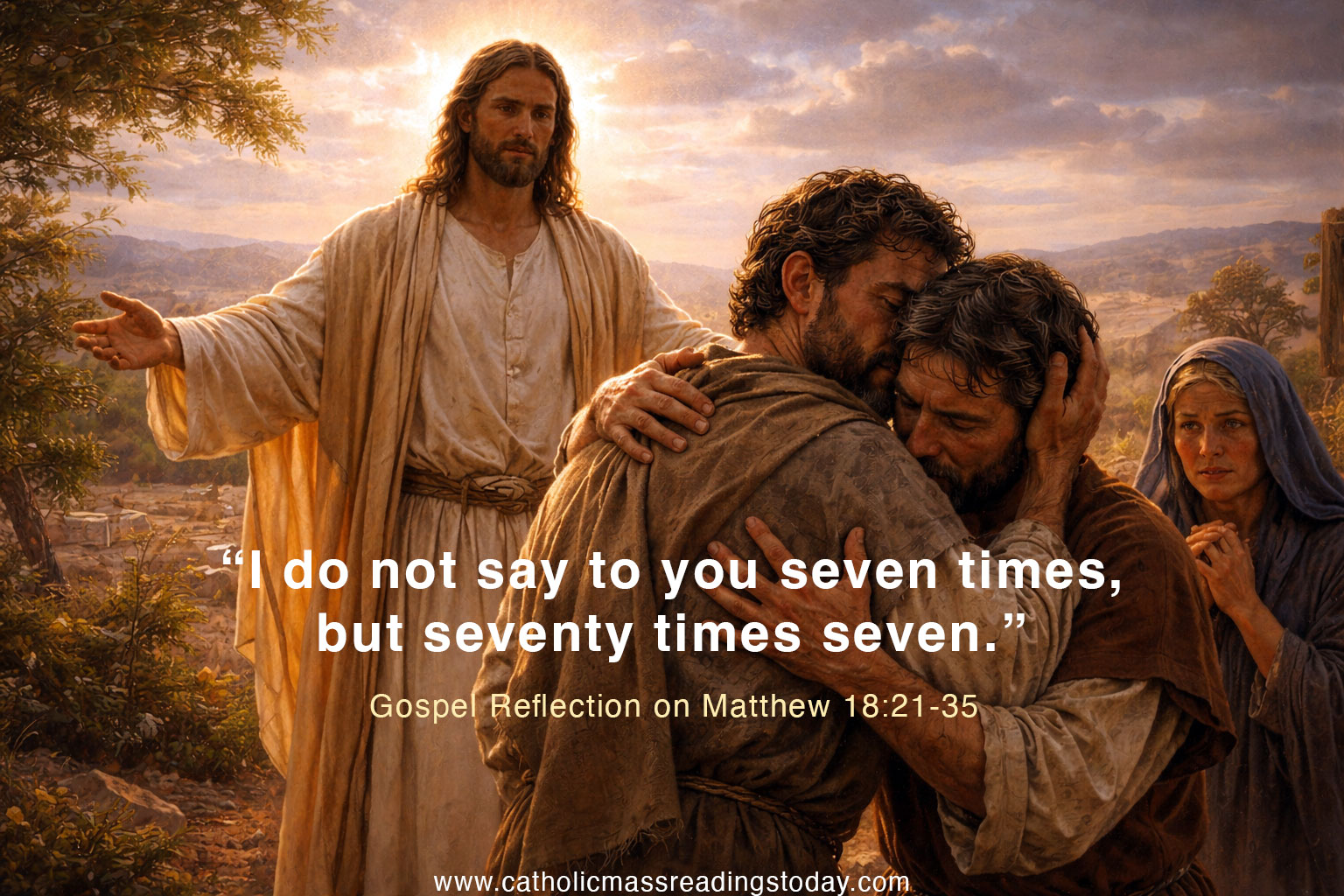
But Jesus’ response overturns all human calculations: “I do not say to you seven times, but seventy times seven.” Jesus is not giving us a mathematical formula. Rather, He is teaching that forgiveness in the Christian life cannot be measured or limited. It must be as abundant as the mercy God has shown us.
To make this truth clearer, Jesus tells the parable of the unforgiving servant. The first servant owes the king an enormous debt, ten thousand talents. This was not just a large amount; it was an impossible one. In modern terms, it would amount to millions upon millions of dollars. The servant has no hope of repaying it. Faced with the consequences, he falls to his knees and begs for patience.
The king, moved with compassion, does something extraordinary: he cancels the entire debt. This is pure mercy. The servant receives a forgiveness he could never have earned.
Yet the story takes a troubling turn. Immediately after receiving such mercy, the same servant encounters a fellow servant who owes him a relatively small amount, one hundred denarii. Compared to the first debt, it is insignificant. But instead of showing the mercy he himself received, he grabs the man by the throat and demands payment. When the fellow servant begs for patience using almost the same words he himself used before the king, he refuses and has him thrown into prison.
The king hears of this and is outraged. The servant who had been forgiven so much has learned nothing about mercy. His heart remained unchanged. The king’s judgment is severe because the servant’s failure was not simply financial, it was moral and spiritual. He received mercy but refused to become merciful.
Jesus concludes with a warning that is both sobering and necessary: “So also my heavenly Father will do to every one of you, if you do not forgive your brother from your heart.”
This Gospel challenges us deeply, especially during this third week of Lent. Lent is a time when the Church invites us to examine our hearts honestly. We fast, we pray, we give alms but these practices mean little if our hearts remain hardened toward others.
Forgiveness is not always easy. Some wounds run deep. Some betrayals leave scars that seem impossible to forget. Yet Jesus reminds us that the mercy we have received from God is infinitely greater than any wrong done to us. Every time we pray the Our Father, we say: “Forgive us our trespasses, as we forgive those who trespass against us.” In other words, we are asking God to measure His forgiveness toward us according to the forgiveness we show others.
When we reflect honestly on our lives, we begin to see how much we ourselves have been forgiven. God has been patient with us countless times, when we failed, when we sinned, when we ignored His voice. His mercy has no limit. Recognizing this should soften our hearts toward those who have wronged us.
This message is especially important when we look at the world around us today. Our world is filled with conflict, division, resentment, and revenge. Nations remain locked in war. Communities are torn apart by political hatred. Families are divided by bitterness. Social media and public discourse often reward anger more than understanding. The cycle of retaliation seems endless.
Jesus proposes another path, the difficult but liberating path of mercy.
Forgiveness does not mean pretending that wrong was right. It does not mean ignoring justice. Rather, it means refusing to allow resentment and hatred to take root in our hearts. Forgiveness frees us from becoming prisoners of our own anger.
When we forgive, we imitate the heart of God.
In this third week of Lent, this Gospel invites us to ask ourselves a few important questions:
- Is there someone I am refusing to forgive?
- Is there a hurt I keep revisiting, allowing it to poison my peace?
- Is there a relationship that could begin healing if I allowed God’s mercy to work through me?
Often the greatest obstacle to forgiveness is pride. We want to hold on to the feeling that we were wronged. But Jesus calls us to humility and to remember that we too stand in constant need of mercy.
Saint John Paul II once said that forgiveness is the “restoration of freedom.” When we forgive, we break the chains that bind both ourselves and others.
This is why forgiveness lies at the very heart of the Gospel. The entire mission of Jesus culminates in forgiveness. Even from the Cross, after being betrayed, mocked, and crucified, Jesus prayed: “Father, forgive them.”
As we continue our Lenten journey toward Easter, this Gospel reminds us that the road to the Resurrection always passes through mercy. A heart that learns to forgive becomes a heart capable of receiving the fullness of God’s love.
Let us Pray
Lord Jesus,
You have forgiven us more than we can ever understand.
You see our weaknesses, our failures, and our sins,
yet you continue to show us mercy.
Give us the grace during this Lenten season
to let go of resentment and bitterness.
Teach us to forgive not only with our words,
but truly from the depths of our hearts.
Heal the divisions in our families,
bring peace where there is conflict,
and soften hearts hardened by anger.
May we become instruments of your mercy
in a world that so deeply needs it.
We ask this through Christ our Lord.
Amen.