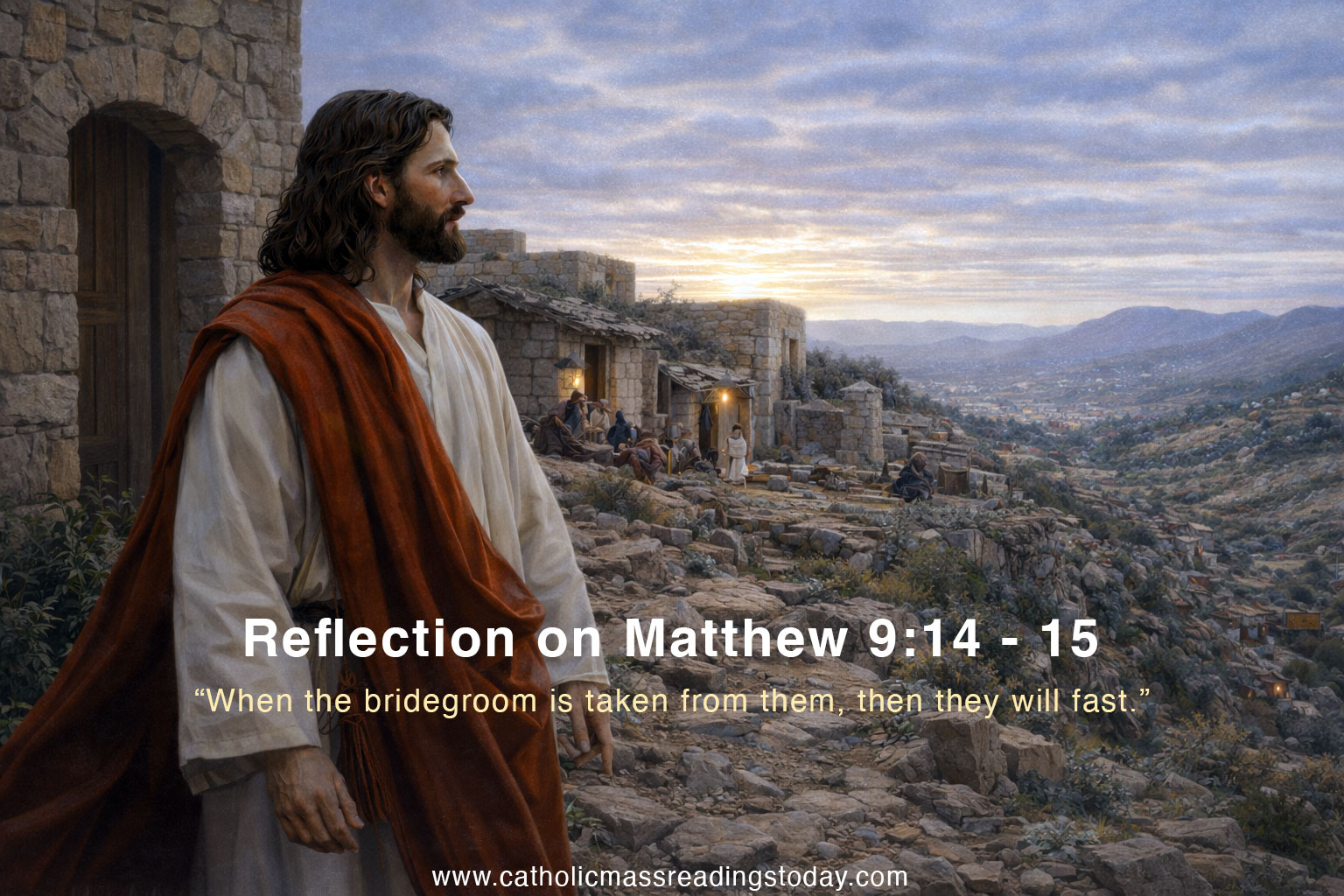
“When the bridegroom is taken from them, then they will fast.”
In today’s Gospel, we see a simple but deeply meaningful question. The disciples of John approach Jesus and ask why His disciples do not fast as they and the Pharisees do. This is a sincere question. In those days fasting was a serious religious practice, a visible sign of devotion and repentance. Jesus answers them in a way that shifts their understanding completely: “Can the wedding guests mourn as long as the bridegroom is with them?”
With this image, Jesus reveals something profound about who He is and what fasting truly means.
1. Jesus as the Bridegroom
In Catholic teaching, the image of the bridegroom is rich with meaning. Throughout Scripture, God presents Himself as the Bridegroom and His people as the bride. In this moment, Jesus is gently revealing His divine identity, not just as a teacher giving moral instructions; but He is the Bridegroom who has come to unite Himself with His people.
We know a wedding is a time of joy, celebration, and presence, we usually don’t fast at a wedding feast. We celebrate. we rejoice, we are fully present to the one we love. The disciples were in the physical presence of Christ walking with Him, listening to Him, eating with Him. It was a time of joy.
But then Jesus says something that carries a shadow of the Cross: “The days will come, when the bridegroom is taken away from them, and then they will fast.” He is pointing ahead to His Passion, to Good Friday when He will be taken away.
For us as Catholics, this has deep meaning during Lent. Lent is a time when we spiritually walk toward that moment when the Bridegroom is taken away. Our fasting is not an empty ritual; it is participation in the longing for Christ and in the mystery of His sacrifice.
2. Fasting Is About Relationship
Jesus teaches us that fasting is not about performance but about relationship.
The Pharisees fasted as a religious obligation. John’s disciples fasted as part of a penitential preparation. But Jesus reminds them that fasting must come from love, not from comparison or competition.
Remember, fasting should be between you and your God. Do not fall into the trap of comparing spiritual practices, asking yourself:
- “Why does she fast more than me?”
- “Why does he not give up as much as I do?”
- “Why are they not observing Lent seriously?”
Catholic spirituality is not about measuring ourselves against others. It is about responding personally to Christ. When we fast during Lent, we are not trying to prove something. We are expressing longing by saying, “Lord, I desire You more than comfort. I want You more than food. I hunger for Your presence.” If fasting does not deepen our love for Christ, it becomes just dieting with religious language.
3. Joy and Sacrifice go together
This Gospel also reminds us that Christianity is not a religion of constant sadness. There is a time for joy and a time for fasting. There is a time for feasting and a time for sacrifice.
As Catholics, we live in this reflective moments:
- Christ has already come, we usually rejoice.
- Christ has died and risen, we celebrate.
- Christ will come again, we long and prepare.
That is why even in Lent, which is penitential, the Church does not remove joy completely. We still celebrate the Eucharist. We still gather as a community. We still hear the Good News.
In our daily lives, this balance is important. Some people think being holy means being serious, gloomy, and withdrawn. But Jesus attended weddings, shared meals and rejoiced with friends and its also during these period that He fasted for forty days in the desert.
Holiness is not about rejecting joy; it is about ordering our joy toward God.
4. What this means for us today
Today, most of us are used to too much love for our comfort. A bit of hunger and we are looking at nearest fast food or quick to scroll through our phone to order, when we feel a bit bored again we are quick to scroll through our phone for quick social media excitement, If we feel lonely we look to distract ourselves. We rarely sit with longing.
Fasting teaches us to sit disciplined with longing.
When you skip a meal and feel that hunger, you are reminded: “I am not self sufficient. I need God.” When you give up something you enjoy, you are saying, “Lord, I choose You above this.”
But this Gospel also challenges us not to turn our faith into a rigid checklist. Sometimes we become overly focused on rules without remembering the Person behind them.
Ask yourself:
- Is my fasting bringing me closer to Jesus?
- Is it making me more patient, more loving, more merciful?
- Or is it making me proud and judgmental?
True Catholic fasting should soften our hearts, not harden them.
5. Living this Gospel in everyday life
Today, the Bridegroom is not physically before us as He was with the disciples though truly present in the Eucharist. He is present in the Word, present in the poor and in our families yet we still experience moments when He feels “taken away” times of emptiness in prayer, times of suffering, times when God feels distant. Those are the moments of fasting.
When:
- A marriage is struggling.
- A child is far from the faith.
- Work is overwhelming.
- Illness enters the home.
- Prayer feels empty.
In these moments, we fast not only from food but from self reliance. We lean into trust and say, “Lord, even when I do not feel You, I choose You.” This is mature faith.
6. A personal invitation
This Gospel invites each of us to examine why we fast and how we fast. Are we fasting because “it is Lent” and everyone else is doing it? Or are we fasting because we love the Bridegroom?
As Catholics, we fast on Ash Wednesday and Good Friday abstaining from eating meat. Beyond these minimum requirements, Lent is a personal journey. Maybe your fasting this year needs to be:
- From harsh words.
- From impatience.
- From constant phone use.
- From gossip.
- From resentment.
Maybe the Bridegroom is inviting you not just to give something up, but to give your heart more fully.
7. A hope that looks forward
“When the bridegroom is taken from them, then they will fast.”
Our fasting is not meaningless denial, it is not spiritual punishment, neither is it an attempt to impress God but an expression of love and longing.
We fast because we miss Him.
We fast because we desire Him more deeply.
We fast because we know that this world, with all its beauty and all its pain, is not our final home.
As Catholics, we live between presence and promise. Christ is truly with us in the Eucharist, in the Word, in the Church and in one another and we await the fullness of His Kingdom. A day is coming when all the suffering will end, when all our tears will be wiped away, when our faith will become sight.
Our Lenten fasting reminds us that we are on a journey, training our hearts not to cling too tightly to temporary comforts but stretch our desire toward heaven. This is the time to purify our love.
One day, there will be no more fasting but only the eternal wedding feast of the Lamb. Until that day, we fast with hope ans sacrificing with trust. We love with expectation.
In every small act of self denial, we call out with the Church: “Come, Lord Jesus.”
Let us Pray
Lord Jesus Christ,
our Bridegroom and our Savior,
We thank You for calling us into a stronger relationship with You.
Teach us the true meaning of sincere fasting
not as empty ritual,
not as a show before others,
but as a humble longing for Your presence.
Purify our hearts during this Lenten journey.
When we feel weak, strengthen us oh Lord.
When we feel distant from You, draw us closer.
When we struggle with sacrifice, remind us of Your Cross.
Aid our fasting to make us more loving,
more patient,
more forgiving,
and more compassionate to those around us.
May every hunger we experience
lead us to hunger more deeply for You.
May every sacrifice we make
unite us more closely to Your Passion.
And may this journey of Lent
prepare our hearts for the joy of Your Resurrection
and the eternal feast You promise to those who love You.
We ask this through Christ our Lord.
Amen.