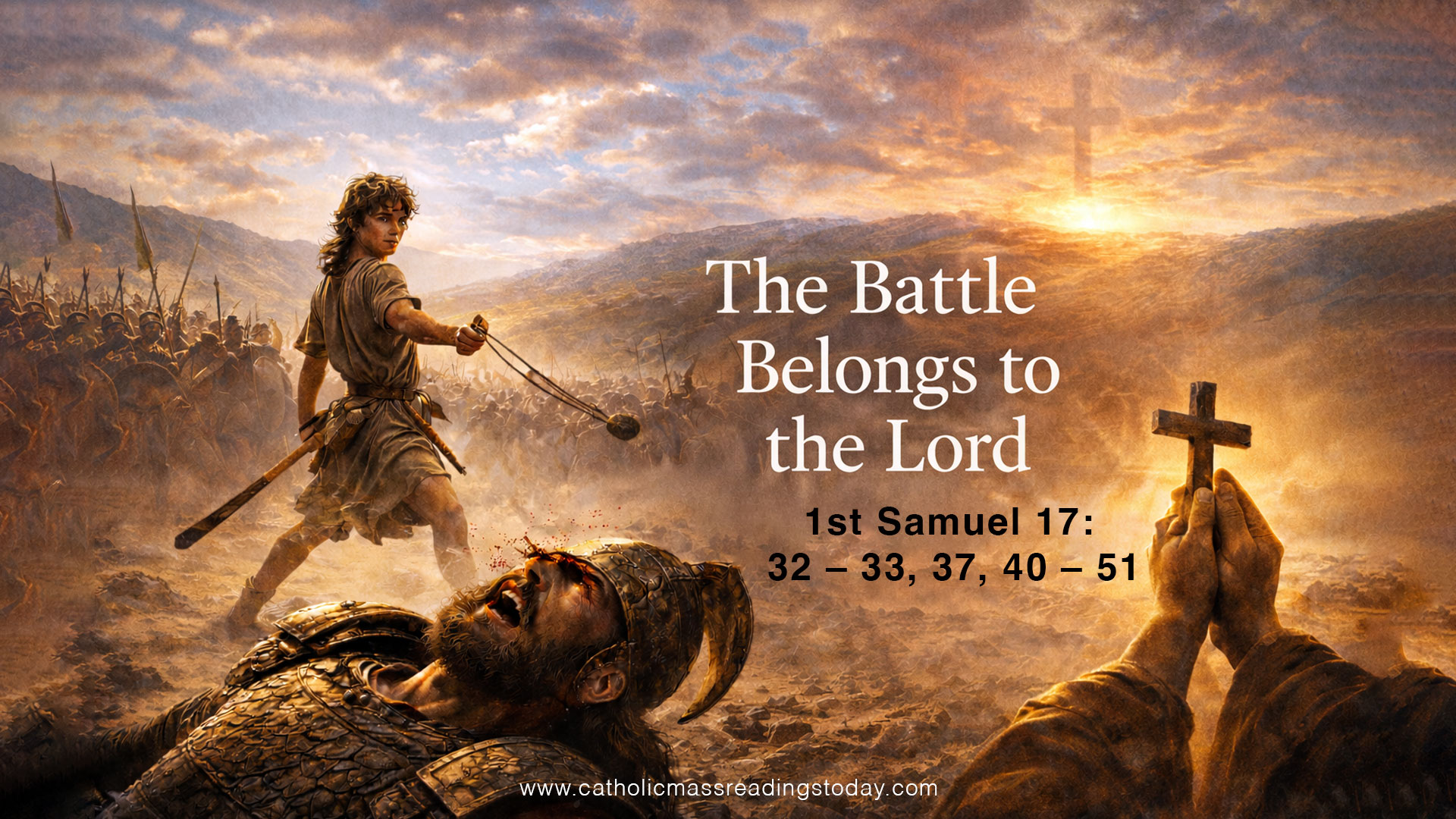
**Reflection on the First Reading
1 Samuel 17: 32–33, 37, 40–51**
The story of David and Goliath is one of the most powerful and beloved passages in Sacred Scripture, not because it glorifies violence, but because it reveals how God acts through humility, faith, and trust rather than through human strength.
At first glance, David seems entirely unqualified. He is young, inexperienced in battle, and stands before a seasoned warrior armed with sword, spear, and armor. Saul himself represents human reasoning when he tells David, “You are not able to go against this Philistine.” Yet Scripture repeatedly teaches us that God does not see as man sees. Where the world measures strength by appearance and power, God looks at the heart.
David’s confidence does not come from arrogance or self-belief. Instead, it is rooted in memory of God’s past faithfulness. He recalls how the Lord delivered him from the lion and the bear. This remembrance becomes the foundation of his courage. Faith grows when we remember what God has already done in our lives. David teaches us that trust in God is not blind optimism, but a response built on experience of God’s saving power.
One of the most striking moments in this passage is David’s refusal of Saul’s armor. The armor symbolizes reliance on human systems, strategies, and securities. David cannot fight in someone else’s strength. He must face the battle as he is, equipped only with what God has already placed in his hands. The sling and stones, simple tools of a shepherd become instruments of divine victory. This reminds us that God often uses what seems small, ordinary, or insignificant to accomplish His greatest works.
When David confronts Goliath, he makes a profound declaration of faith:
“The battle is the Lord’s.”
This is the heart of the reading. David understands that he is not fighting for personal glory, but for the honor of God. The victory is not meant to exalt David, but to reveal to Israel and to the nations that the Lord is the true deliverer.
Goliath represents more than an external enemy. He symbolizes fear, doubt, sin, and the voices that intimidate us into believing we are powerless. Like David, we often stand before challenges that seem impossible, temptations, injustices, personal struggles, or trials that overwhelm us. This passage assures us that when we place our trust in God, even the giants in our lives can fall.
From a Christian perspective, David also foreshadows Christ. Just as David defeats the enemy not through conventional power, Christ conquers sin and death not by force, but through humility, obedience, and the Cross. What appears weak to the world becomes the very means of salvation.
This reading invites us to ask ourselves:
- Where am I relying on my own strength instead of God’s?
- What “giants” am I afraid to face?
- Am I willing to trust God with the simple tools He has already given me faith, prayer, obedience, and love?
The story of David and Goliath reassures us that no challenge is too great when God is at the center. Victory belongs not to the strongest, but to those who trust fully in the Lord.
Prayer
Lord God of hosts,
You are our strength and our shield.
Teach us to trust in You when we feel small and unworthy.
Help us to remember Your faithfulness in our past
and to face today’s battles with courage rooted in faith.
May we always proclaim, in word and deed,
that the battle belongs to You.
Amen.