Humility Before God in a World of Comparison
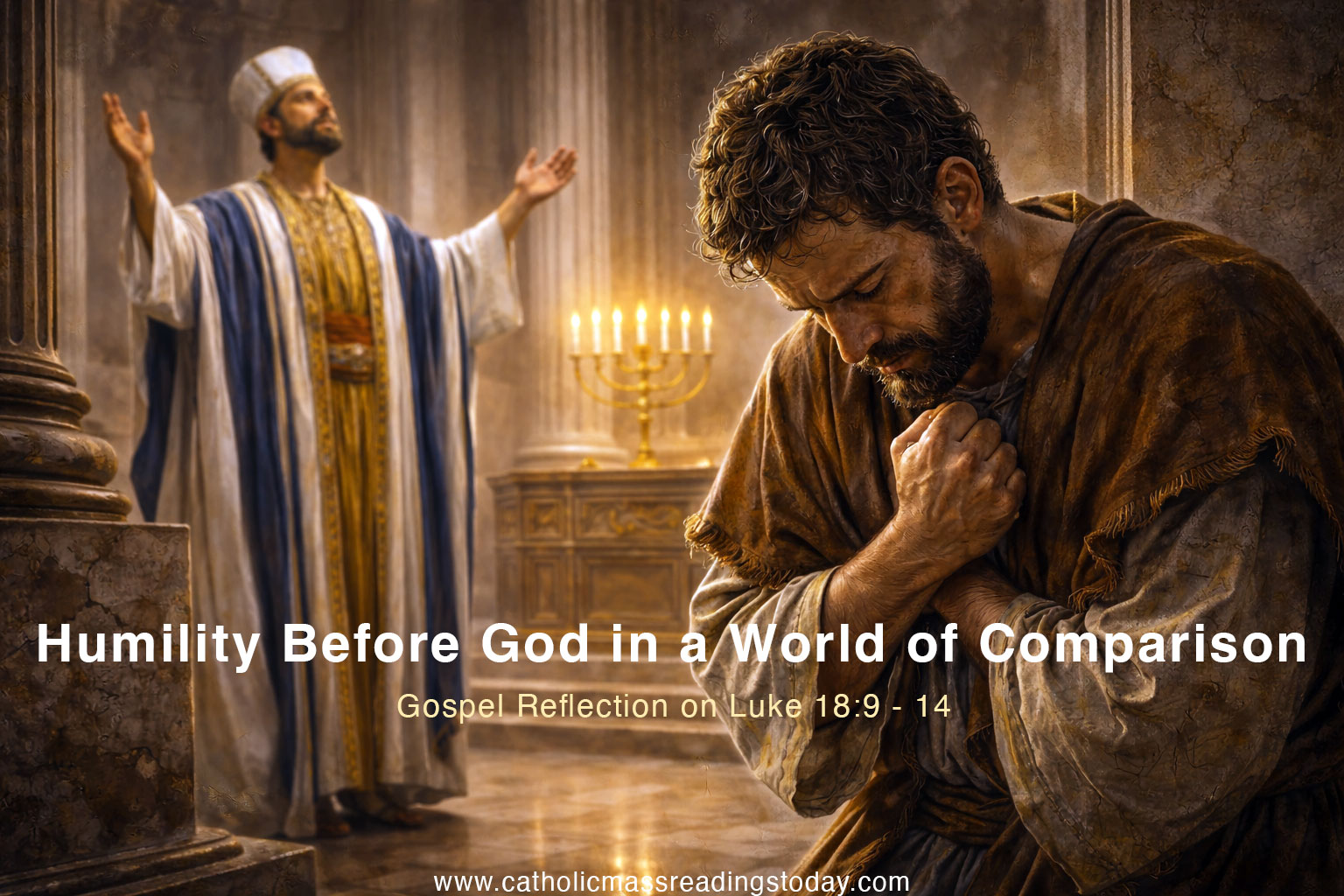
In today’s Gospel, Jesus tells a parable that speaks directly to our hearts. Two men go up to the temple to pray. One is a Pharisee, respected and religious. The other is a tax collector, a man widely despised by society at the time. Both stand before God, but they stand with very different hearts.
The Pharisee begins his prayer by thanking God, but very quickly his words turn into a comparison. He thanks God that he is not like other people, extortioners, adulterers, or even like the tax collector nearby. He lists his good works: fasting twice a week and giving a tenth of his income. These actions are not wrong. In fact, they are good religious practices. The problem lies in the spirit behind them. His prayer becomes more about praising himself than about praising God.
The tax collector stands at a distance. He does not even lift his eyes to heaven. He beats his breast and says a simple prayer: “God, be merciful to me, a sinner.” He brings nothing before God except honesty and humility.
Jesus then gives the surprising conclusion. It is the tax collector; not the Pharisee, who goes home justified before God. And Jesus ends with a powerful truth: “Everyone who exalts himself will be humbled, but the one who humbles himself will be exalted.”
This Gospel speaks strongly to our world today.
We live in a time where comparison has become almost a daily habit. Social media, public opinion, and modern culture often encourage people to measure themselves against others. It is easy to look at someone else’s mistakes and quietly think, “At least I am not like them.” The Pharisee’s prayer can appear in many forms today. Sometimes it hides behind religious practice, moral arguments, or even public virtue.
Today we often present the best version of ourselves to the world while quietly judging others. We see this when individuals or groups attack others with harsh words, convinced of their own righteousness. Pride can enter the heart even when someone believes they are defending what is right.
Jesus reminds us that the real question is not how we appear before others, but how we stand before God.
The tax collector shows us the attitude that pleases the Lord. He does not defend himself. He does not justify his actions. He simply asks for mercy. In that moment, his heart opens to God’s grace.
This message is deeply connected to Catholic life. Every Mass echoes the prayer of the tax collector. At the beginning of the liturgy we confess, “I have greatly sinned… through my fault.” We strike our breast as a sign of humility, much like the tax collector did in the temple. Before receiving Holy Communion we say, “Lord, I am not worthy.”
These words remind us that none of us comes before God because we are perfect. We come because we need His mercy.
This Gospel also invites us to look at how we treat others. In today’s world people are often labeled quickly. Mistakes become public, and forgiveness can be rare. Yet Christ shows us a different path. Instead of placing ourselves above others, we should recognize that we all stand in need of grace.
When we remember our own weaknesses, compassion grows, judgment fades and mercy becomes easier to give.
Humility does not mean thinking less of ourselves but seeing ourselves truthfully before God. It means knowing that every good thing in our lives comes from Him.
The Pharisee trusted in his achievements whilst the tax collector trusted in God’s mercy.
Jesus makes it clear which path leads closer to the Kingdom.
If we want to grow in holiness, we must learn to pray like the tax collector. Honest prayer opens the door for God to work in us. Pride closes it.
Every day gives us a chance to choose humility over self righteousness, mercy over judgment, and trust over pride. When we do, we begin to walk the path that leads to the heart of God.
Let us Pray
Lord God,
You see our hearts more clearly than we see them ourselves.
Protect us from pride and from the habit of judging others.
Teach us to approach You with humility and honesty.
Give us the courage to admit our faults
and the grace to trust in Your mercy.
Help us to treat others with compassion,
remembering that we all depend on Your forgiveness.
Create in us a humble heart, O Lord,
so that we may walk in Your truth
and grow closer to Your Kingdom each day.
Through Christ our Lord.
Amen.