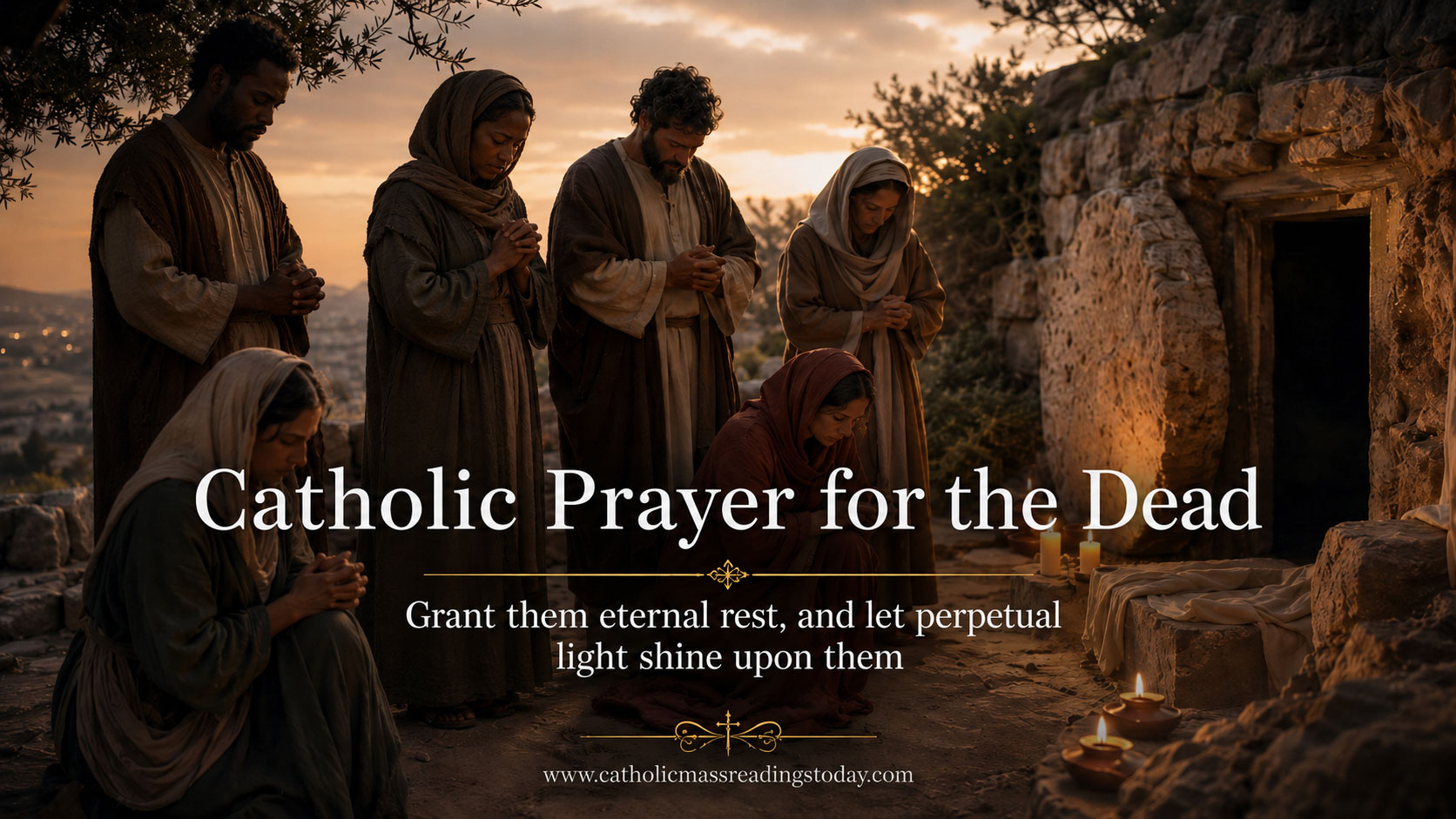
There are few moments in human life more sobering than standing before death. Whether we are mourning a parent, a spouse, a child, a sibling, a friend, or a fellow believer, death has a way of stripping away illusion. It reminds us that life is fragile, that love is real, and that the human heart was made for something beyond the grave.
For Catholics, death is never treated lightly. The Church does not pretend that separation is easy, nor does she speak about eternal things in a shallow or sentimental way. She grieves, she prays, she hopes, and she entrusts the dead to the mercy of God.
This is where the practice of Catholic prayer for the dead becomes so important. Catholics pray for the dead because love does not end at death. We pray because we believe in the communion of saints, in the mercy of God, in the resurrection of the body, and in the purification by which souls are made ready for the fullness of heaven. We pray because the dead are not forgotten before God, and they should not be forgotten by us.
This article explores the meaning, history, biblical foundation, and spiritual importance of Catholic prayer for the dead, and why this ancient Christian practice remains one of the most beautiful expressions of faith, hope, and charity.
What Is Catholic Prayer for the Dead?
Catholic prayer for the dead is the practice of praying for those who have died, asking God to grant them mercy, forgiveness, purification, peace, and eternal rest.
These prayers are offered because the Church believes that the soul lives on after death and that our bond in Christ is not broken by death. Those who die in God’s friendship, but still need purification, are helped by the prayers of the faithful. Those already in heaven no longer need our prayers, but those undergoing purification benefit from them. Those who have definitively rejected God are beyond earthly intercession, but because we do not judge the hidden state of souls, the Church continues to commend the dead to God’s mercy.
Catholics therefore pray not out of uncertainty alone, but out of love and faith. We do not pray to “change” God’s mind, but to participate in His mercy and to exercise charity toward those who have gone before us.
Why Catholics Pray for the Dead
The practice of praying for the dead rests on several deeply Catholic convictions.
First, it rests on the belief that death is not annihilation. The human person does not simply disappear. Each soul stands before God.
Second, it rests on the belief that salvation is entirely dependent on the mercy of God. No one enters eternal life by human merit alone. Every soul stands in need of divine mercy.
Third, it rests on the belief that some souls, though saved, still undergo purification before entering the fullness of heavenly glory. This is what the Church calls purgatory.
Fourth, it rests on the belief that the Church is one in Christ: the faithful on earth, the souls being purified, and the saints in heaven remain united in what the Church calls the communion of saints.
So Catholics pray for the dead because:
- we love them
- we believe God hears prayer
- we believe souls may be helped by our intercession
- and we believe mercy remains central to the Christian hope
Prayer for the dead is therefore not an optional emotional custom. It is a deeply theological act rooted in Catholic doctrine.
The Biblical Foundation for Catholic Prayer for the Dead
One of the clearest biblical foundations for Catholic prayer for the dead is found in 2 Maccabees 12:44 – 46. After battle, Judas Maccabeus offers prayers and sacrifice for the fallen, believing it to be holy and good to pray for the dead so that they may be loosed from their sins.
This passage has long held an important place in Catholic teaching because it shows that prayer for the dead was already practiced among God’s people before the coming of Christ. It reveals a conviction that the dead can still be aided by the prayers and offerings of the living.
Some Christians do not accept 2 Maccabees as Scripture, but the Catholic Church does, and it remains a key witness to this ancient practice.
Other biblical passages also support the Catholic understanding, even if more indirectly.
1 Corinthians 3:13 – 15
Saint Paul speaks of a person being saved, but “as through fire.” The Church has long seen in this passage an indication that there can be purification after death for those destined for salvation.
Matthew 12:32
Jesus speaks of sins that will not be forgiven “either in this age or in the age to come,” which suggests that some forgiveness can indeed relate to the age to come.
2 Timothy 1:16 – 18
Paul prays that the Lord grant mercy to the household of Onesiphorus and asks that Onesiphorus may find mercy on that Day, language many have taken as suggestive of prayer for one who has died.
These passages do not stand alone. They belong to the wider biblical vision that God is just, merciful, and actively at work in sanctifying His people.
Catholic Teaching on Purgatory
To understand Catholic prayer for the dead, one must understand the Church’s teaching on purgatory.
Purgatory is not a second chance after death. It is not a middle kingdom between heaven and hell where souls decide later. It is the final purification of those who die in God’s grace and friendship, but who are not yet fully purified.
The souls in purgatory are saved souls. Their eternal destiny is heaven. But because nothing unclean can enter the full presence of God, they undergo purification so as to be made perfectly holy.
This teaching is deeply hopeful. It means that God’s work of sanctification is not superficial. He completes what He has begun. He does not abandon the soul that dies in friendship with Him but still needs cleansing of attachments, imperfections, and the effects of sin.
And this is precisely why Catholics pray for the dead. If souls in purgatory can be helped by our prayers, then love compels us to pray.
The Communion of Saints and Prayer for the Dead
One of the most beautiful doctrines in Catholic life is the communion of saints. This means that the Church is not divided into disconnected groups, but remains one in Christ.
There are traditionally three states of the Church:
- the Church Militant: the faithful still journeying on earth
- the Church Suffering: the souls being purified
- the Church Triumphant: the saints in heaven
These are not three churches, but one Church.
Because of this unity, prayer moves across the mystery of death. The saints in heaven intercede for us. We pray for one another on earth. And we also pray for the dead who are being purified.
This is not strange when seen in the light of Christian love. If we pray for the sick, the poor, the grieving, and the struggling, why would we stop loving someone simply because death has occurred? Death changes many things, but it does not cancel charity.
In that sense, Catholic prayer for the dead is one of the clearest acts of supernatural love.
How Catholics Pray for the Dead
The Church has many ways of praying for the dead, some liturgical and some personal.
The Holy Sacrifice of the Mass
The most powerful prayer Catholics can offer for the dead is the Mass. To have a Mass offered for a deceased person is one of the greatest acts of charity, because the sacrifice of Christ is made present and the dead are commended to God through the prayer of the Church.
The Eternal Rest Prayer
One of the most well known Catholic prayers for the dead is:
Eternal rest grant unto them, O Lord,
and let perpetual light shine upon them.
May they rest in peace.
Amen.
This prayer is simple, direct, and deeply moving. It expresses both petition and hope.
The Rosary for the Dead
Many Catholics pray the Rosary for deceased loved ones, entrusting them to the Blessed Virgin Mary and asking for God’s mercy and peace.
The Office for the Dead
The Church has an ancient liturgical tradition of praying the Office for the Dead, especially in monastic and clerical life, though lay faithful may also participate.
November Devotions and All Souls’ Day
The month of November is especially dedicated to prayer for the dead, and All Souls’ Day on November 2 is a central occasion when the Church prays for all the faithful departed.
Personal Prayer
Catholics also pray spontaneously for the dead:
- at gravesides
- after hearing of a death
- on anniversaries
- in moments of remembrance
- and in daily prayer
These prayers may be very simple: “Lord, have mercy on his/her soul,” or “Receive him/her into Your peace.”
Why the Mass Matters Most
If one wants to understand Catholic prayer for the dead properly, one must recognize why the Mass holds first place.
At Mass, the Church does not offer mere good wishes. She unites her prayer to the sacrifice of Christ. The death and resurrection of Jesus are the source of all mercy, all forgiveness, all hope for eternal life. When the dead are remembered at Mass, they are entrusted to the redeeming love of Christ Himself.
This is why Catholics so often request memorial Masses for loved ones. It is not only a custom. It is an expression of faith that Christ’s sacrifice is powerful, living, and sufficient.
No private prayer can surpass the dignity of the Holy Mass as an offering for the dead.
Is Praying for the Dead Still Important Today?
Very much so.
Modern life often encourages people to move on quickly from death. Mourning is shortened, silence is avoided, and eternal questions are often pushed aside. But the Christian heart cannot be formed by forgetfulness.
To pray for the dead is to resist that forgetfulness. It says:
- this life matters
- this soul matters
- death is real
- judgment is real
- mercy is real
- eternity is real
It also protects us from a shallow view of salvation. We do not canonize everyone emotionally. We do not assume lightly what belongs to the judgment of God. Instead, we pray. We hope. We entrust.
That is a deeply Catholic posture: humble, loving, and reverent.
Catholic Prayer for the Dead Is an Act of Mercy
The Church has long recognized prayer for the dead as one of the spiritual works of mercy.
This is important.
Mercy is not only something we receive. It is something we are called to show. We feed the hungry, visit the sick, comfort the sorrowful, instruct the ignorant, forgive offenses and we also pray for the living and the dead.
To pray for the dead is therefore not only a pious devotion. It is mercy in action.
This is especially moving when we remember those who may have no one praying for them:
- forgotten souls
- abandoned souls
- those whose names are no longer spoken
- those who died suddenly
- those whose funerals were unattended
- those who were loved imperfectly on earth
The Church’s prayer embraces them too.
What Catholic Prayer for the Dead Says About God
The practice of praying for the dead reveals something profoundly beautiful about God.
It tells us that God is just, because every soul stands before Him in truth.
It tells us that God is merciful, because He purifies and saves.
It tells us that God is patient, because He completes the work of grace.
It tells us that God is relational, because He does not save us as isolated individuals but within the communion of the Church.
And it tells us that God is worthy of trust, because even in the face of death, the Church dares to hope.
Common Misunderstandings About Catholic Prayer for the Dead
Because this practice is sometimes misunderstood, it is helpful to clarify a few points.
Catholics do not worship the dead
Prayer for the dead is not worship of the dead. Worship belongs to God alone. Catholics pray for the dead, not to them as divine beings.
Catholics do not believe prayer overrides God’s justice
Prayer does not cancel divine justice. Rather, it appeals to divine mercy within God’s perfect wisdom.
Catholics do not treat purgatory as a second chance
Purgatory is not a second chance to choose God after death. It is the purification of those who already die in His grace.
Catholics do not claim certainty about every individual soul
The Church canonizes saints, but she does not declare ordinary deceased individuals to be certainly in heaven. That is why prayer remains so fitting and important.
How Families Can Practice Catholic Prayer for the Dead
Catholic families can keep this tradition alive in simple and meaningful ways.
They can:
- have Masses offered for deceased relatives
- pray the Eternal Rest prayer regularly
- remember loved ones on anniversaries
- visit cemeteries and pray there
- include the dead in family Rosaries
- teach children to pray for grandparents and departed family members
- observe November with special devotion
These practices help keep memory holy. They teach children that death is serious, prayer is meaningful, and love remains faithful.
A Catholic Prayer for the Dead
Merciful Father,
in Your hands are the living and the dead.
We commend to You all the faithful departed,
especially those whom we have loved in this life.
Cleanse them of every sin,
purify them of every imperfection,
and receive them into the light of Your presence.
Grant them eternal rest,
and let perpetual light shine upon them.
May they rest in peace.
Through Christ our Lord.
Amen.
Why Catholic Prayer for the Dead Should Never Be Lost
If the Church were ever to stop praying for the dead, she would lose something deeply human and deeply Christian.
She would lose the language of hope in the face of loss.
She would lose a profound act of mercy.
She would lose a practice rooted in Scripture, tradition, and love.
She would lose a visible sign that death does not destroy the bonds of Christ.
But the Church will not lose it, because this practice belongs too deeply to her heart.
As long as Christians bury their dead, mourn their beloved, and believe in the resurrection, they will pray.
They will pray because God is merciful.
They will pray because souls matter.
They will pray because Christ has conquered death.
They will pray because love still speaks.
Meeting point of grief and hope
The beauty of Catholic prayer for the dead is that it stands at the meeting point of grief and hope.
It acknowledges the pain of loss without despair.
It acknowledges the seriousness of judgment without panic.
It acknowledges the holiness of God without forgetting His mercy.
It is one of the Church’s quiet treasures.
To pray for the dead is to say:
you are loved,
you are remembered,
and we entrust you to God.
And in the end, that is one of the most Christian things a soul can do.
Traditional Catholic Prayer for the Dead
Eternal rest grant unto him/her, O Lord,
and let perpetual light shine upon him/her.
May he/she rest in peace.
Amen.
May all the faithful departed, through the mercy of God, rest in peace. Amen.