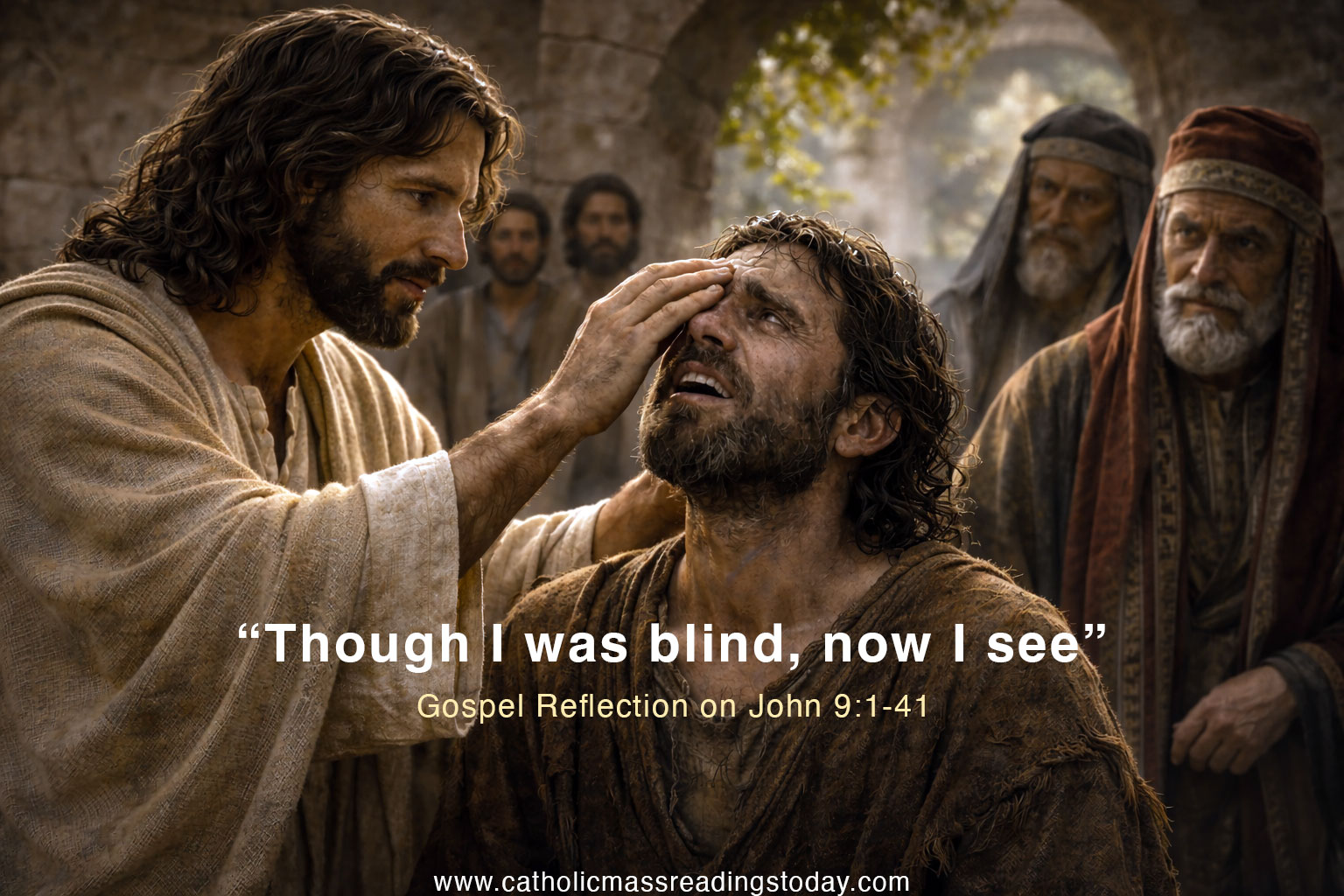
“Though I was blind, now I see.”
Today’s Gospel is one of the longest and most powerful encounters in the ministry of Jesus. It is not only a story about the healing of physical blindness but a much deeper story about spiritual sight, faith, courage, and the danger of spiritual pride.
The passage begins with a question that people still ask today. When the disciples see the blind man, they immediately ask, “Who sinned, this man or his parents, that he was born blind?” In the thinking of many people at that time and even today, suffering was seen as punishment for sin. If someone experienced illness, misfortune, or disability, people assumed that someone must have done something wrong.
Jesus rejects this way of thinking.
He answers clearly that neither the man nor his parents sinned in a way that caused his blindness. Instead, Jesus says that this situation will reveal the works of God. This response teaches us something very important about suffering. Not every hardship in life is a punishment from God. Many times suffering becomes the place where God’s grace and power are revealed.
In our world today, we still struggle with this question. When tragedy strikes, people often ask, “Why did God allow this?” A family loses a loved one, someone is born with a disability, a person faces illness or hardship. It is natural to search for reasons yet the Gospel reminds us that suffering is not always something to explain; often it is something through which God works in ways we cannot immediately see.
Jesus then says something remarkable: “I am the light of the world.” This statement lies at the center of the entire story. The healing of the blind man becomes a sign of something much greater. Christ did not come only to restore physical sight. He came to open the eyes of the human heart.
When Jesus heals the man, He does so in a very unusual way. He makes clay with His saliva and places it on the man’s eyes. Then He tells him to go and wash in the pool of Siloam. The man obeys. He goes, he washes, and he returns able to see.
This moment reflects a pattern we often see in the life of faith. God invites us to act in trust before we see the full result. The blind man could have refused. He could have doubted or hesitated. Instead, he follows the instruction of Jesus. His obedience opens the door to healing.
In many ways, this moment reminds us of the Sacraments of the Church. God uses simple physical signs to bring spiritual grace. Water in Baptism cleanses and gives new life. Bread and wine become the Body and Blood of Christ in the Eucharist. Oil strengthens in Confirmation and Anointing of the Sick. In this Gospel, clay and water become instruments of healing.
The story then shifts focus. The miracle itself becomes less important than the reaction of the people around it. The neighbors begin to argue. Some recognize the man. Others doubt that it is really him. Instead of celebrating the miracle, people begin debating it.
Soon the Pharisees enter the story, they question the man repeatedly. Their concern is not the healing but the fact that it happened on the Sabbath. In their strict interpretation of the law, making clay counted as work, which was forbidden on that day.
This reveals something tragic about spiritual blindness. The Pharisees are so attached to their interpretation of the rules that they fail to see the work of God happening before them.
The man who had been blind gradually grows in faith throughout the story. At first he simply calls Jesus “the man called Jesus.” Later he says Jesus is a prophet. By the end of the Gospel, after Jesus finds him again, the man declares, “Lord, I believe,” and he worships Him.
This progression shows how faith often grows in stages. Rarely do people come to full belief all at once. Faith deepens through encounter, experience, and reflection.
Meanwhile, the religious leaders move in the opposite direction. Instead of growing in faith, they grow more resistant. They question the man’s parents. They accuse the healed man and finally, they throw him out of the synagogue.
Ironically, the man who was once physically blind begins to see the truth clearly, while those who claim to see become spiritually blind.
This part of the Gospel speaks strongly to our world today. Many people claim certainty about truth, morality, and religion. Yet certainty alone does not guarantee openness to God. Pride can close the heart. The Pharisees believed they already understood everything about God. Because of that, they could not recognize God standing right in front of them.
The danger of this attitude still exists today. Sometimes people become so confident in their own ideas, opinions, or religious knowledge that they stop listening. Faith requires humility. A person who thinks he already sees everything clearly may become blind to God’s action.
The healed man teaches us something different. He does not claim to know everything. His testimony is simple and honest: “One thing I know, that though I was blind, now I see.”
This simple statement carries great power. It reminds us that faith often begins with personal experience of God’s mercy. Many believers throughout history could echo the same words. Perhaps they once lived far from God. Perhaps they struggled with doubt or darkness. Then something happened, an encounter, a prayer, a moment of grace and their eyes were opened.
In today’s world, many of us experience a different kind of blindness. It may not be physical blindness, but blindness of the heart. We may lose sight of God amid the noise of modern life. Others become blinded by material success, pride, or indifference. Some reject faith because of misunderstandings or past wounds.
Yet Christ continues to walk through our world as the Light. He still seeks those of us who struggle to see clearly. He still heals hearts and opens eyes.
Near the end of the Gospel, Jesus finds the man who had been cast out. This detail is beautiful. When society rejects someone, Christ seeks them out. Jesus asks him directly, “Do you believe in the Son of Man?” When the man learns that Jesus is the one who healed him, he responds with faith and worship.
This moment shows the ultimate purpose of the miracle. Physical sight leads to spiritual sight. The man does not only see the world; he now recognizes the Savior.
Jesus then concludes with a powerful statement: “Those who do not see may see, and those who see may become blind.” The meaning becomes clear. Those who recognize their need for God will receive light. Those who believe they already have all the answers may close themselves to the truth.
The Gospel invites each of us to ask an honest question: Where might I still be blind?
Perhaps we struggle to see the needs of the poor. Perhaps we overlook someone who suffers quietly. Perhaps pride prevents us from admitting our faults. Perhaps we fail to recognize how God is working in unexpected ways.
Christ offers us the same gift He offered the blind man: light.
Through prayer, the Scriptures, the Sacraments, and the life of the Church, Jesus continues to open our eyes. Every time we approach the Sacrament of Reconciliation, we ask Him to remove the blindness of sin. Every time we receive the Eucharist, we receive the Light of the world.
The journey of faith is, in many ways, a journey from blindness to sight.
Let us Pray
Lord Jesus,
You are the Light of the world.
You see the darkness that sometimes fills our hearts.
Open our eyes so that we may recognize Your presence in our lives.
Heal the blindness caused by pride, fear, and doubt.
Teach us to see others with compassion and love.
Give us the courage to follow You, even when the world does not understand.
Like the man who was healed,
may we one day stand before You and say with faith,
“Lord, I believe.”
Amen.