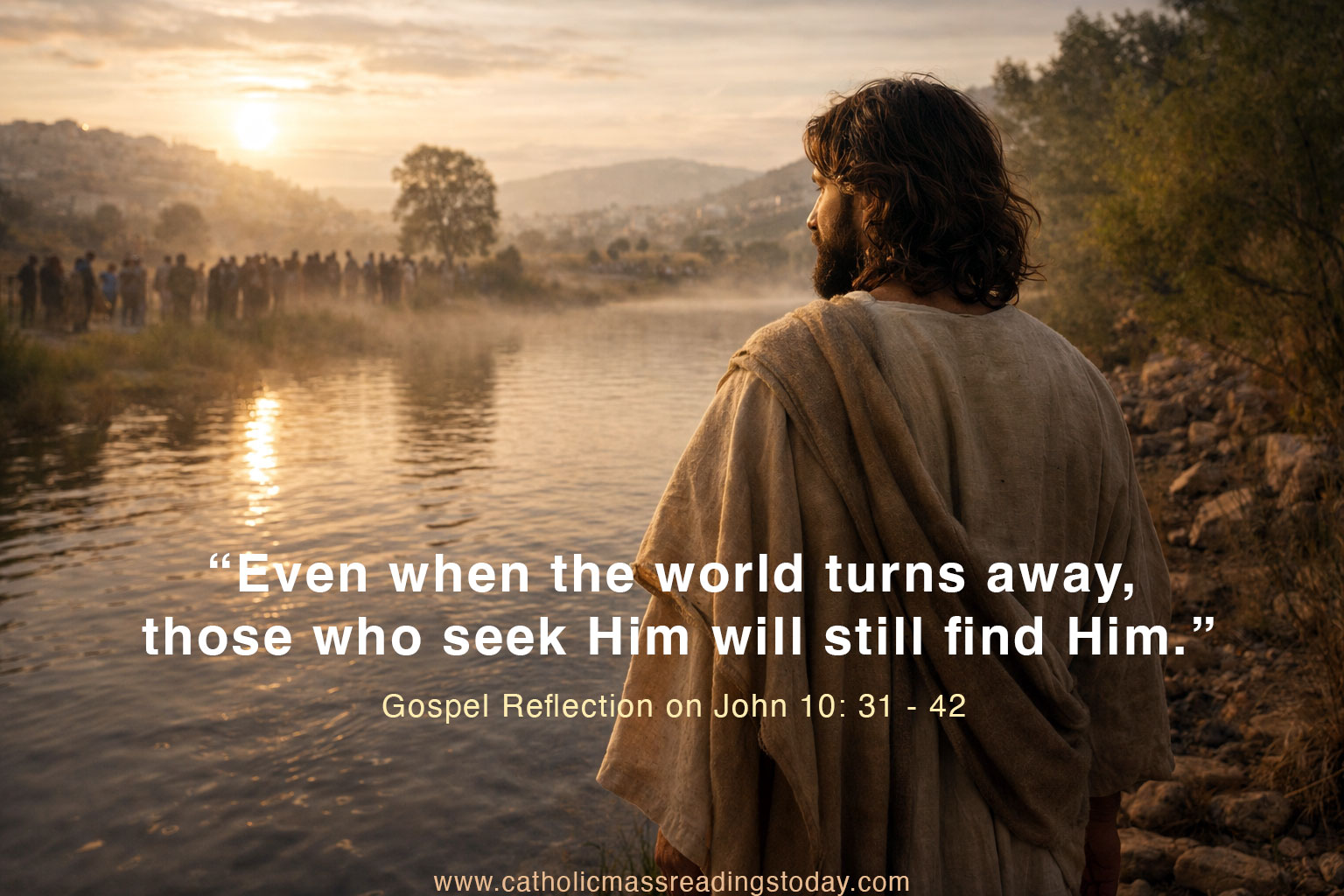
There’s a tension in this Gospel that feels very real. You can almost sense how quickly things escalate from a conversation into anger, from questioning into violence. The people pick up stones, ready to act, convinced they are defending what is right. And yet, standing right in front of them is Jesus, calmly asking a simple question: “For which of my good works do you stone me?”
It’s a question that lingers.
Because the truth is, Jesus had done nothing but good, healing, teaching, restoring, showing mercy. But sometimes goodness itself can be unsettling, especially when it challenges what we’ve always believed or exposes what we would rather not face. The issue wasn’t really His works, it was who He claimed to be. “I am the Son of God… the Father is in me and I am in the Father.” That was too much for them to accept.
And if we’re honest, we’re not so different.
There are moments in life when we resist God, not because He has failed us, but because what He is asking of us stretches us, unsettles us, or calls us to change. It’s easier to stay where we are, to hold on to our own understanding, our own control. The people in the Gospel thought they knew God, but when God stood right in front of them, they couldn’t recognize Him.
That’s a sobering thought.
In today’s world, we’re surrounded by noise, opinions, information, constant distractions. Everyone seems to have something to say, and it’s easy to get caught up in it all. Faith can become something we fit in when convenient, rather than something we truly live. And when life gets difficult, when prayers feel unanswered, when things don’t go as planned it’s easy to question, to doubt, even to pull away.
But Jesus, in this Gospel, doesn’t argue for the sake of argument. He points to His works. “If I am not doing the works of my Father, then do not believe me; but if I do them… believe the works.”
In other words, look at what is happening. Look at the lives being changed. Look at the love, the healing, the truth.
And maybe that’s something we’re invited to do in our own lives especially during this fifth week of Lent.
To pause and ask ourselves: where have we seen God at work? Not just in big, dramatic ways, but in the quiet moments, unexpected help, strength when we felt weak, peace in the middle of chaos, the presence of someone who showed us kindness when we needed it most.
Because sometimes we’re so focused on what isn’t happening that we miss what is.
There’s also something powerful in the ending of this Gospel. Jesus leaves that place of hostility and goes back across the Jordan, to where it all began, where John had first baptized, where people had first started to listen. And there, away from the noise and the anger, people come to Him again. They reflect, they remember, and they begin to believe.
That movement, from rejection to belief is something many of us experience in different ways. Faith is not always a straight path. There are moments of doubt, confusion, even resistance. But if we keep seeking, if we keep coming back, something begins to change.
Lent is a time for that return.
A time to step away from the noise, from whatever is pulling us away, and come back to the heart of things. To listen again. To look again. To give God space to work in us.
And maybe the most challenging part of this Gospel is not the crowd with the stones but the quiet invitation behind it all.
To not just believe with our words, but to recognize Jesus in our lives. To trust Him, even when it’s not easy. To follow Him, even when it asks something of us.
Because at the end of it all, faith is not about winning arguments or proving a point. It’s about relationship. It’s about recognizing Him not just in Scripture, but in the way He continues to move, to speak, and to work in our lives today.
And like those who came to Him across the Jordan, we’re given the same opportunity.
To come closer.
To see more clearly.
And, in our own way, to believe.