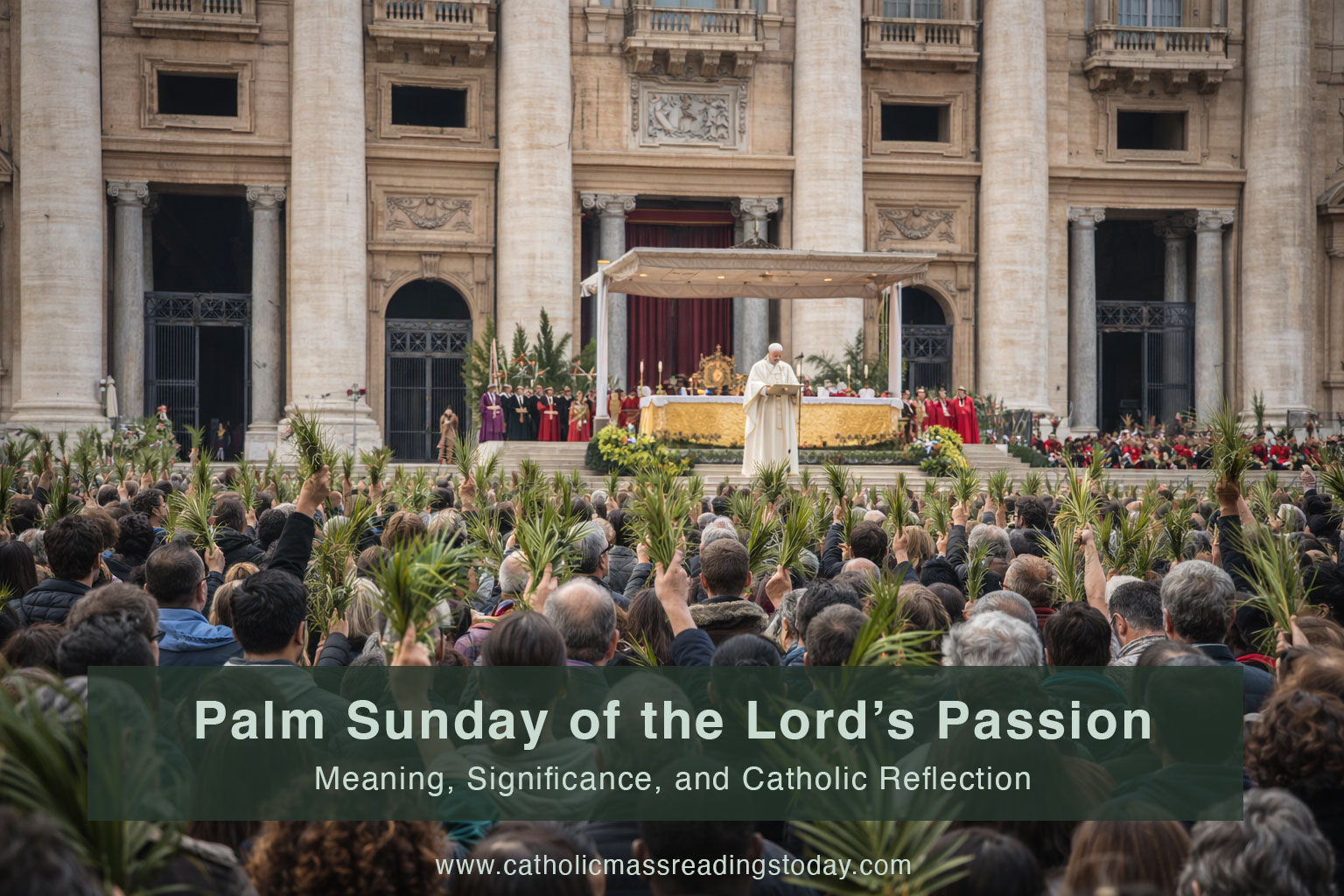
Palm Sunday: The Beginning of Holy Week
Palm Sunday marks one of the most powerful and emotional moments in the Catholic liturgical year. Celebrated on the Sunday before Easter, it opens the door into Holy Week, the most sacred time for Christians around the world.
On this day, the Church remembers two deeply connected events:
- Jesus’ triumphant entry into Jerusalem
- The beginning of His Passion, His suffering and journey to the Cross
That’s why the Church officially calls it Palm Sunday of the Lord’s Passion. It is both a celebration and a solemn reflection. Joy and sorrow meet in a single liturgy.
The Triumphal Entry: “Hosanna in the Highest”
Palm Sunday begins with a Gospel reading of Jesus entering Jerusalem, riding humbly on a donkey. The crowds welcome Him with palm branches, laying them on the road and shouting:
“Hosanna to the Son of David!”
In that moment, Jesus is received as a king but not the kind of king people expected. He comes not with power or armies, but with humility and peace.
The palm branches we carry today are a direct continuation of that moment. They are not just symbolic, they are a participation in that same welcome.
And yet, there is something sobering about it.
Because the same voices that cried “Hosanna” would, just days later, cry “Crucify Him.”
Why Palm Sunday Includes the Passion
One of the most striking aspects of Palm Sunday in the Catholic Church is that the Gospel reading shifts dramatically from celebration to suffering.
During Mass, the full Passion narrative is proclaimed.
This is intentional.
The Church does not allow us to stay only in the comfort of celebration. It invites us to see the full truth: that the same Jesus who is praised is also rejected, betrayed, and crucified.
It’s a reminder that faith is not just about moments of joy it is also about remaining faithful when things become difficult.
Palm Sunday in Today’s World
Palm Sunday is not just a historical event. It speaks directly into modern life.
Today, we still see how quickly opinions change. People can celebrate someone one moment and reject them the next. Truth is often overshadowed by convenience, pressure, or fear.
And if we’re honest, we sometimes do the same in our own lives.
- We follow God when it’s easy
- We pray when we need something
- But when faith demands sacrifice, change, or courage we hesitate
Palm Sunday challenges us personally:
Am I only praising Jesus when it’s convenient?
Or am I willing to follow Him all the way, even to the Cross?
The Spiritual Meaning of Palm Sunday
Palm Sunday invites us into something deeper than tradition.
It is an invitation to:
- Examine our own faith honestly
- Recognize our weaknesses without fear
- Walk with Christ not just in glory, but in suffering
It reminds us that discipleship is not comfortable. It is real. It costs something.
But it is also where true life is found.
The Importance of Palm Sunday for Catholics
For Catholics, Palm Sunday is not just symbolic, it is deeply sacramental and spiritual.
It marks:
- The official beginning of Holy Week
- The final preparation before Easter
- A call to deeper prayer, reflection, and repentance
It invites every believer to slow down and enter into the story not as a spectator, but as a participant.
Final Reflection: A Personal Question
Palm Sunday leaves us with a question that lingers:
Where do I stand in this story?
Am I among those who welcome Christ?
Am I among those who walk away when things become difficult?
Or am I ready to follow Him fully, honestly, and faithfully?
As Holy Week begins, the journey is no longer just about remembering what happened.
It becomes about walking with Him.