Holy Tuesday doesn’t come with the same outward attention as Palm Sunday or Good Friday, yet in many ways, it is one of the most intense days of Holy Week. If you sit with the Gospel passages long enough, you begin to feel it, the pressure building, the conversations sharpening, the lines being drawn.
By this point, Jesus is no longer simply teaching, He is confronting and at the same time, hearts around Him are being revealed, some opening, others closing.
Holy Tuesday is a day of truth, tension, and decision.
What is Holy Tuesday in the Catholic Church?
Holy Tuesday is the third day of Holy Week, following Holy Monday and leading toward the Sacred Triduum. The Church places before us Gospel readings that highlight the growing opposition to Jesus and His clear awareness of what lies ahead.
Unlike earlier moments in His ministry, Jesus is now in Jerusalem, teaching publicly in the Temple. The atmosphere is different. There is urgency, there is resistance, there is also a deep sense that time is running short.
What Happened on Holy Tuesday?
The Gospels associated with Holy Tuesday (especially from John and Matthew) reveal several important moments:
1. Jesus Teaches in the Temple
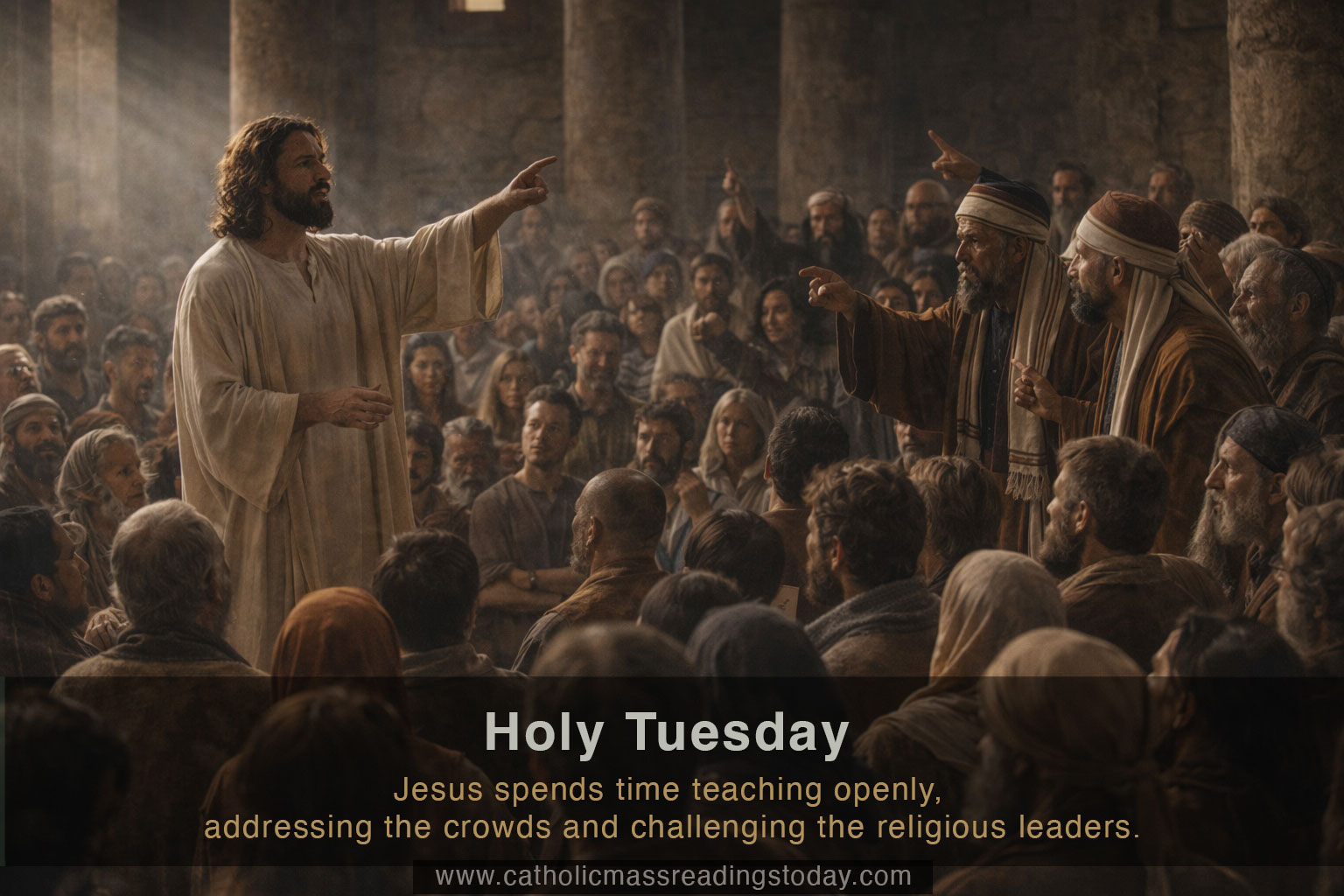
Jesus spends time teaching openly, addressing the crowds and challenging the religious leaders. His words are not vague or softened. They are direct.
He speaks about:
- Faithfulness
- Hypocrisy
- The true meaning of obedience to God
He tells parables that, while simple on the surface, carry sharp truths especially for those who believe they already have everything figured out.
2. Confrontation with Religious Leaders
By Holy Tuesday, the tension between Jesus and the chief priests and Pharisees has become undeniable.
They question Him:
- By what authority do You act?
- Who do You think You are?
But beneath their questions is something deeper, not a search for truth, but a resistance to it.
Jesus responds not just with answers, but with parables that expose the condition of their hearts.
It’s uncomfortable. And it’s meant to be.
3. The Exposure of Hypocrisy
One of the strongest themes of Holy Tuesday is Jesus’ warning against hypocrisy.
He sees people who:
- Appear righteous outwardly
- But inwardly are far from God
This isn’t just a message for leaders at the time, it is a message that reaches across every generation, including ours.
It reminds us that faith is not about appearance. It is about authenticity.
4. Jesus Foretells His Passion
Amid all this, Jesus speaks openly about what is coming:
- His suffering
- His death
- His betrayal
He is not caught off guard by any of it.
And yet, there is no panic in Him only surrender.
5. The Betrayal Draws Closer
Holy Tuesday also brings us closer to the reality of Judas’ betrayal.
While it may not yet be fully acted out, the decision is already forming.
This is one of the most sobering parts of Holy Week:
Judas was not an outsider.
He walked with Jesus.
He listened.
He witnessed everything.
And still, something in him turned.
That reality alone should make us pause.
The Meaning of Holy Tuesday
Holy Tuesday is about truth revealed in the light.
It is a day that invites us to look honestly at ourselves not the version of ourselves we present to others, but who we are before God.
It is about:
- The danger of living a divided life
- The courage to face uncomfortable truths
- The call to genuine conversion
Jesus does not condemn for the sake of condemning.
He confronts in order to heal.
But healing requires honesty.
Holy Tuesday in Today’s World
If we’re honest, Holy Tuesday speaks directly into the world we live in.
We live in a time where:
- Image often matters more than integrity
- People say the right things but live differently
- Truth is sometimes avoided because it’s inconvenient
Even within ourselves, there can be that same tension:
- We want to follow God
- But we also want control
- We believe but not always fully
Holy Tuesday doesn’t shame us for this.
It invites us to face it.
Because the moment we stop being honest is the moment we stop growing.
What is Expected of Us on Holy Tuesday?
The Church does not impose strict obligations for Holy Tuesday, but spiritually, it is a day of deep invitation.
Here’s how we can live it meaningfully:
1. Examine Your Authenticity
Take a quiet moment and ask:
- Is my faith something I live or something I display?
- Am I the same person in private as I am in public?
This is not about guilt.
It’s about truth.
2. Listen to Jesus’ Words
Instead of rushing through Scripture, sit with it.
Let His words challenge you.
Let them unsettle you if they need to.
Growth rarely happens in comfort.
3. Be Willing to Change
Holy Tuesday is not just about seeing what’s wrong, it’s about responding.
Maybe it’s:
- Letting go of pride
- Repairing a relationship
- Turning away from something you know isn’t right
Conversion doesn’t always come in big moments.
Sometimes it begins with a quiet decision.
4. Stay Close, Even When It’s Difficult
The disciples themselves struggled during this time.
Holy Tuesday reminds us:
Faith is not proven when things are easy,
but when we remain even when it’s uncomfortable.
A Deeper Reflection
There’s something sobering about Holy Tuesday.
By now, everything is moving toward the Cross.
Nothing is hidden anymore.
And yet, people still respond differently:
- Some lean in closer
- Others pull away
- Some remain undecided
That same reality exists today.
We all stand somewhere in that crowd.
And maybe the most important question Holy Tuesday asks is this:
Am I truly open to the truth even when it challenges me?
A Final Thought
Holy Tuesday is not loud.
It doesn’t demand attention.
But it quietly asks for something more difficult:
Honesty.
As we continue walking through Holy Week, we are not just remembering events, we are being invited into them.
To listen.
To reflect.
To choose.
Because before the Cross comes into view,
there is always a moment where we must decide where we stand.
And Holy Tuesday is that moment.