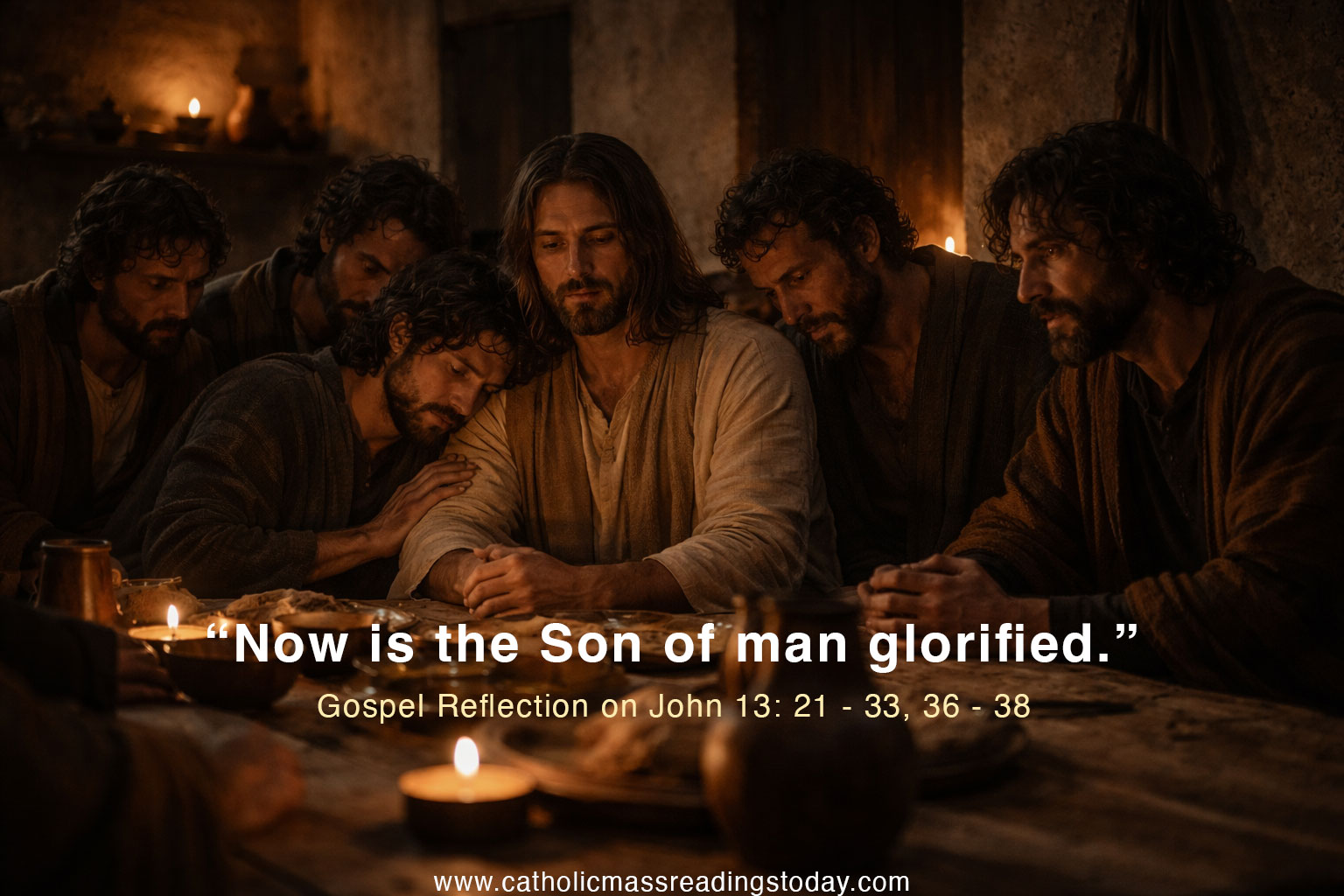
There is something especially heavy about this Gospel. By Tuesday of Holy Week, the shadow of the Cross is no longer far away. It is close. You can feel it in the tone of Jesus’ words, in the troubled silence around the table, in the confusion of the disciples, and in the sorrow that seems to hang over the whole room.
Saint John says that Jesus was “troubled in spirit.” That line matters. It reminds us that Jesus did not move toward His Passion as someone untouched by pain. He knew exactly what was coming. He knew betrayal was already in motion. He knew one of His own would leave the table and hand Him over. He knew Peter, full of love and confidence, would still deny Him before the night was over. And yet, He remained there. He did not run. He did not harden His heart. He stayed.
That alone says so much about the love of Christ.
Sometimes we imagine betrayal only as something dramatic, something done by terrible people far from God. But this Gospel makes it much more uncomfortable than that. Judas is not a stranger. Peter is not an enemy. They are both close to Jesus. They have walked with Him, listened to Him, eaten with Him, watched His miracles, heard His words. And still, one will betray and the other will deny.
That is one of the hardest truths in today’s Gospel: it is possible to be very near Jesus outwardly and still be weak, divided, or unfaithful inwardly.
And if we are honest, that truth reaches us too.
Judas and Peter fail differently, but both reveal something about the human heart. Judas shows us what happens when darkness is allowed to grow in secret. Sin rarely begins in public. It begins quietly, in excuses, in little compromises, in hidden dishonesty, in attachments we refuse to surrender. Judas did not wake up suddenly as a betrayer. Something had been forming in him for some time. And by the time he stood at that table, his heart was already drifting away.
Peter is different. Peter loves Jesus. There is no doubt about that. When he says, “I will lay down my life for you,” I believe he means it. But sincere feeling is not the same thing as strength. Peter overestimates himself. He speaks from love, but also from confidence in his own ability. Jesus, who sees deeper, knows the truth: Peter is not as strong as he thinks he is.
That also feels very real.
How many times do we say, “Lord, I would never do that,” and then fail in smaller ways? We may not betray Christ for silver, and we may never deny Him out loud in a courtyard, but how often do we deny Him in silence, in compromise, in fear of what others will think? How often do we keep quiet when truth should be spoken, or choose comfort over discipleship, or follow our own will while still telling ourselves we are faithful?
This Gospel is painful because it exposes how fragile we really are.
And yet it is also full of mercy.
Jesus knows exactly what Judas is going to do, and still He offers him the morsel. Jesus knows Peter will deny Him, and still He speaks to him not to humiliate him, but to prepare him. There is something profoundly moving about that. Jesus is never blind to our weakness, but neither is He quick to stop loving us because of it.
That is very important for us on this Tuesday of Holy Week. Because many people today live under crushing pressures, financial pressure, social pressure, family struggles, private temptations, hidden wounds, anxiety about the future, fear of failure, fear of rejection. In such a world, it is easy for faith to become thin. It is easy to speak bravely when life is calm, and much harder to remain faithful when fear enters the room.
We live in a time where many people are tired. Tired emotionally, spiritually, mentally. Some are carrying quiet burdens no one sees. Others are trying to appear strong while inwardly they are falling apart. And in that kind of world, this Gospel becomes deeply personal. It reminds us that weakness is real, but it also reminds us that Christ sees us fully. He is not surprised by our struggles. He knows where we are fragile. He knows where we are tempted. He knows the places where we speak with confidence but have not yet learned dependence on grace.
That may be one of the great lessons of today’s Gospel: we cannot remain faithful to Jesus by self confidence alone.
Peter’s problem is not that he loved too much. It is that he trusted too much in himself. He had not yet learned that discipleship is sustained by grace, by prayer, by humility, by staying close to the Lord not only when we feel strong but especially when we know we are weak.
And Judas shows the opposite danger: what happens when a heart closes instead of opening. What happens when sin is not brought into the light, when greed, resentment, or hidden dishonesty are allowed to deepen. The tragedy of Judas is not only that he betrayed Jesus. It is that somewhere along the way, he stopped letting Jesus truly reach him.
So today the Gospel places before us two questions.
The first is this: where am I resisting Jesus in secret?
Not in the obvious places everyone can see, but in the interior life. In motives. In habits. In attachments. In the compromises I have made peace with.
The second is this: where am I overestimating myself?
Where am I saying, “Lord, I will never fail You,” while neglecting prayer, humility, repentance, and dependence on God?
Holy Week is not meant to flatter us. It is meant to purify us. And Tuesday of Holy Week does that with particular sharpness. It invites us to step away from illusions both the illusion that we are stronger than we are, and the illusion that our hidden choices do not matter.
There is also something deeply beautiful hidden in this Gospel. Right in the middle of betrayal and denial, Jesus begins speaking of glory. That seems almost impossible. Judas has just gone out into the night. Peter’s denial has already been foretold. The Cross is near. And still Jesus says, “Now is the Son of man glorified.”
This is the mystery of Holy Week. What looks like defeat becomes the place where divine love shines most clearly. What looks like darkness becomes the road to redemption. Jesus is not glorified apart from suffering, but through His complete obedience to the Father in the midst of suffering.
That matters for us too. Because many of us want resurrection without surrender, light without darkness, holiness without sacrifice. But Jesus shows another way. He shows us that even painful faithfulness can become a place of glory when it is united to the will of God.
So what is expected of us today?
First, honesty. We should not rush through this Gospel. We should let it search us. This is a good day for a serious examination of conscience. Not a superficial one, but a real one.
Second, humility. If Peter can fall, then so can we. That should not make us despair, but it should make us pray more deeply and trust less in ourselves.
Third, closeness to Christ. The answer to betrayal and denial is not pretending we are better than Judas or Peter. The answer is staying near Jesus, asking Him for the grace to remain faithful.
And finally, hope. Because even when this Gospel exposes our weakness, it does not leave us there. Peter will fail, yes, but Peter will also return. Grace will find him again. That too is part of the story.
On this Tuesday of Holy Week, perhaps the best prayer is a simple one:
Lord, keep me close when my heart is weak.
Protect me from hidden darkness.
Save me from pride in myself.
And when I am tempted to run, deny, or betray You,
hold me fast in Your mercy.
Because this Gospel is not only about Judas and Peter.
It is about every heart that loves Christ imperfectly,
and every soul that still needs His grace to remain faithful to the end.