There is something very human about this Gospel. It begins not with certainty or joy, but with two disciples walking away, leaving Jerusalem behind, carrying confusion, disappointment, and broken hope.
“We had hoped…”
Those words say everything.
They had believed in Jesus. They had trusted Him. And now, as far as they could understand, it had all ended in suffering and death. Even the news of the empty tomb did not yet bring them peace, it only added to their confusion. So they walk, talk, and try to make sense of it all, like so many of us do when life does not unfold the way we expected.
And it is precisely there, in that place of disappointment, that Jesus comes to meet them.
He does not wait for them to figure everything out. He does not appear in glory at first. Instead, He walks with them, quietly, patiently, almost unnoticed. This is often how the Risen Christ works in our lives. Not always in dramatic ways, but in the ordinary paths we walk, in conversations, in moments we might easily overlook.
Yet, they do not recognise Him.
Not because He is absent, but because their hearts are still heavy. Grief, fear, and dashed expectations can cloud our vision. Even today, it is possible for Christ to be very near to us, and still we fail to recognise Him because we are too focused on what we think should have happened, rather than what God is actually doing.
Jesus then begins to open the Scriptures to them. He does not immediately reveal Himself; instead, He helps them understand. This is deeply Catholic in its meaning: God forms us gradually. He teaches, He reveals, He leads us step by step. Faith is not forced, it is awakened.
And something begins to change within them.
“Did not our hearts burn within us…?”
Before their eyes are opened, their hearts are already being stirred. This is how grace often works. There is first an interior movement, a quiet fire, a sense that something is shifting, that truth is drawing near.
But the moment of recognition comes in a very specific place:
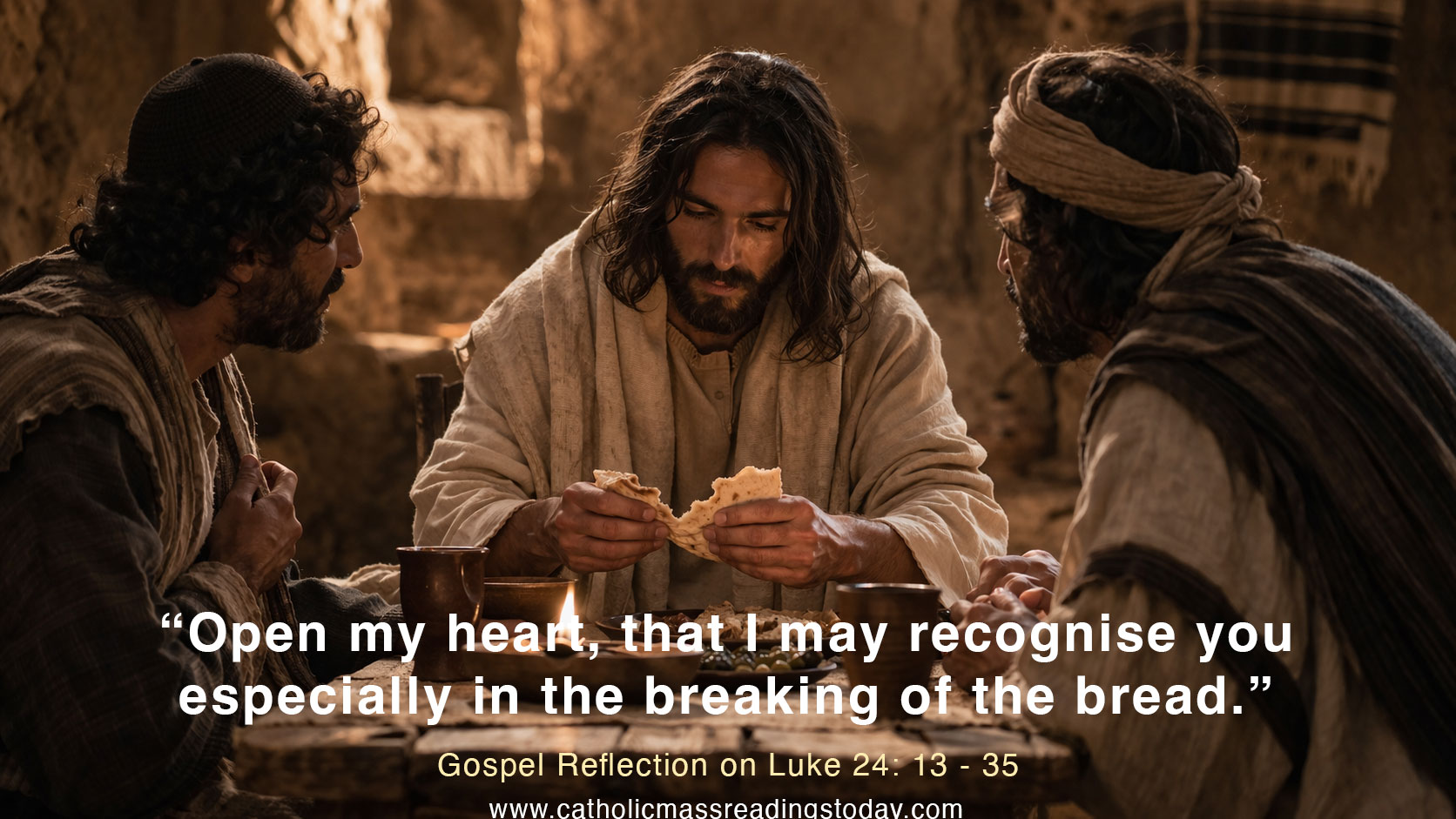
“in the breaking of the bread.”
This is not accidental. The Church has always seen in this moment a clear sign of the Eucharist. It is there, in the breaking of the bread, that they finally recognise Him. The same Jesus who walked with them, who spoke to them, is made known fully in that sacred act.
Even today, this remains true.
We encounter Christ in Scripture, yes—but we recognise Him most deeply in the Eucharist. At every Mass, the same pattern unfolds: the Word is proclaimed, our hearts are stirred, and then Christ is made present in the breaking of the bread. This Gospel is not just a story from the past, it is a reflection of what happens at every altar.
And notice what happens next.
The moment they recognise Him, He vanishes.
Not because He is gone, but because He no longer needs to be seen in the same way. Their faith has awakened. They now know where to find Him.
And immediately, they return to Jerusalem.
The same road they walked in sadness, they now retrace with urgency and joy. Encountering the Risen Christ always sends us back, not to remain where we are comfortable, but to go and share the Good News.
This speaks directly to our world today.
We live in a time where many people are, in a sense, on the road to Emmaus, walking away, confused, disappointed, questioning. Some have lost hope. Some feel that God is distant or silent. Others struggle to reconcile faith with suffering.
But this Gospel reminds us: Christ is still walking with His people.
He is present in our conversations, in our searching, even in our doubts. He speaks through Scripture. He reveals Himself in the Eucharist. And He continues to invite us, not just to recognise Him, but to become witnesses.
The question is not whether He is present.
The question is whether we are open enough to recognise Him.
And perhaps today, the simplest prayer we can make is this:
“Lord, walk with me… even when I do not see you.
Open my heart, that I may recognise you
especially in the breaking of the bread.”