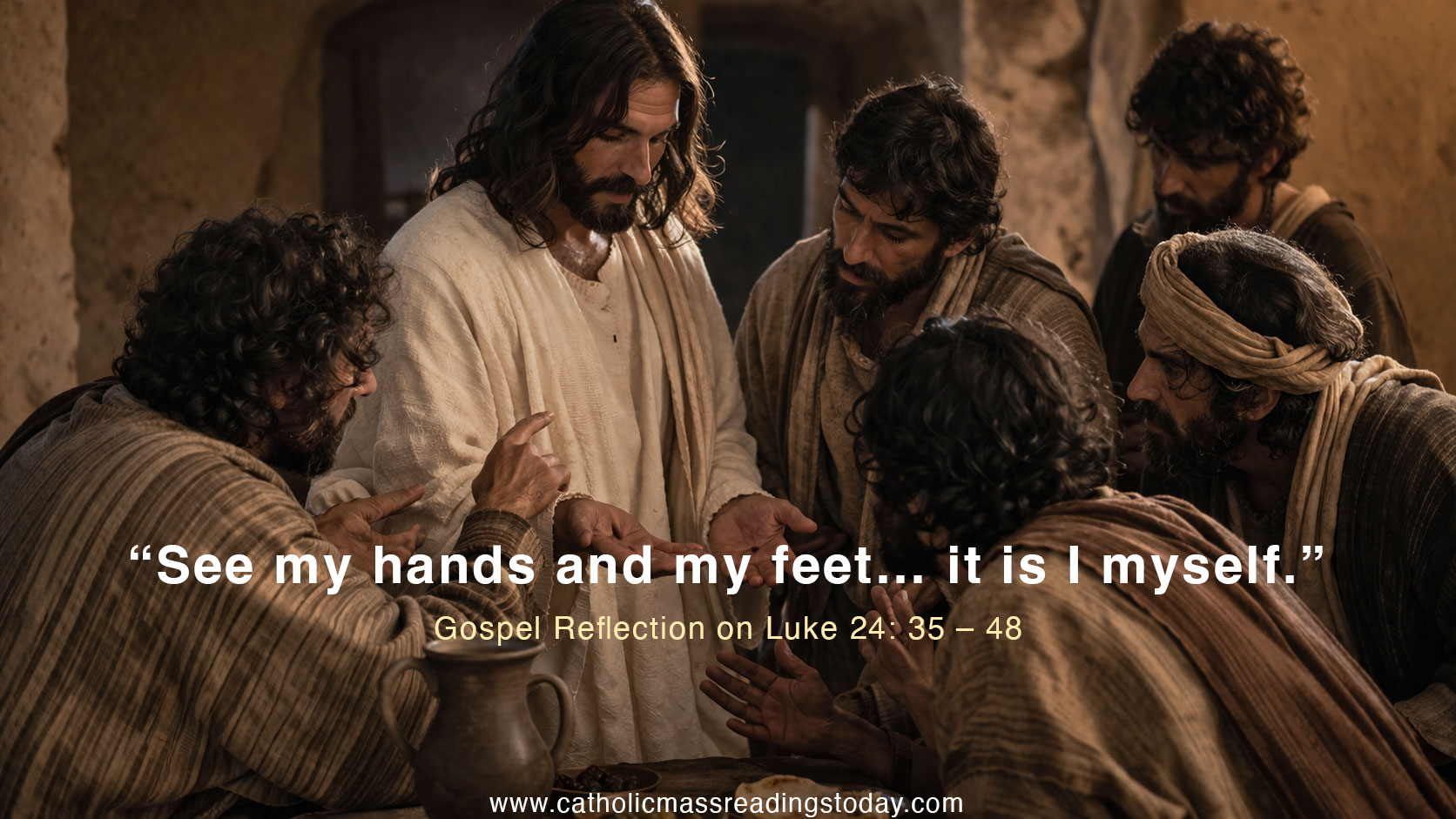
There is something striking about how this Gospel begins: the disciples are gathered together, speaking about the risen Lord and yet, when Jesus actually stands among them, they are afraid.
It is a very human reaction.
They had heard the testimony. Some had even begun to believe. But when the reality of the Resurrection stands before them, their first response is not joy, it is fear and confusion. “They were startled and frightened.” It reminds us that faith is not always instant or easy. Even those closest to Jesus struggled to grasp what God had done.
And so the first words of the risen Christ are simple, yet profound:
“Peace to you.”
This is not just a greeting. It is a gift.
The peace Christ offers is not the absence of trouble, but the presence of God in the midst of it. These men had just lived through betrayal, suffering, and the trauma of the crucifixion. Their hearts were unsettled, full of questions and doubt. Jesus does not rebuke them for this, He meets them there, gently, offering peace before anything else.
Then He invites them to see and to touch:
“See my hands and my feet… it is I myself.”
The wounds are still there.
This is important. The Resurrection does not erase the suffering of the Cross, it transforms it. The wounds of Christ are no longer signs of defeat, but of victory. In our own lives, we often wish that God would remove every trace of our struggles. But the risen Christ shows us something deeper: that even our wounds can be transformed into something meaningful, something redemptive.
He goes further still and He eats with them.
This simple act grounds everything in reality. The Resurrection is not a symbol or an idea; it is real, physical, lived. Christ is truly alive. And in doing this, He reassures them that what they are witnessing is not an illusion, but the fulfillment of God’s promise.
Then comes a moment that is easy to overlook, but deeply important:
“He opened their minds to understand the Scriptures.”
Faith is not blind. It is something that grows through understanding, through reflection, through allowing God to illuminate what we could not grasp on our own. The disciples had heard the Scriptures all their lives, but only now do they begin to truly understand them in the light of Christ’s suffering and Resurrection.
And at the heart of this understanding is a message that defines the mission of the Church:
repentance and forgiveness of sins should be preached in His name to all nations.
This is the heart of Easter.
The Resurrection is not just about Christ rising from the dead, it is about what that victory means for us. It means that sin does not have the final word. It means that forgiveness is possible. It means that no one is beyond the reach of God’s mercy.
And then Jesus says something that places a responsibility on the disciples and on us:
“You are witnesses of these things.”
To be a witness is not simply to have knowledge; it is to live in a way that reflects what we have seen and received. The disciples were not chosen because they were perfect or without doubt they were chosen because they encountered Christ and were willing, in time, to let that encounter change them.
In our world today, this call remains just as urgent.
We live in a time where many hearts are troubled, where doubt, fear, and uncertainty are common. People are searching for peace, often in places that cannot truly give it. And into this world, Christ still speaks the same words: “Peace to you.”
But He chooses to speak them through us.
Through the way we forgive.
Through the way we live with hope.
Through the way we carry our own wounds with faith.
The Resurrection is not just something we believe, it is something we are called to witness.
And perhaps the most comforting part of this Gospel is this: even in their fear and doubt, Jesus did not abandon the disciples. He came to them, stood among them, and patiently led them into faith.
He does the same with us.
So today, whatever questions may be in your heart, whatever fears you carry, hear His words again:
“Peace to you.”
And trust that the same risen Lord who stood among His disciples is still present, guiding, strengthening, and sending us out as witnesses of His mercy and His love.