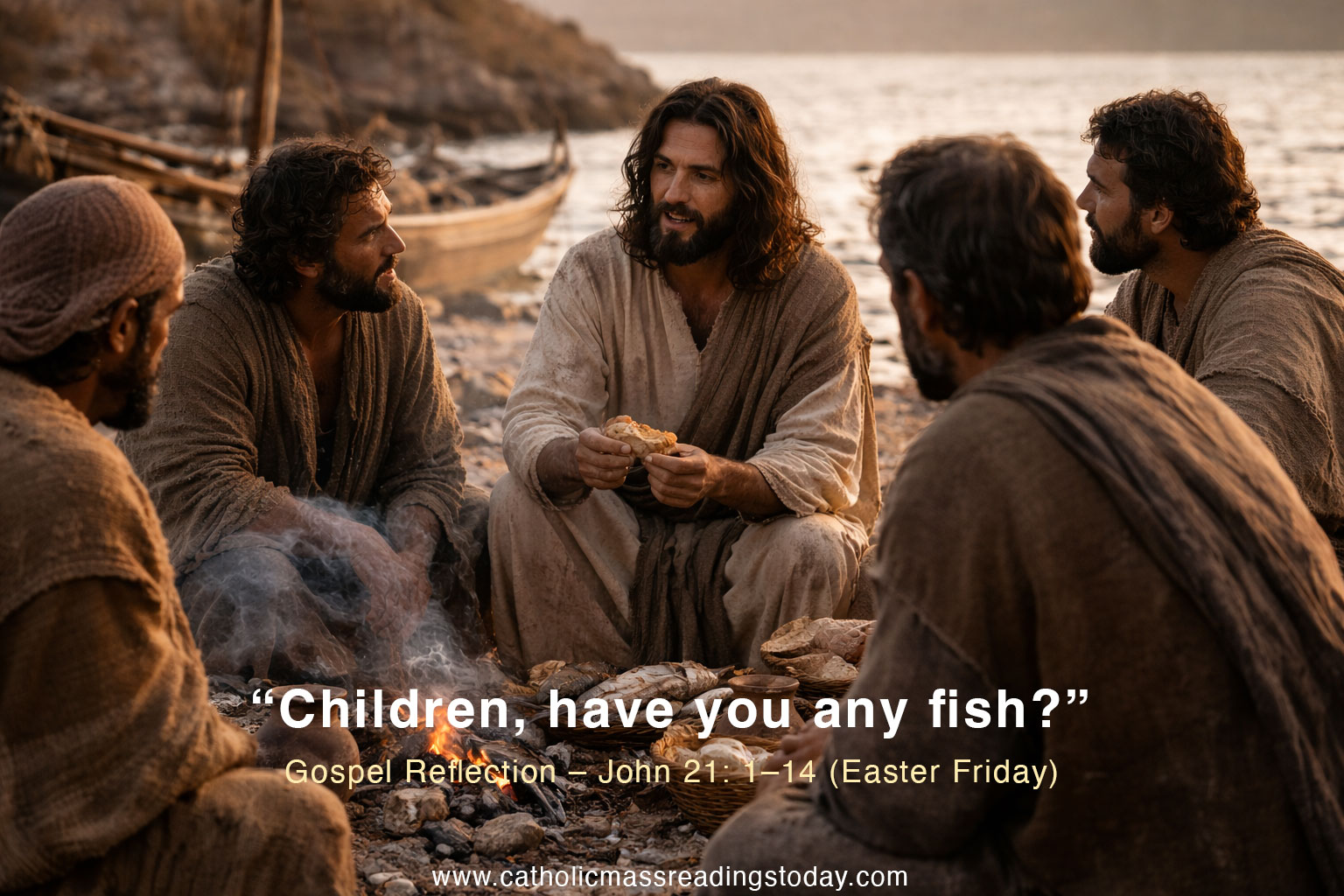
There is something quietly powerful about this Gospel.
It does not begin with miracles or crowds or preaching, but with tired men going back to what they know. After everything they had witnessed, the Passion, the Resurrection, the disciples return to fishing. It almost feels ordinary… even a little empty.
And perhaps that is the first point we are meant to notice.
They fished all night and caught nothing.
How often does that happen in our own lives? We work hard, we try our best, we return to familiar routines, yet something feels unfulfilled. Effort is there, but fruit is missing. The nets come up empty.
It is in that very moment at daybreak, in the quiet in between that Jesus appears.
Not with spectacle. Not with force.
He simply stands on the shore.
The disciples do not recognize Him at first. And this too speaks deeply to us. Because very often, the Lord is present in our lives, yet we fail to recognize Him especially when He comes in ways we do not expect.
Then comes a simple question:
“Children, have you any fish?”
It is not a question asked out of ignorance, but out of invitation. Jesus is drawing them into awareness of their need. Only when they acknowledge their emptiness are they ready to receive.
And then He gives them a direction that seems almost too simple:
“Cast the net on the right side of the boat.”
They obey.
And everything changes.
The net that was empty becomes overflowing, so full that they can barely haul it in.
Here we see a truth at the heart of the Christian life:
fruitfulness does not come from effort alone, it comes from obedience to Christ.
We can work tirelessly, but without Him, something remains lacking. Yet a single act of trust in His word can transform everything.
“It is the Lord!”
Recognition comes not through sight, but through experience.
The beloved disciple sees the sign and understands. Peter, with his characteristic love and urgency, does not hesitate, he throws himself into the water to reach Jesus.
There is something deeply human in Peter’s reaction.
He does not wait to arrive properly. He does not compose himself. He simply goes.
Love moves faster than reason.
And perhaps this is what Easter is meant to awaken in us again, not just belief, but desire. A desire to run toward the Lord, even after failure, even after confusion, even after going back to our old ways.
The Meal on the Shore
When they arrive, they find something unexpected:
Jesus has already prepared a fire.
There is already fish.
There is already bread.
Before they bring anything, He has already provided.
This moment is deeply Eucharistic.
“Jesus came and took the bread and gave it to them…”
It echoes the Last Supper. It points to the Mass. It reminds us that the risen Christ continues to feed His people, not only physically, but spiritually.
And yet, He still tells them:
“Bring some of the fish that you have just caught.”
This is important.
God provides, but He also invites us to participate. What we bring may seem small compared to what He has already prepared, but He still asks for it.
Our efforts, our work, our lives, they are not meaningless. When offered to Him, they become part of something greater.
What This Means for Us Today
In the world we live in today, many people feel like those disciples in the boat.
Busy. Trying. Searching.
Yet often coming up empty.
We live in a time of constant activity, but not always of meaning. Many cast their nets into careers, relationships, ambitions, hoping to find fulfillment. Yet something still feels missing.
This Gospel gently reminds us:
Without Christ, even our best efforts can feel empty.
With Christ, even simple obedience can bear abundance.
It also reminds us that Jesus often meets us not in extraordinary moments, but in the ordinary, at the shoreline of our daily lives.
In our routines.
In our struggles.
In our quiet disappointments.
And when He comes, He does not come to condemn, but to restore, to feed, and to invite us back into relationship.
A Final Thought
Easter is not only about the Resurrection as an event, it is about encountering the Risen Christ in our lives now.
On that shore, the disciples discovered something essential:
They were not alone.
They had not been abandoned.
And their mission was not over.
The same is true for us.
No matter how empty our nets may seem, no matter how far we feel we have gone back, Christ stands on the shore, calling, guiding, and preparing something greater than we can see.
And all He asks is this:
Trust His word.
Recognize His presence.
And come to the table He has prepared.