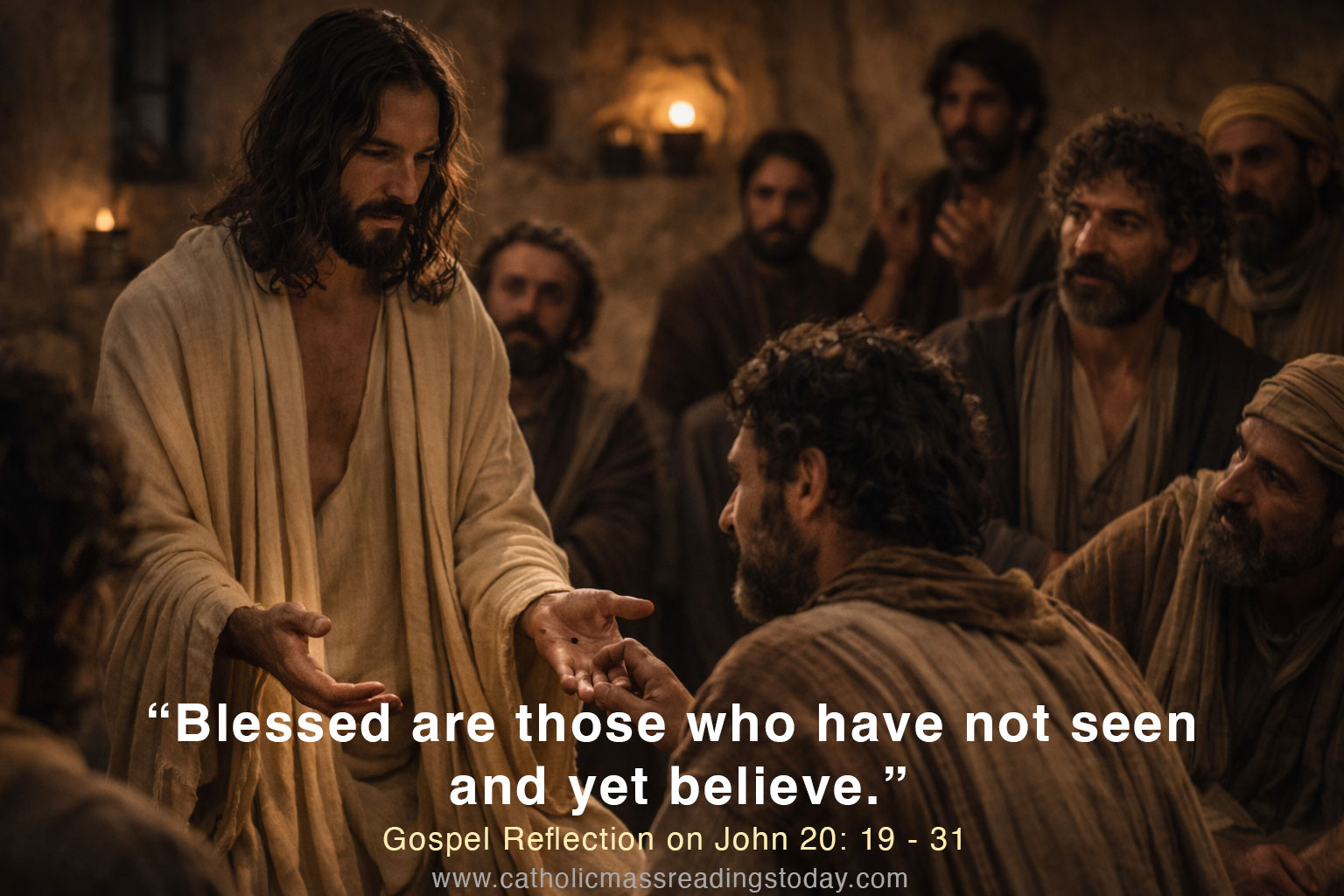
There is something deeply comforting about the way this Gospel unfolds. The disciples are gathered behind closed doors, not out of devotion, but out of fear. These are men who had walked with Jesus, witnessed His miracles, and heard His promises, yet now they are hiding, uncertain, and shaken by all that has happened.
And it is into that very place of fear that Jesus comes.
He does not wait for them to be strong. He does not wait for their faith to be perfect. He comes as they are, and His first words are not a correction, but a gift: “Peace be with you.”
This peace is not simply the absence of fear, it is the presence of Christ Himself. In the Catholic teaching, this moment carries a profound truth: the risen Lord meets us not when we have everything figured out, but precisely in our confusion, our doubts, and even our failures. His peace is not earned; it is given.
Then, in a deeply significant act, He shows them His wounds.
The wounds are not hidden. They remain. And yet they are no longer marks of defeat, they are signs of victory and mercy. This is at the heart of Divine Mercy Sunday. The Church invites us to contemplate that the same wounds that once bore suffering are now the source of grace. From His pierced side flows the mercy of God for the whole world.
Jesus then breathes on them and says, “Receive the Holy Spirit… If you forgive the sins of any, they are forgiven.”
Here we see the foundation of the Sacrament of Reconciliation. The Church has always understood this moment as Christ entrusting His mercy to His apostles, and through them to the Church. It is a reminder that God’s mercy is not abstract, it is something we can encounter personally, tangibly, again and again. No matter how far we may feel we have gone, there is always a way back.
Then we meet Thomas.
Too often, Thomas is remembered only for his doubt. But his honesty is something many of us quietly share. He refuses to pretend. He wants to see, to touch, to be sure. And what is striking is how Jesus responds, not with rejection, but with understanding. Eight days later, He returns, and this time He speaks directly to Thomas, inviting him into faith.
“Do not be faithless, but believing.”
There is no harshness in these words, only an invitation.
And Thomas, in that moment, gives one of the most profound confessions in all of Scripture:
“My Lord and my God!”
Doubt, when met with Christ, becomes faith.
This speaks powerfully to our world today. We live in a time where many struggle with belief, where questions are common, and certainty can feel distant. This Gospel reminds us that doubt is not the end of the journey, it can be the beginning of a deeper encounter with Christ, if we are willing to remain open.
Finally, Jesus says something that reaches beyond that room, beyond that moment, and directly to us:
“Blessed are those who have not seen and yet believe.”
That is us.
We have not seen Him with our eyes, yet we are invited to know Him through faith, through the Church, through the sacraments, through His Word. And on Divine Mercy Sunday, this invitation becomes even more personal: to trust in His mercy.
Not in our own strength.
Not in our own worthiness.
But in His love.
At the center of this Gospel is a simple but life changing truth: Christ is not distant. He comes into our locked rooms, into our fears, our doubts, our hidden struggles and He speaks peace. He shows us His mercy. He invites us to believe.
And perhaps the prayer that rises naturally from this reflection is the one the Church places on our lips on this day:
“Jesus, I trust in You.”
Because in the end, faith is not about having all the answers, it is about trusting the One who stands before us, wounded and risen, offering us peace and mercy that never fail.