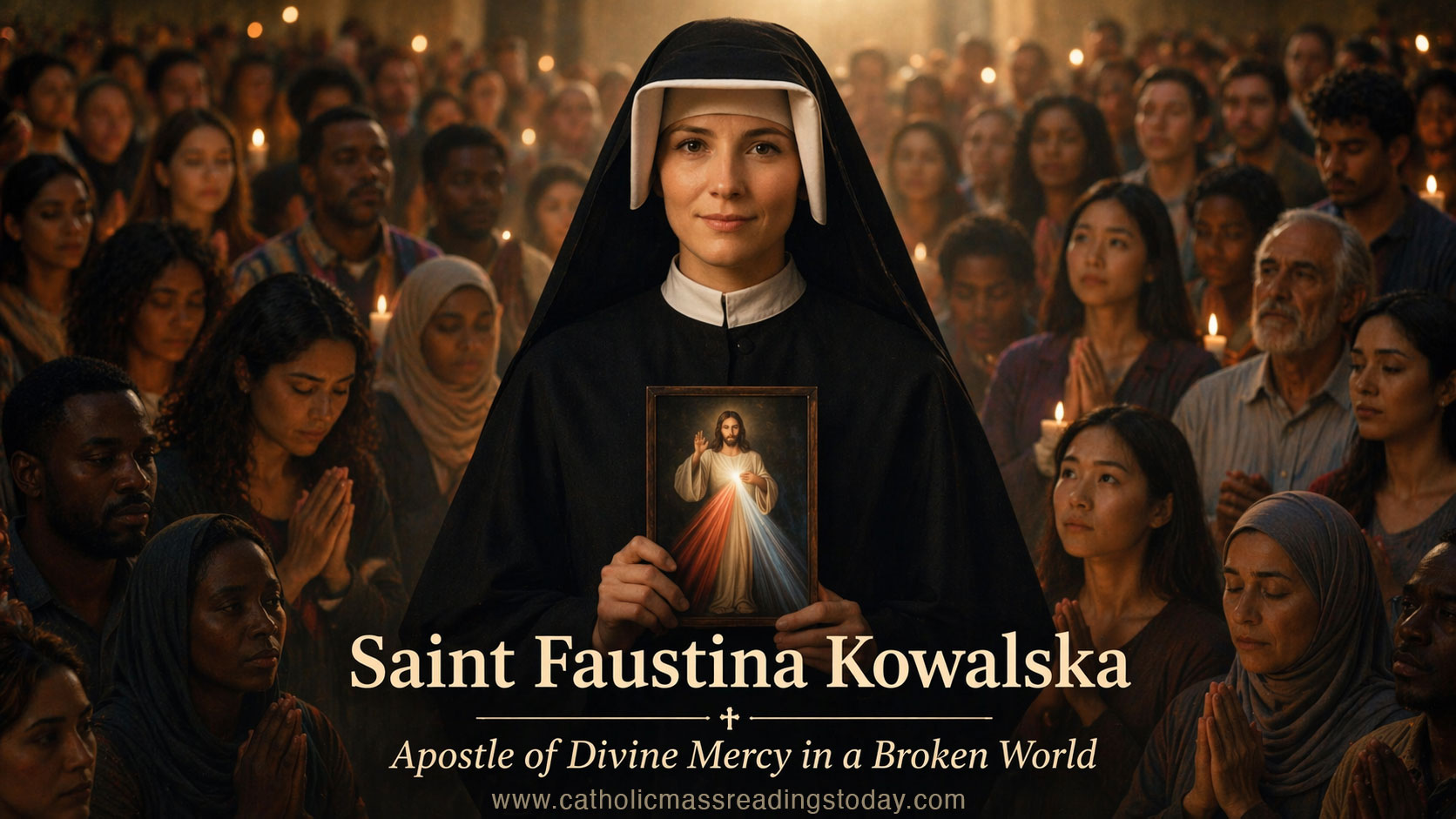
There are saints whose lives are marked by visible greatness, scholars, founders, missionaries and then there are those whose greatness is hidden, quiet, almost unnoticed by the world. Saint Faustina Kowalska belongs to the latter, yet her impact has reached every corner of the globe. From a simple life of obedience and prayer emerged one of the most powerful spiritual messages of our time: the message of Divine Mercy.
A Humble Beginning
Saint Faustina was born as Helena Kowalska on August 25, 1905, in the small village of Głogowiec in Poland. She was the third of ten children in a poor but deeply religious family. From a young age, Helena showed a sensitivity to God’s presence that set her apart. While other children were occupied with ordinary concerns, she was already drawn inward, toward prayer and silence.
Her family could not afford much, and like many young girls of her time, she worked as a housemaid to support herself. Yet even in these ordinary tasks, something extraordinary was taking place within her soul. She later wrote that she felt a persistent call to religious life, one she initially resisted, but could not ignore.
At the age of 20, after a powerful interior experience in which she felt Christ urging her to follow Him more completely, she entered the Congregation of the Sisters of Our Lady of Mercy in Warsaw. It was here that Helena became Sister Maria Faustina of the Blessed Sacrament.
A Life Hidden from the World
Faustina’s life in the convent was outwardly simple. She served as a cook, gardener, and porter, tasks that rarely draw attention or recognition. There was nothing about her external life that would suggest she would one day become known throughout the world.
But holiness is not measured by visibility.
Within the silence of her daily routine, Faustina lived a deep interior life marked by prayer, sacrifice, and an intense union with Christ. It was in this hidden life that she began to experience extraordinary mystical encounters visions of Jesus, conversations with Him, and a profound awareness of His mercy.
The Message of Divine Mercy
At the heart of Faustina’s life is the message she was entrusted to share: that God’s mercy is greater than any sin, and that humanity must turn back to Him with trust.
In her now famous Diary, titled “Divine Mercy in My Soul,” she recorded these encounters with remarkable honesty and simplicity. There is no attempt to embellish or impress but only a quiet faithfulness to what she experienced.
Jesus revealed to her that the world was in great need of His mercy, and that this mercy must be proclaimed urgently. He asked her to spread several specific devotions:
- The Divine Mercy Image, showing Jesus with rays of red and pale light flowing from His heart
- The Divine Mercy Chaplet, a prayer offered for the salvation of souls
- The Hour of Mercy (3 PM), recalling the moment of His death on the Cross
- Divine Mercy Sunday, to be celebrated on the first Sunday after Easter
But above all, He asked for something deeper than any devotion: trust.
“The graces of My mercy are drawn by means of one vessel only, and that is trust.”
Trust and Mercy: The Core of Her Spirituality
If one were to summarize Saint Faustina’s spirituality in a single phrase, it would be this: “Jesus, I trust in You.”
This trust is not naive optimism. It is not pretending that life is easy or that suffering does not exist. Faustina herself experienced illness, misunderstanding, and spiritual trials. She suffered from tuberculosis and endured periods of deep interior darkness.
Yet in all of this, she held firmly to one truth: that God is merciful, and that His mercy is always available.
At the same time, Faustina understood that receiving mercy carries a responsibility, to show mercy to others. She wrote that mercy must be lived in three ways: through our actions, our words, and our prayers.
In a world often marked by judgment, resentment, and division, her message is both challenging and necessary.
Suffering as Participation in Christ
One of the more difficult aspects of Faustina’s life is her understanding of suffering. She did not seek suffering for its own sake, but she came to see it as a way of participating in Christ’s redemptive love.
She offered her sufferings for the salvation of souls, trusting that even hidden sacrifices could bear fruit. This is a deeply Catholic understanding, that our lives, united with Christ, can become instruments of grace for others.
It is a perspective that runs counter to modern thinking, which often seeks to avoid suffering at all costs. Faustina does not glorify pain, but she shows that even suffering, when united to Christ, can be transformed into something meaningful.
Death and Recognition
Saint Faustina died on October 5, 1938, at the age of just 33. At the time of her death, she was largely unknown outside her convent.
Yet God’s plans often unfold quietly.
Years later, her diary began to spread, and the message of Divine Mercy gained recognition, especially through the support of Pope Saint John Paul II, who himself was Polish and deeply devoted to Divine Mercy. He canonized her in the year 2000 and officially established Divine Mercy Sunday for the universal Church.
Today, devotion to Divine Mercy has reached millions around the world.
A Saint for Our Time
What makes Saint Faustina so relevant today is the simplicity and urgency of her message.
We live in a world where many people carry hidden wounds, guilt, regret, broken relationships, a sense of being unworthy or beyond redemption. In such a world, the message of Divine Mercy is not just comforting, it is necessary.
Faustina reminds us that:
- No one is beyond God’s mercy
- No sin is greater than His love
- No life is too broken to be restored
But she also challenges us:
- To trust God more deeply
- To return to Him in humility
- To extend mercy to others, even when it is difficult
Conclusion: A Quiet Light That Still Shines
Saint Faustina Kowalska did not found a great movement in her lifetime. She did not travel the world or preach to large crowds. She lived quietly, faithfully, and often unnoticed.
And yet, through her, God gave the world a message that continues to transform hearts.
Her life reminds us that holiness is not about doing extraordinary things, it is about allowing God to work through us, even in the ordinary.
And her message continues to echo, perhaps now more than ever:
Trust in His mercy. Return to Him. And let that mercy flow through you to others.
In a world that often forgets compassion, Saint Faustina stands as a gentle but powerful witness that mercy is not weakness, it is the very heart of God.