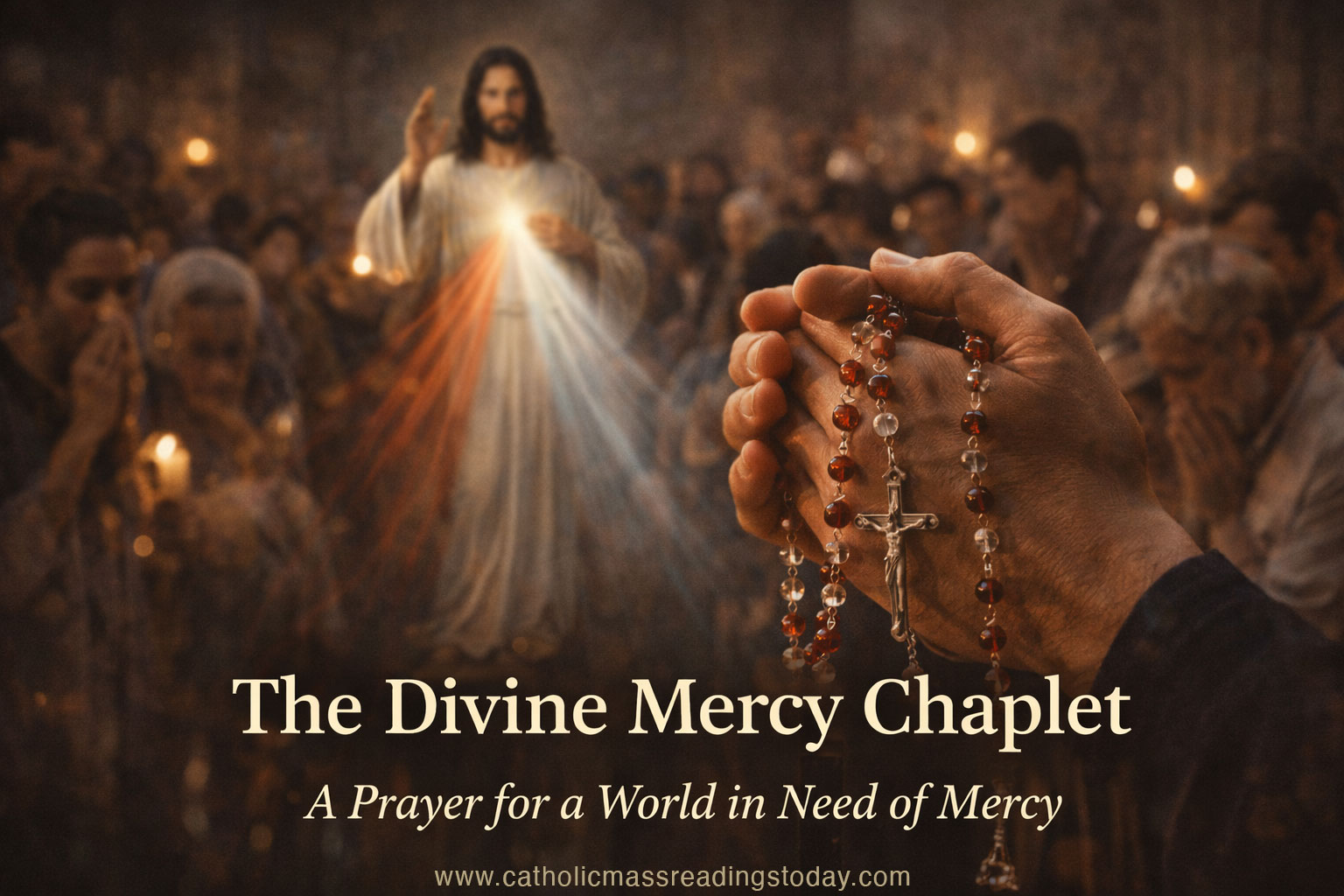
In a world often marked by anxiety, injustice, and wounded hearts, the Church offers a prayer that speaks directly to the deepest human need, the need for mercy. The Divine Mercy Chaplet is not just a devotion; it is a lifeline. Rooted in the revelations given to Saint Faustina Kowalska, this prayer draws us into the very heart of Christ, where mercy flows without limit.
The Origin of the Divine Mercy Chaplet
The Divine Mercy Chaplet was entrusted to the Church through Saint Faustina, a humble Polish nun of the early 20th century. In her diary, she recounts how Jesus revealed to her the urgency of turning to God’s mercy, especially in times of great sin and suffering.
One of the most striking moments came when Jesus taught her this chaplet as a powerful prayer for sinners and for the dying. He promised that through it, souls would obtain great mercy, especially at the hour of death. This was not presented as a private devotion alone, but as a gift for the whole Church, a prayer meant to be spread across the world.
The Structure and Meaning of the Chaplet
The Divine Mercy Chaplet is prayed using the rosary beads, yet its focus is uniquely centered on the Passion of Christ. Each word draws us deeper into the mystery of redemption.
At its heart is the offering:
“Eternal Father, I offer You the Body and Blood, Soul and Divinity of Your dearly beloved Son, our Lord Jesus Christ…”
This is not merely symbolic. It echoes the sacrifice of the Mass, where Christ offers Himself to the Father for the salvation of the world. When we pray these words, we are spiritually uniting ourselves to that same sacrifice, pleading for mercy not only for ourselves, but for the whole world.
The repeated invocation:
“For the sake of His sorrowful Passion, have mercy on us and on the whole world”
reminds us that mercy is not something we earn, it is something poured out through Christ’s suffering. Every bead becomes an act of trust, a quiet surrender to the love of God.
A Prayer for Our Times
There is something profoundly fitting about the Divine Mercy Chaplet in today’s world. We live in a time where many feel lost, burdened by guilt, or disconnected from God. Others carry wounds inflicted by injustice, betrayal, or hardship.
The Chaplet speaks into all of this.
It teaches us that no sin is greater than God’s mercy. It reminds us that no situation is beyond redemption. And perhaps most importantly, it calls us to become people of mercy ourselves.
In praying the Chaplet, we are not only asking for mercy, we are being formed by it. Slowly, gently, our hearts begin to change. We become more patient, more forgiving, more compassionate. The prayer does not leave us where we are; it transforms us.
The Hour of Mercy
Jesus asked that the Chaplet be prayed especially at 3:00 p.m., the Hour of Mercy, the hour of His death on the cross. At this moment, the Church pauses to remember the price of our salvation.
Praying the Chaplet at this hour carries a special depth. It is a time to step away from the noise of the day and stand, even briefly, at the foot of the Cross. There, we are reminded that mercy is not cheap, it is born from love that was willing to suffer.
A Mission for Every Christian
The Divine Mercy Chaplet is not reserved for a select few. It is simple enough for anyone to pray, yet deep enough to sustain a lifetime of reflection. Whether prayed alone in silence, with family at home, or in a church before the Blessed Sacrament, it becomes a powerful act of intercession.
The Church, especially through the celebration of Divine Mercy Sunday, continues to invite the faithful to embrace this devotion. It is a call not only to pray, but to trust, to trust that God’s mercy is greater than our fears, our failures, and even our doubts.
Living the Chaplet
Ultimately, the Divine Mercy Chaplet is meant to extend beyond the words we say. It is meant to shape how we live.
To pray for mercy is also to give mercy.
To receive forgiveness is also to forgive.
To trust in God’s love is also to reflect that love to others.
In a world that often chooses judgment, the Chaplet calls us to choose compassion. In a culture that can be quick to condemn, it invites us to become instruments of healing.
Conclusion
The Divine Mercy Chaplet is one of the Church’s greatest treasures for our time. It is simple, yet profound. Quiet, yet powerful. Personal, yet universal.
In praying it, we stand before God not as perfect people, but as children who know they need mercy and who believe, with confidence, that it will be given.
And perhaps that is its greatest gift: it teaches us not just how to pray, but how to hope.