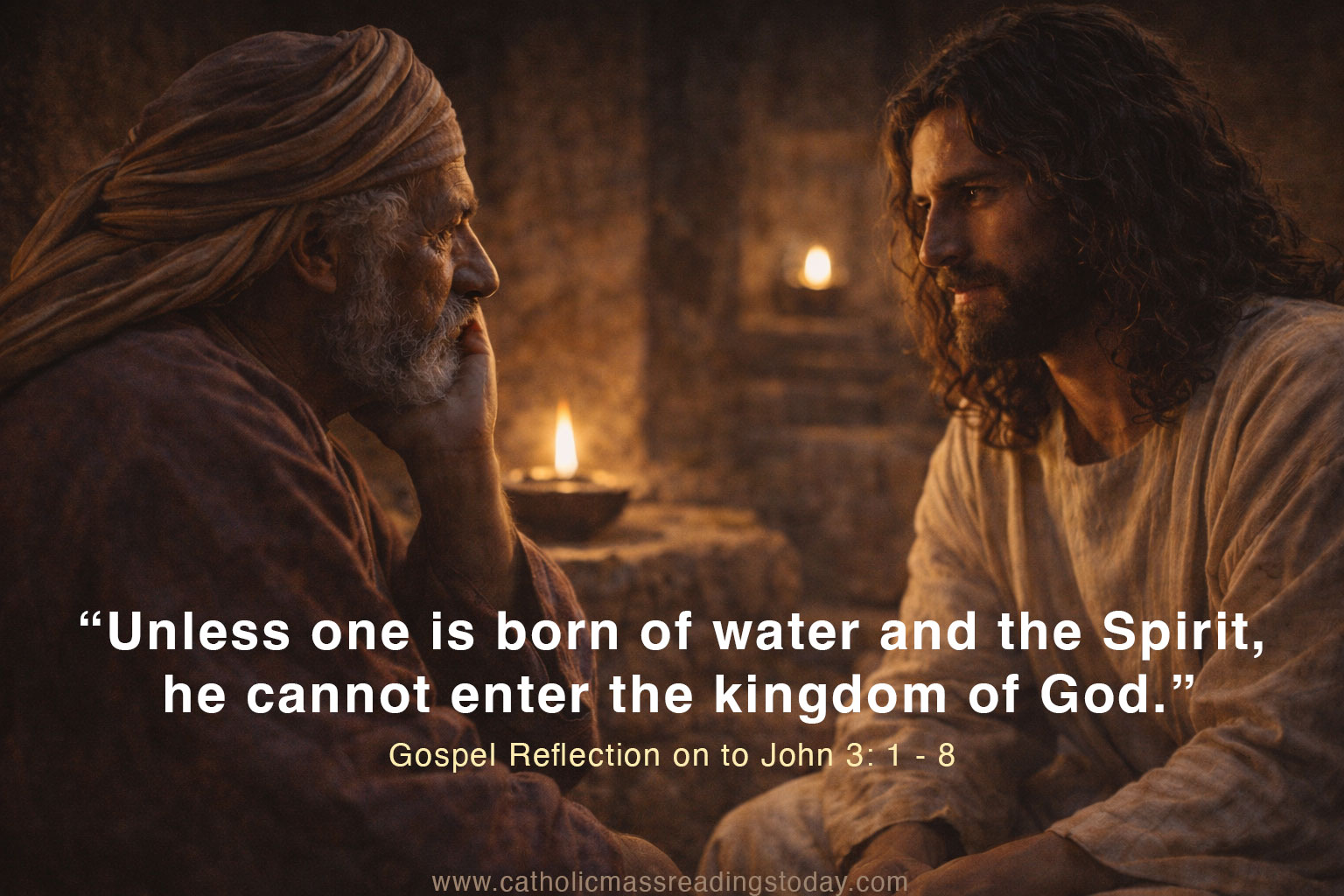
There is something deeply human about Nicodemus in this Gospel. He is a learned man, a leader, someone who understands the law and the traditions, yet he comes to Jesus at night, quietly, almost cautiously. It is the kind of moment many of us can relate to: when questions about faith rise within us, but we are not quite ready to ask them openly.
Nicodemus recognizes that there is something different about Jesus. He sees the signs, the authority, the presence of God at work. And yet, understanding does not come easily. When Jesus speaks of being “born anew,” Nicodemus hears it in a purely human way. He thinks in terms of what is visible, logical, and physically possible. “How can a man be born when he is old?” he asks.
Jesus, however, is inviting him and us into a deeper reality.
To be “born of water and the Spirit” is not about starting life over in a human sense. It is about transformation. In the teaching of the Church, this points clearly to the Sacrament of Baptism, where we are reborn not by our own effort, but by the grace of God. Through water and the Holy Spirit, we are brought into a new life, one that is no longer defined only by the flesh, but by the Spirit.
This is where the Gospel becomes very real for us today.
We live in a world that often emphasizes control, clarity, and certainty. We want to understand everything, to measure it, to explain it. But the life of the Spirit does not always work that way. Jesus uses the image of the wind, something we cannot see, yet we know it is there by its effects. It moves freely, beyond our control, beyond our full understanding.
Faith, in many ways, is like that.
To live by the Spirit is to accept that God is at work even when we do not fully understand how. It is to trust that transformation is happening within us, even when we cannot see immediate results. It is to allow God to lead us beyond what is comfortable or familiar.
Nicodemus came to Jesus in the darkness of night, but that encounter was the beginning of something new in him. Later in the Gospel, we see glimpses that his heart was changing, that he was slowly stepping into the light.
And perhaps that is where this Gospel meets us most personally.
We all have moments of darkness, times of doubt, confusion, or hesitation. We may come to God quietly, with questions we are not even sure how to ask. But Jesus does not turn Nicodemus away. He meets him there, patiently, and invites him deeper.
The same is true for us.
To be “born anew” is not a one time feeling or emotional moment. It is a lifelong journey. It is the daily choice to live as children of God, to forgive when it is hard, to trust when things are uncertain, to love when it costs us something.
It is, in the end, a surrender.
A surrender of our need to fully control or fully understand, and a willingness to let God work within us in His own way, in His own time.
And so this Gospel leaves us with a quiet but powerful invitation:
to step out of the darkness, to open our hearts, and to allow the Spirit of God to give us new life again and again.