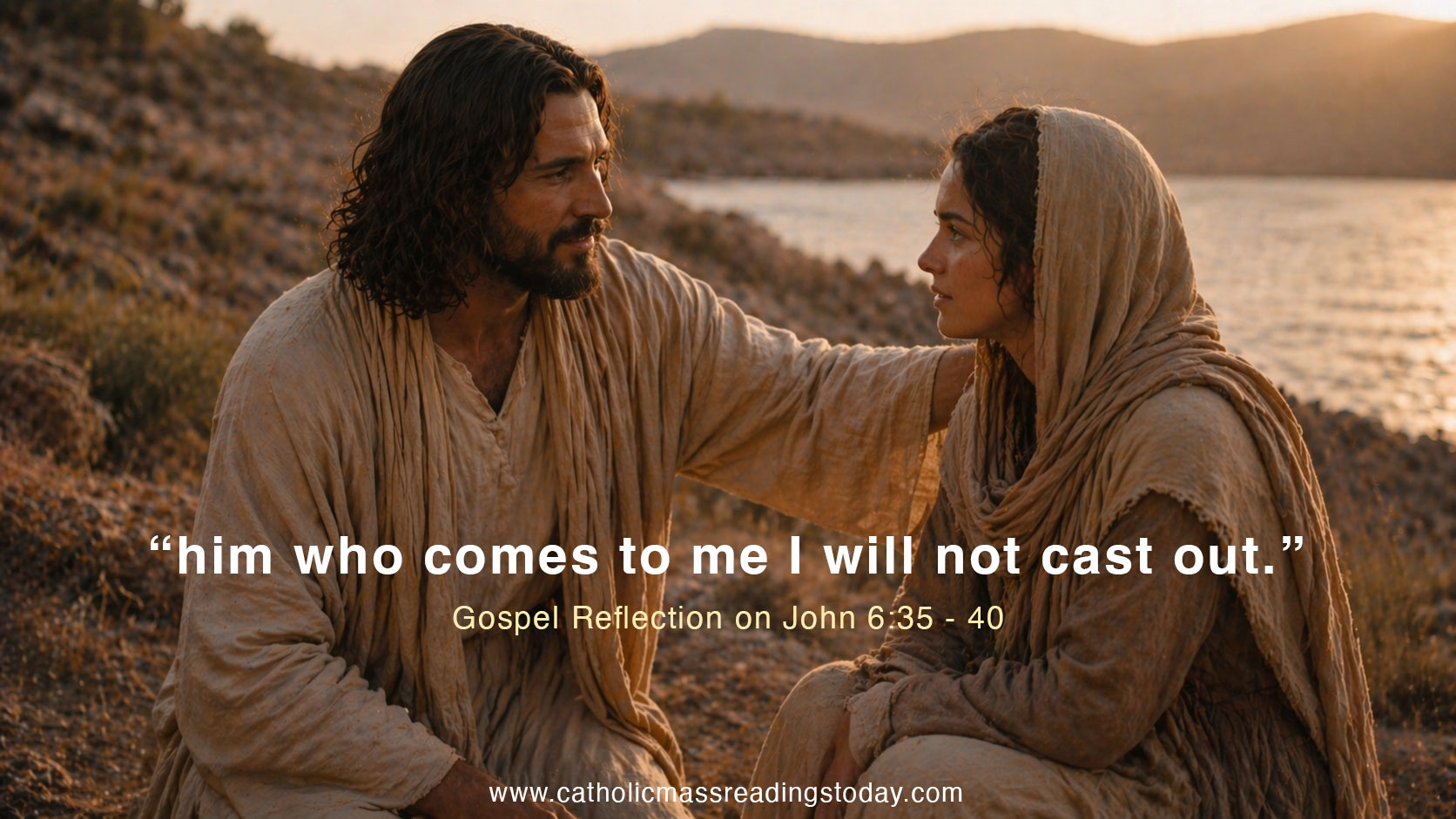
There is something deeply reassuring in this Gospel, almost like a steady voice speaking into the fears we carry quietly within us.
Jesus says, “him who comes to me I will not cast out.”
Those words alone are enough to stop us in our tracks.
Because if we are honest, many of us carry a hidden fear that we are not enough, that we have failed too many times, wandered too far, or grown too weak in faith to truly belong. We may not say it out loud, but it lingers in the background: What if I come to God and I am turned away?
And here, Jesus answers that fear directly.
He does not say, “I might receive you,” or “only if you are worthy.”
He says, “I will not cast you out.”
In the Catholic teaching, this reveals the very heart of God’s mercy. Christ is not distant or selective in His love. He came precisely to gather, to restore, to bring back what is lost. His mission is not to reject, but to save.
And then He goes even further.
“This is the will of him who sent me, that I should lose nothing of all that he has given me.”
Think about that for a moment. God’s will is not vague or uncertain, it is personal. It includes each one of us. You are not just part of a crowd in God’s eyes. You are known, desired, and held within His will.
To say that He will “lose nothing” is to say that your life matters to Him in a way we often struggle to understand. Even in our brokenness, even in our doubts, even in our moments of weakness, He does not let go easily.
This is the kind of love that does not give up.
And at the center of it all is this powerful image:
“I am the bread of life.”
Jesus is not offering something external. He is offering Himself as the source of life, the one who nourishes the soul in a way nothing else can. In the Catholic life, this becomes most real in the Eucharist, where this promise is not just spoken, but lived. We do not simply remember Christ, we receive Him.
And yet, there is a quiet tension in this Gospel.
Jesus says, “you have seen me and yet do not believe.”
It is possible to be close to Christ and still not truly trust Him. To hear His words, to know about Him, even to follow outwardly, and yet keep a distance in the heart.
Belief, as the Church teaches, is not just about seeing, it is about surrender. It is choosing to trust Him, even when things are unclear. It is allowing His will to become more important than our own.
And that is where this Gospel gently challenges us:
Do I truly believe that Christ is enough for me?
Do I trust that He will not cast me out?
Do I live as someone who is being led toward eternal life?
Because this promise is not only about the end of time. It begins now. Eternal life is already taking root in us when we live in communion with Christ, when we come to Him, trust Him, and remain in Him.
And then comes that final, powerful assurance:
“I will raise him up at the last day.”
This is the hope that anchors everything. No matter what we face, no matter how uncertain life becomes, our story is not heading toward loss, it is heading toward resurrection.
Christ does not just walk with us through life. He carries us beyond it.
Let us Pray
Lord Jesus,
You are the Bread of Life,
the one who satisfies the deepest hunger of our hearts.
So often we come to You with doubts, with fears,
and with the weight of our own shortcomings.
Yet You remind us that You will never cast us out.
Help us to trust in Your mercy.
Help us to believe not only with our minds,
but with our lives.
Draw us closer to You each day,
especially in the Eucharist,
where You give Yourself to us completely.
Hold us in Your love, Lord,
and keep us faithful,
until the day You raise us up to eternal life.
Amen.