There is a quiet mystery at the heart of this Gospel, one that we don’t grasp all at once, but are slowly drawn into.
Jesus begins by saying something that can feel both comforting and unsettling:
“No one can come to me unless the Father who sent me draws him.”
Faith, then, is not something we manufacture on our own. It begins with God. Long before we start searching for Him, He is already at work within us, nudging, calling, stirring something in our hearts. That quiet desire to pray, that longing for meaning, that restlessness when life feels empty, these are not accidents. They are signs that God is drawing us closer.
And yet, we still have to respond.
God does not force Himself upon us. He invites. He teaches. He patiently waits for our hearts to open.
Jesus goes on to say, “Every one who has heard and learned from the Father comes to me.” In the Catholic understanding, this reminds us that faith grows through listening, through Scripture, through the teachings of the Church, through prayer, and through the quiet work of grace within us. It is a journey of learning to recognize God’s voice and trusting it.
Then comes the heart of the message:
“I am the bread of life… I am the living bread which came down from heaven.”
These are not just poetic words. They are a revelation.
The people listening to Jesus would have remembered the manna in the desert, bread given by God to sustain His people day by day. It was miraculous, yet temporary. It kept them alive, but it could not give them eternal life.
Jesus is saying: what you received then was only a sign. I am the fulfillment.
In Catholic teaching, this passage points us directly to the Eucharist. Jesus is not speaking symbolically when He says, “the bread which I shall give for the life of the world is my flesh.” He is preparing His listeners and us for a reality that goes beyond human understanding: that He will give Himself, fully and truly, as our spiritual nourishment.
This is where the Gospel becomes deeply personal.
Because it is one thing to hear these words. It is another to live them.
Do we really believe that Christ is enough to satisfy the deepest hunger of our hearts?
Do we approach the Eucharist with the awareness that we are receiving not just bread, but Christ Himself?
Do we allow that encounter to change us?
So often, we try to fill our lives with things that cannot last, success, comfort, recognition, control. And yet, the more we chase them, the more we realize they cannot sustain us. They are like the manna, good for a time, but not enough.
Only Christ is enough.
And still, His invitation remains simple and open:
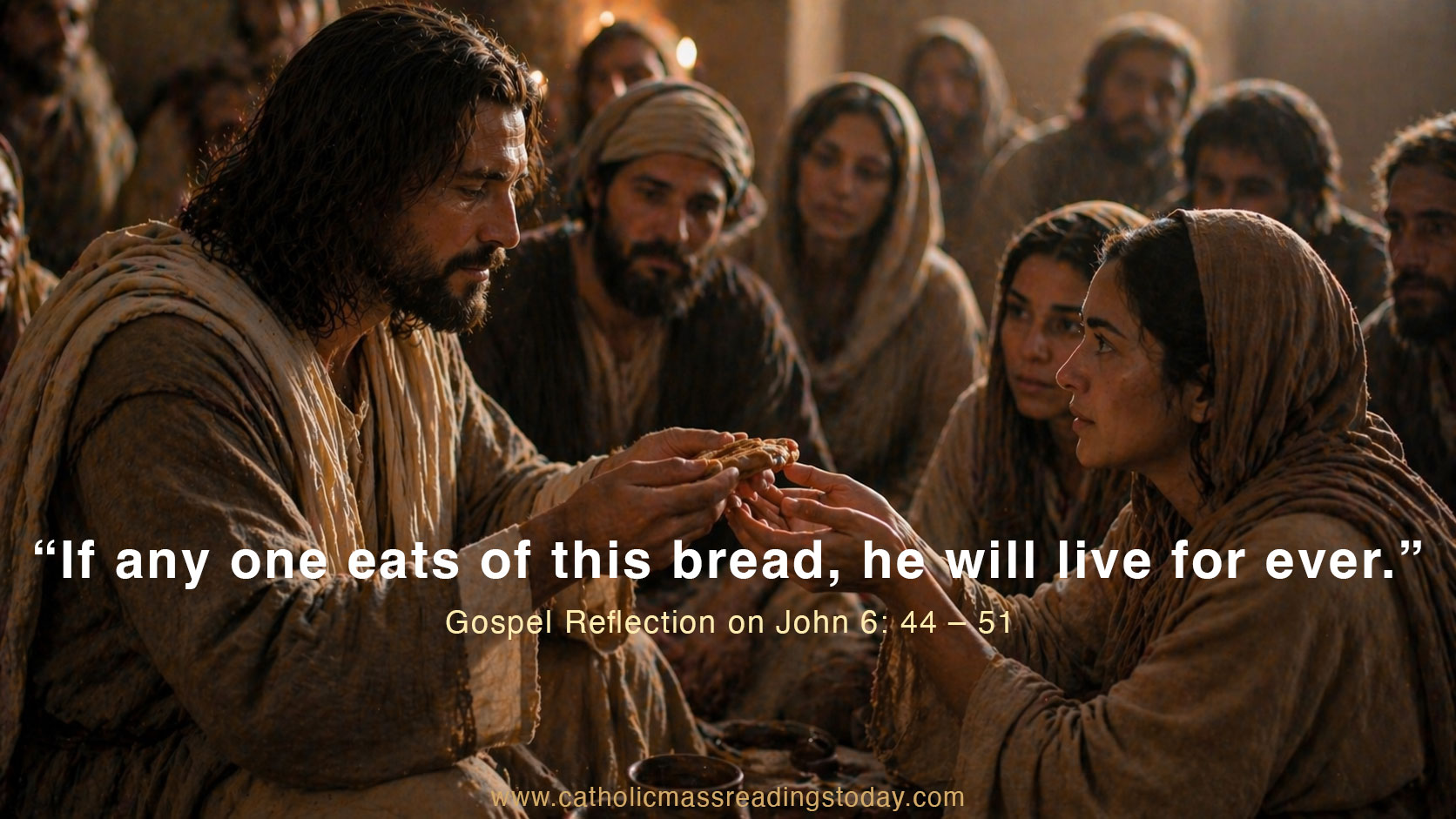
“If any one eats of this bread, he will live for ever.”
There is no complexity in the invitation, only depth. To “eat this bread” is not just to receive Him outwardly, but to allow Him to become part of our lives, to trust Him, to follow Him, to remain in Him.
And then comes that promise that holds everything together:
“I will raise him up at the last day.”
This is our hope. Not just that life will improve, not just that we will find peace here and now—but that our lives are moving toward something eternal. That nothing given to God is lost. That even death itself does not have the final word.
Christ does not simply feed us for the journey, He carries us to its fulfillment.
Let us Pray
Lord Jesus,
You are the living bread come down from heaven,
the one who alone can satisfy the hunger of our hearts.
Draw us closer to You,
even when we do not fully understand.
Open our hearts to hear Your voice
and to trust in Your presence.
Teach us to approach You with faith,
especially in the Eucharist,
where You give Yourself to us completely.
Nourish us, strengthen us,
and lead us on the path to eternal life.
And when our journey is complete,
raise us up, as You have promised,
to live with You forever.
Amen.