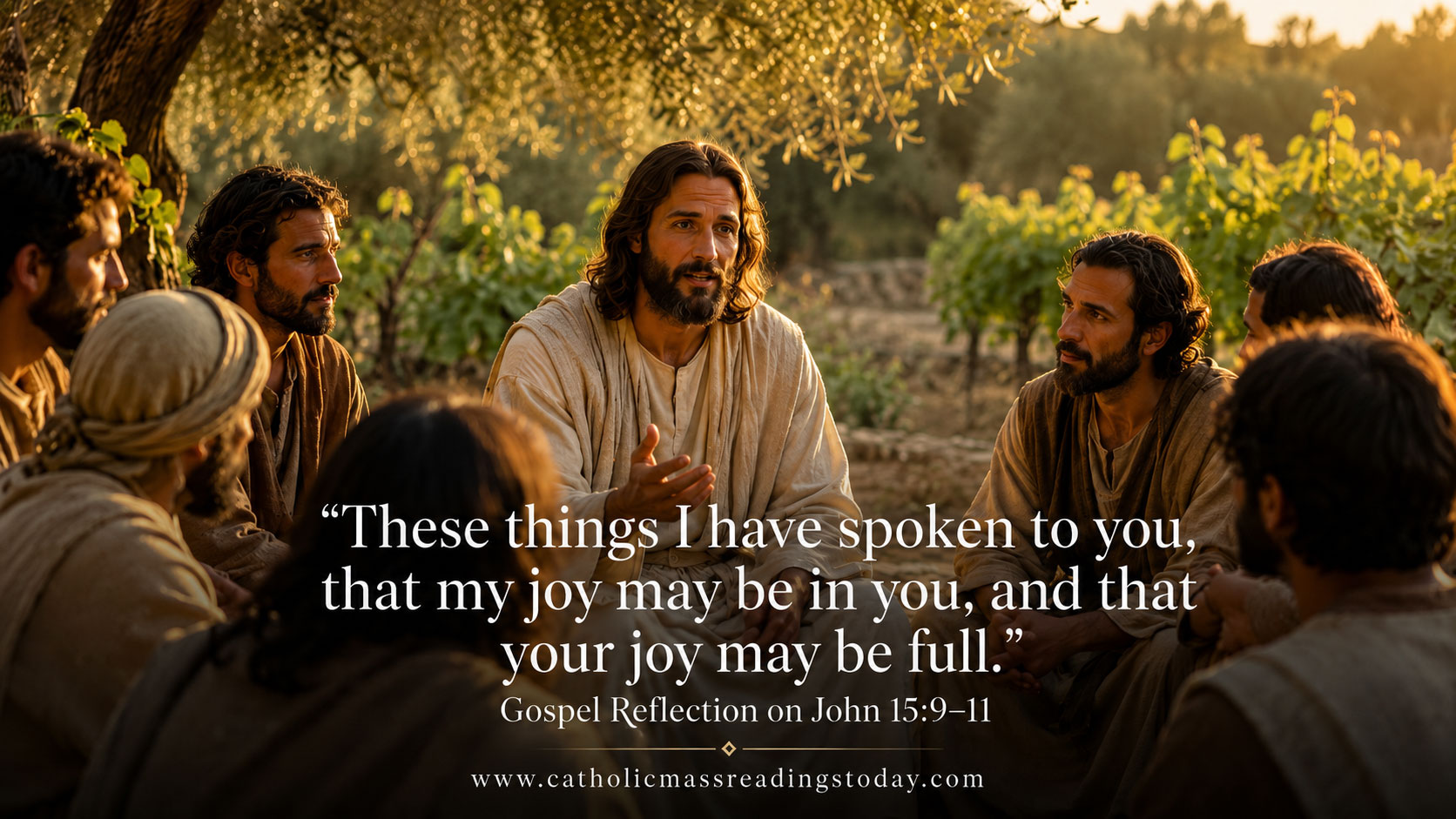
In this brief Gospel, the Lord gives us words that are both simple and inexhaustible: “As the Father has loved me, so have I loved you; abide in my love.” There are passages of the Gospel that seem to open before us like a vast horizon, and this is surely one of them. In only a few lines, Jesus leads us into the mystery of divine love, the meaning of obedience, and the true source of Christian joy.
These words are spoken not in abstraction, but in the intimacy of farewell. The Lord is preparing His disciples for what is to come. He knows that the Cross is near. He knows that confusion, sorrow, and fear will test their hearts. And what does He choose to speak of in that hour? Love. Not merely their love for Him, but first His love for them. Indeed, even more deeply, the love that flows from the Father to the Son.
“As the Father has loved me, so have I loved you.”
We should pause before these words. They are astonishing. Jesus does not say simply that He loves us kindly, or greatly, or faithfully, though all of this is true. He says that the very love with which He is loved by the Father is the measure and source of the love He now gives to His disciples. This means that the Christian life begins not with our striving, but with an undeserved gift. Before we act, before we respond, before we prove anything, we are loved. And not with a small love, not with a conditional love, not with a weary tolerance, but with a love that has its source in the eternal communion of the Father and the Son.
This is one of the deepest truths of the Gospel, and one of the easiest to hear without truly receiving. Many people believe, in theory, that Christ loves them. Yet inwardly they continue to live as though they must earn His regard, defend their worth, or carry their lives without the confidence of being loved by God. The Lord’s words cut through this fear. The Christian is not first one who performs for God, but one who receives from God. The disciple is first the beloved.
And yet Jesus does not stop there. He adds the command: “Abide in my love.” To be loved by Christ is pure gift. To abide in that love requires a response. The Lord does not treat us as passive recipients of sentiment. He invites us into communion. To abide means to remain, to dwell, to stay, to make one’s home. The Christian life is not meant to be a series of brief encounters with grace interrupted by long stretches of forgetfulness. It is meant to become a stable dwelling in the love of Christ.
This raises an important question: how does one abide in His love? The Lord answers with great clarity: “If you keep my commandments, you will abide in my love, just as I have kept my Father’s commandments and abide in his love.”
Here the Gospel corrects one of the great misunderstandings of our time. Love is often reduced to feeling, preference, or emotional warmth. But Jesus reveals that love and obedience are not enemies. In fact, love reaches its maturity in fidelity. To abide in His love is not merely to feel close to Him, nor to speak of Him affectionately, nor to admire His teaching from a distance. It is to keep His commandments. It is to let His word shape the concrete pattern of our life.
This is not because Christ is less loving than we hoped, but because His love is truer than sentiment. Real love desires union, and union requires conformity. If we love Him, we cannot wish to remain unchanged. If we want to abide in His love, then His commandments cannot be optional decorations placed on the edges of our life. They become the road by which our love is made real.
This too is deeply Catholic. The Church has never opposed love and truth, grace and commandment, mercy and moral life. She knows that Christ does not free us from obedience; He frees us for obedience. He does not abolish the commandments; He fulfills them in love and teaches us to live them from within. His grace does not excuse us from holiness. It makes holiness possible.
And notice that Jesus Himself is our model here: “Just as I have kept my Father’s commandments and abide in his love.” The Son reveals that obedience is not humiliation, but filial love. He does not obey as a servant crushed by power, but as the Beloved Son who entrusts Himself wholly to the Father. His obedience is living, loving, and free. In Him, we see that the deepest freedom is not found in self-assertion, but in loving surrender to the will of God.
This is a truth the modern world often resists. We are told that freedom means being answerable only to ourselves, shaping truth according to preference, and guarding autonomy above all. But Christ reveals another freedom: the freedom of remaining in the Father’s love through obedience. He shows us that the heart does not become larger by resisting God, but by belonging to Him.
Then the Lord says something very beautiful and very important: “These things I have spoken to you, that my joy may be in you, and that your joy may be full.”
How striking that after speaking of commandment and obedience, Jesus speaks of joy. The world often imagines that joy lies elsewhere, in self indulgence, independence, novelty, possession, or escape from obligation. Yet the Lord teaches the opposite. True joy is found not outside the love of God, but within it. The commandments are not barriers to joy. They are the way by which joy is protected and made full.
This is crucial, because many people, even sincere believers, secretly imagine holiness as noble but joyless. They assume that if one gives oneself fully to God, something essential to human happiness must be lost. But Christ says the exact contrary. His desire is not that our joy be reduced, but that it be fulfilled. The life of grace is not the enemy of joy. It is its deepest source.
Of course, the joy of which He speaks is not the same as constant emotional uplift or a life free from pain. Jesus Himself is moving toward the Cross as He says these words. The joy He gives is deeper than passing consolation. It is the joy of communion, the joy of belonging to the Father, the joy that remains even when suffering is real. Christian joy is not fragile because it is not built on circumstance. It is rooted in love that does not change.
This means that even in times of sorrow, dryness, confusion, or trial, a deep current of joy can remain within the soul that abides in Christ. Not superficial cheerfulness, not forced positivity, but a steady and hidden gladness that comes from knowing one is held in the love of God. The saints knew this well. Their lives were not spared suffering, but many of them radiated joy precisely because suffering had not separated them from Christ.
This Gospel therefore speaks powerfully to the needs of our own time. We live in a world that is both hungry for love and suspicious of commitment, eager for happiness yet often unable to recognize where true joy is found. Many search for fulfillment in experiences that cannot endure, in affirmations that cannot sustain, and in freedoms that leave the heart more restless than before. Jesus speaks into that confusion with serene authority: remain in My love. Keep My commandments. There your joy will become full.
It is worth asking, then, what prevents us from abiding. Sometimes it is distraction, a life so scattered that the soul seldom becomes still before God. Sometimes it is attachment to sin, patterns of life we do not wish to surrender. Sometimes it is fear, fear that if we really give ourselves to Christ, He will ask more than we wish to give. Sometimes it is discouragement, the weary feeling that our failures have made abiding impossible.
But the Lord’s words remain an invitation, not a rejection. He does not say, “Become perfect, and then come.” He says, “Abide in my love.” The branch does not begin by proving its worth; it remains attached to the vine. So too the Christian life is sustained not by flawless performance, but by continual return. Again and again, we come back to Him in prayer, in repentance, in the sacraments, in trust, in fidelity to His word. And there, slowly but truly, the heart begins to dwell where it was always meant to dwell.
For Catholics, this abiding takes flesh especially in sacramental life. We abide in Him through the Eucharist, where the love of Christ is not merely remembered but given. We abide in Him through confession, where what has ruptured communion is healed by mercy. We abide in Him through prayer, where love becomes personal and living. We abide in Him through fidelity to the commandments, where the shape of our daily life begins to reflect the one we claim to love.
The Church herself must also hear this Gospel as a summons. She will bear convincing witness to the world only if she remains in the love of Christ. Her mission cannot be sustained by strategy alone, nor by activity, nor by institutional strength. If she does not abide, she will become restless and thin. But if she remains in Him, then the world will encounter through her not merely words about Christ, but something of His own joy.
And this is perhaps the final grace of the passage: Jesus does not merely offer us a joy that comes from Him. He says “that my joy may be in you.” He wants to place His own joy within us. The Christian life is not simply moral effort in the hope of eventual reward. It is already a participation in the life of Christ. His love becomes our dwelling; His joy becomes our strength; His obedience becomes our path.
So this Gospel leaves us with a simple but life defining call: remain.
- Remain when prayer is easy, and remain when it is dry.
- Remain when obedience is clear, and remain when it is costly.
- Remain when joy is felt, and remain when joy must be carried in faith.
- Remain in His love.
For in that abiding, the soul discovers not less life, but more.
Not less freedom, but true freedom.
Not less joy, but joy made full.
Let us Pray
Lord Jesus Christ,
You have loved us with a love deeper than we can measure,
a love that flows from the heart of the Father Himself.
Teach us to abide in that love.
When we are distracted, call us back.
When we are fearful, reassure us.
When we are tempted to seek joy apart from You,
draw us again to the path of life.
Give us hearts that are faithful in keeping Your commandments,
not from fear alone,
but from love that desires to remain close to You.
May Your word take root in us,
Your grace strengthen us,
and Your joy live within us.
In a restless world,
make us people who dwell in Your love.
In a wounded world,
make us witnesses to the joy that comes from belonging to You.
And when obedience is difficult,
remind us that nothing You ask is outside the love You give.
You who live and reign with the Father
in the unity of the Holy Spirit,
God for ever and ever.
Amen.