This Gospel is not an easy one, but it is a necessary one. The Lord speaks with great clarity to His disciples: “If the world hates you, know that it has hated me before it hated you.” These are not words meant to frighten, but to strengthen. They are not spoken to take away peace, but to prepare the heart for fidelity. Christ does not deceive His disciples with false promises of comfort or worldly success. He tells them the truth: to belong to Him is a grace beyond measure, but it also brings with it a real cost.
In every age, there is a temptation to seek a Christianity without that cost, a Christianity admired by the world, welcomed by every power, approved by every culture, and emptied of anything that provokes resistance. But the Gospel does not permit such illusions. If Christ Himself, who is Truth and Love incarnate, was rejected, misunderstood, and persecuted, then those who truly belong to Him should not be surprised if they too experience opposition.
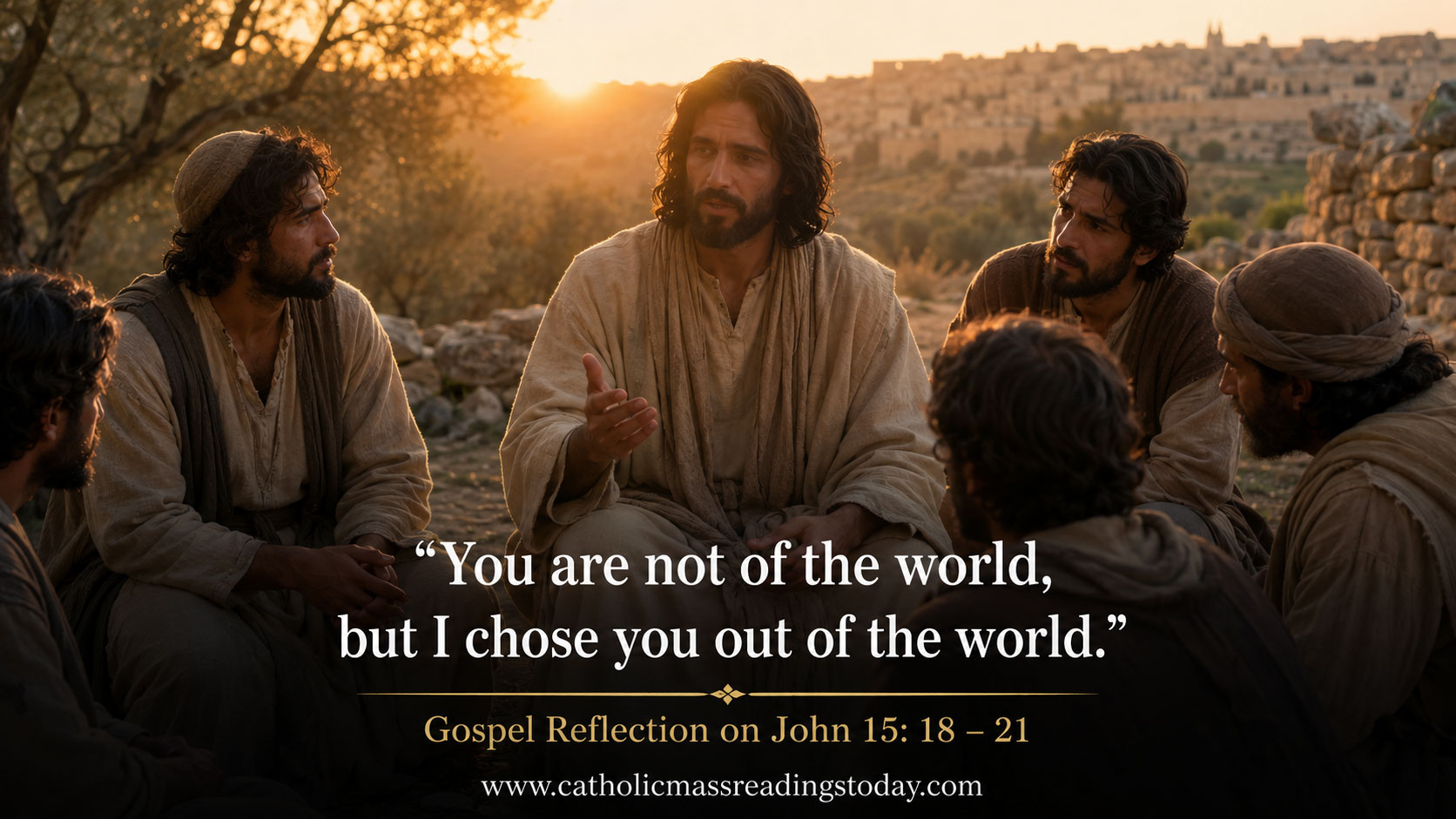
The Lord says, “If you were of the world, the world would love its own; but because you are not of the world, but I chose you out of the world, therefore the world hates you.” These words go to the heart of Christian identity. The disciple lives in the world, but does not belong to it in the deepest sense. This does not mean contempt for the world as God’s creation. It does not mean fleeing human life, rejecting society, or withdrawing from love and responsibility. The Church has never taught hatred of the world in that sense, because the world is the place God so loved that He sent His Son into it.
Rather, Jesus is speaking of “the world” as that pattern of life closed in upon itself, a world shaped by pride, falsehood, self worship, injustice, moral blindness, and resistance to God. To belong to Christ is to be drawn out of that order and into another way of living: the way of truth, humility, purity, sacrifice, mercy, and obedience to the Father.
This is why the Christian can never simply blend in without remainder. The Gospel carries within it a judgment upon every false peace, every dishonest compromise, every idolatry of power, pleasure, or self. A disciple who remains truly faithful to Christ will inevitably become, at certain moments, a contradiction to the spirit of the age.
This contradiction may take many forms. It may appear in how one speaks the truth when falsehood is fashionable. It may appear in defending the dignity of life when convenience suggests otherwise. It may appear in honoring marriage, chastity, forgiveness, humility, reverence, and fidelity when these are seen as burdens or even absurdities. It may appear in refusing corruption, in rejecting cruelty, in resisting dehumanization, in standing with the poor, in bearing suffering with hope, or in choosing holiness over applause.
The world often tolerates a Christ who remains distant, symbolic, harmless, and silent. But it resists the living Christ when He speaks through His disciples with moral clarity and holy love. That resistance is not always violent in the obvious sense. Sometimes it comes through ridicule, exclusion, indifference, misrepresentation, or pressure to conform. Sometimes it comes through the quiet wearing down of conviction. Sometimes it comes through the subtle temptation to soften the Gospel so that it no longer unsettles anyone.
And yet the Lord does not say: avoid all this by becoming less visibly mine. He says, in effect: remember who you are, and remember who I am.
“You are not of the world, but I chose you out of the world.” Here there is not only warning, but immense consolation. The Christian is not adrift. He has been chosen. This is one of the most beautiful and humbling truths in all of the Gospel. Before we ever struggled to remain faithful to Christ, He had already looked upon us with love. Before we gave witness, He had already called us. Before the world rejected us, He had already claimed us for Himself.
To be chosen by Christ is not a cause for pride, but for gratitude and holy perseverance. The disciple endures because he knows he does not belong to himself. His life has been claimed by Another. He has been brought near not by merit, but by grace. And if grace has chosen him, grace will also sustain him.
The Lord continues: “Remember the word that I said to you, ‘A servant is not greater than his master.’” These words are deeply important. The disciple is not asked to walk a road that Christ Himself has refused. He does not stand ahead of us demanding sacrifices He has not made. He goes before us. He teaches by example. He suffers first. He is rejected first. He is faithful first.
This changes everything.
Christian suffering for the sake of truth is never meaningless imitation of a tragic pattern. It is participation in the life of Christ. When the disciple bears misunderstanding, rejection, or persecution for remaining faithful to the Lord, he is not simply enduring an unfortunate social consequence. He is being configured more closely to the Master.
This does not mean Christians should seek persecution or cultivate a spirit of grievance. That would be a distortion. The Church does not glorify conflict for its own sake. She seeks peace, dialogue, charity, and the conversion of hearts. But when fidelity to Christ does bring suffering, the disciple must not imagine that something has gone wrong. On the contrary, he must remember that he is walking where the Master has already walked.
This is why so many martyrs and confessors of the faith have radiated peace even in suffering. They were not sustained by stubbornness alone, nor by human heroism in the ordinary sense. They were sustained by union with Christ. They knew that to suffer on His account was not abandonment, but nearness.
The Lord says also: “If they persecuted me, they will persecute you; if they kept my word, they will keep yours also.” Here the Gospel reveals both sobriety and hope. Not all will reject the disciple. Some will listen. Some will recognize the voice of Christ in the witness of His followers. Some will keep the word. The Christian is therefore never permitted to become bitter toward the world. He speaks truth not in hatred, but in hope. Even in the face of hostility, the disciple remains a missionary. He does not return contempt for contempt. He does not answer hatred with hatred. He remains a witness to truth in charity.
This is a crucial point, especially in our own fractured time. The disciple is not called to become harsh simply because the world is harsh. He is not called to mirror the aggression of the age. Christ speaks plainly about hatred, but He Himself meets sinners with mercy, enemies with patience, and persecutors with intercession. So too the Church must be fearless in truth and gentle in heart. Firmness without charity becomes self-righteousness. Charity without truth becomes emptiness. The Christian witness must hold both together.
Then Jesus says something that reveals the deepest tragedy behind persecution: “All this they will do to you on my account, because they do not know him who sent me.” At the root of resistance to Christ is not merely moral disagreement or social tension, but estrangement from the Father. Those who reject the Son reveal that they do not truly know the Father. This is why the Church’s response to opposition cannot be only political or cultural. It must remain spiritual. The deepest problem is not simply that people reject Christian teaching. It is that they do not know God.
And because they do not know Him, they do not understand His holiness, His truth, His mercy, or the true destiny of the human person. This is why evangelization remains so necessary. The answer to a hostile world is not retreat into resentment, nor surrender into silence, but renewed witness to the face of the Father revealed in Jesus Christ.
For Catholics, this Gospel carries many practical implications.
First, it calls us to examine whether our desire for acceptance has weakened our fidelity. There is a difference between being prudent and being compromised. There is a difference between speaking with charity and hiding the truth. There is a difference between evangelizing wisely and seeking to avoid the Cross altogether. The Christian must ask: do I want above all to belong to Christ, or do I want above all to be approved?
Second, this Gospel reminds us that persecution is not always dramatic. Many Christians today face subtle but real pressure to privatize their faith, soften their convictions, remain silent in the face of error, or live as though Christ had no claim upon public life, moral truth, or personal conscience. The temptation is to remain technically Christian while becoming practically indistinguishable from the spirit of the world. Against that temptation, the Lord’s words stand like a clear bell: “You are not of the world.”
Third, this passage calls the Church to courage. The Church does not exist to echo the world’s passing opinions, but to proclaim the Gospel in season and out of season. She must never delight in opposition, but neither may she fear it so much that she becomes unable to speak. Every generation of Christians must decide anew whether it will remain faithful when fidelity costs something.
And yet this Gospel is not finally about conflict. It is about belonging. Christ does not define the disciple first by what he suffers, but by whom he belongs to. The disciple can endure the hatred of the world because he has already been chosen by the Lord. He can bear rejection because he is not abandoned. He can remain steadfast because his life is hidden with Christ in God.
This is where peace is found. Not in being liked by all, not in avoiding tension at any cost, but in knowing that one’s life is held by Christ. The saints understood this. Their strength did not come from natural boldness alone. It came from certainty of belonging. They knew they were His.
And this certainty must remain alive in us as well. The Christian of today, no less than the disciple of the first century, must hear the Lord say: do not be surprised; do not be ashamed; do not be afraid; you are mine.
To follow Christ is to walk in truth.
To walk in truth is to invite contradiction.
But to belong to Christ is greater than any rejection the world can offer.
For the world passes away.
Its praise passes away.
Its hostility too will pass away.
But the one who remains with Christ remains in what does not pass away.
Let us Pray
Lord Jesus Christ,
You were rejected before we were rejected,
and hated before we were hated.
When the world resists Your truth,
keep us from fear.
When fidelity becomes costly,
keep us from compromise.
When we are misunderstood or opposed on Your account,
keep us close to Your heart.
Teach us to remember that we do not belong to the spirit of the world,
but to You who have chosen us in love.
Give us courage without bitterness,
truth without harshness,
and charity without weakness.
May we never seek persecution,
but if it comes because of faithfulness to You,
grant us the grace to endure it with peace.
Open the hearts of those who do not know the Father.
And make our lives such clear and humble witnesses
that others may come to know Him through the Son.
You who live and reign with the Father
in the unity of the Holy Spirit,
God for ever and ever.
Amen.