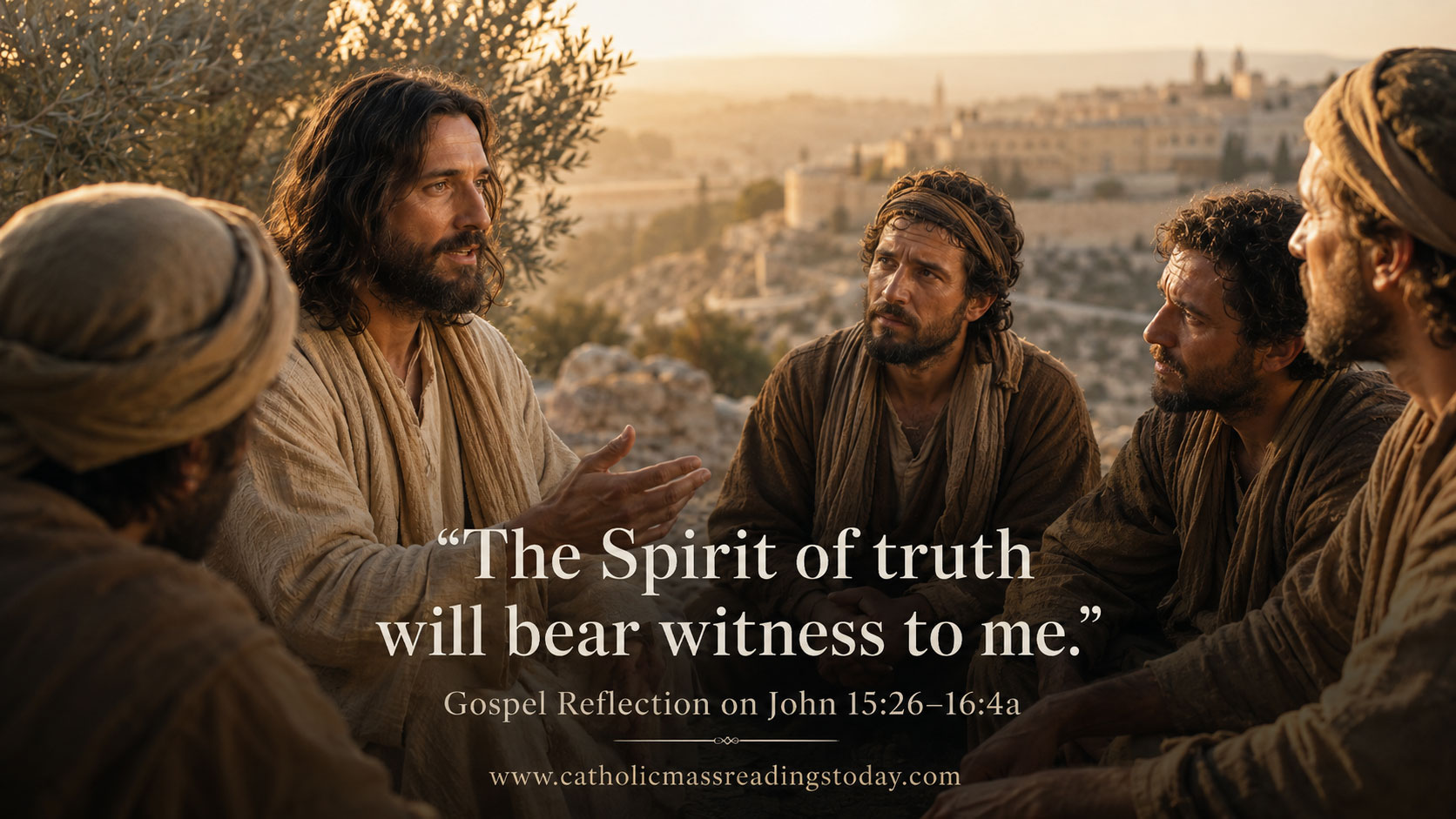
In this Gospel, the Lord Jesus speaks with a kind of clarity that is both consoling and sobering. He does not hide from His disciples what lies ahead. He does not offer them a false peace built on easy promises. He prepares them for the truth: they will be sent, they will be opposed, they will be tested, and they will need help greater than their own strength. And so, before He speaks of persecution, He speaks of the Holy Spirit.
That order matters.
Christ does not first hand His disciples suffering and only later think of consolation. He first gives promise. He first speaks of the Counsellor. He first reminds them that heaven will not remain silent while they carry the burden of witness in the world.
He says: “When the Counsellor comes, whom I shall send to you from the Father, even the Spirit of truth… he will bear witness to me.”
These words reveal something essential about the life of the Church. The Church does not bear witness to Christ by her own power alone. She does not preserve the truth by cleverness, by strategy, or by worldly influence. She lives, remembers, teaches, endures, and proclaims because the Holy Spirit has been given.
The Spirit is called here the Spirit of truth. That title is not accidental. In every age there is confusion, pressure, distortion, and compromise. In every age the human heart is tempted to shape truth according to convenience. But the Holy Spirit does not flatter human weakness. He does not bend revelation to suit passing desires. He is the Spirit of truth. He bears witness to Christ as Christ truly is, not as the world would prefer Him to be, not as ideology would redefine Him, but as the Son sent by the Father for the salvation of the world.
This is deeply important for the Church today. We live in a time when many want spirituality without truth, religion without doctrine, comfort without repentance, and compassion without moral clarity. Yet the Holy Spirit does not come to blur Christ. He comes to reveal Him more clearly. He does not lead us away from the Gospel, but deeper into it. He does not diminish the demands of discipleship; He gives the grace to live them.
Then Jesus adds: “And you also are witnesses.”
The Spirit bears witness, yes, but the disciples are not excused from bearing witness themselves. Divine help does not replace human faithfulness; it makes it possible. This is a pattern found throughout Christian life. God acts first, grace is given first, truth is revealed first but the believer must still answer. The disciple must still stand. The Church must still speak. The Christian must still remain faithful.
A witness is not simply someone who knows certain facts. A witness is one whose life has been touched by the truth and who is no longer free to pretend otherwise. The Apostles were witnesses because they had been with Christ “from the beginning.” They had heard His words, seen His works, received His love, and been formed by His presence. Therefore they could not keep silent.
In a different way, this remains true for us. Anyone who has known the mercy of Christ, who has been forgiven by Him, strengthened by Him, corrected by Him, nourished by Him, cannot treat faith as merely private decoration. The Christian is called to witness, not always loudly, not always publicly, but always truly. Sometimes witness is spoken. Sometimes it is lived in silence. Sometimes it means refusing a lie. Sometimes it means carrying suffering with hope. Sometimes it means remaining Catholic in an environment that rewards compromise.
The world often imagines witness as triumph. The Gospel often shows it as fidelity.
Jesus then says something very tender: “I have said all this to you to keep you from falling away.” This line reveals the heart of the Good Shepherd. He does not warn the disciples because He wishes to burden them, but because He wishes to preserve them. He knows how easily suffering can scandalize the soul. He knows that opposition can make the heart doubt whether it is truly on the right path. So He tells them beforehand: when these things happen, do not think God has abandoned you. Do not think truth has failed. Do not think discipleship has gone wrong. Remember that I told you.
There is mercy in being prepared.
How many believers have been shaken because they expected a Christian life free from real contradiction? How many have quietly assumed that if they were faithful, the world would naturally approve them? But Christ says otherwise. He tells His disciples that fidelity may bring exclusion. He tells them that opposition may come not only from the obviously irreligious, but even from those who imagine themselves to be defending God.
This is one of the most sobering parts of the Gospel: “The hour is coming when whoever kills you will think he is offering service to God.” Here the Lord reveals how dark the human heart can become when zeal is separated from truth, and religion is separated from real knowledge of God. It is possible to speak of God and still resist Him. It is possible to act with confidence and still be blind. It is possible to persecute holiness while imagining oneself righteous.
Jesus gives the reason plainly: “They will do this because they have not known the Father, nor me.”
At the deepest level, persecution of the truth comes from not knowing God. One may possess religious vocabulary, sacred customs, even outward fervor, and still not truly know the Father if one rejects the Son. This should keep us humble. It is not enough, to be active in religious things. It is not enough to feel certain. What matters is whether we know Christ, whether we remain in His truth, whether charity and truth are alive together in us.
This Gospel also teaches us something essential about suffering in the Christian life. Christ does not romanticize persecution, but neither does He treat it as meaningless. Suffering for the truth is not proof that the disciple has failed. Often it is proof that he is walking in the steps of the Master. The servant is not greater than his Lord. If Christ was misunderstood, contradicted, rejected, and finally condemned, then His disciples should not be surprised if they too face resistance when they remain faithful to Him.
This does not mean Christians should seek conflict or take secret pleasure in being opposed. That would be a distortion. The Church does not love persecution. She loves peace. She desires the conversion of hearts, the healing of divisions, the freedom to worship, and the proclamation of the Gospel in peace. But when peace is offered only at the price of truth, the disciple cannot accept that bargain.
There is a false peace that asks the Christian to remain silent about what matters.
There is a false tolerance that welcomes believers only if they no longer speak clearly.
There is a false compassion that asks the Church to stop calling people to holiness.
Against all of this, the Gospel stands firm. The Spirit of truth has been given. The disciple is still a witness.
And yet this witness must always remain marked by charity. One of the dangers in times of opposition is that the Christian becomes hard, bitter, or self-righteous. But the Spirit who bears witness to Christ is the same Spirit who forms the heart of Christ in us. Therefore our witness must never become cruel. We must speak truth without contempt, conviction without arrogance, clarity without hatred. The martyrs did not die cursing their persecutors. The saints did not remain faithful by becoming less loving. The truth they bore was made more credible because it was carried in humility and mercy.
This is a lesson the Church needs always to remember. We cannot defend Christ by losing resemblance to Him.
Jesus says all of this “that when their hour comes you may remember that I told you.” Memory is part of perseverance. The disciple survives trial not only by present strength, but by remembered truth. When confusion comes, when rejection comes, when fidelity costs something, the believer must remember what the Lord has already spoken.
Remember that the Spirit has been promised.
Remember that truth remains truth even when resisted.
Remember that the Lord has not abandoned His own.
Remember that holiness has always carried a cross.
Remember that Christ prepared His disciples not for ease, but for faithfulness.
For Catholics, this Gospel has a very direct meaning in our own time. We too are living in an age where the truth of Christ is often unwelcome. Christian moral teaching is frequently mocked or dismissed. Reverence is treated as weakness. Faithfulness is seen as intolerance. The Church is pressured to conform herself to the passing spirit of the age. Many are tempted to soften what Christ has spoken so that they may avoid discomfort.
But the Gospel does not permit this. The Church may never speak without love, but neither may she love without truth. She may never seek conflict, but neither may she purchase approval by betraying her Lord. She must remain under the guidance of the Holy Spirit, the Spirit of truth, who bears witness to Christ in every age.
This means that each of us must ask:
Do I want to be consoled by the Gospel, but not changed by it?
Do I welcome the Holy Spirit as comfort, but resist Him as truth?
Am I willing to bear witness to Christ when it is easy only, or also when it is costly?
When opposition comes, do I fall away, or do I remember what the Lord has said?
These are serious questions, but they are not meant to crush us. They are meant to steady us. The Gospel today is not a message of despair. It is a message of preparation, courage, and hope. Christ has told us the truth beforehand so that we may remain standing. He has given us the Spirit so that we are not alone. He has called us witnesses so that our lives may not be wasted in silence.
The Christian does not bear witness because success is guaranteed.
He bears witness because Christ is true.
The Church does not remain faithful because the world will always understand.
She remains faithful because the Spirit of truth remains with her.
And so, even in a world that resists, the disciple need not be afraid. The hour of trial is never greater than the presence of God. The Spirit has not withdrawn. The truth has not weakened. Christ has not ceased to sustain His Church.
The same Spirit who strengthened the Apostles,
the martyrs,
the confessors,
the saints hidden and known,
is at work now.
And therefore the believer may go forward in peace, not a cheap peace, but the peace that comes from knowing that truth is not defended by us alone. The Holy Spirit bears witness first. We are only asked to remain faithful enough that our lives do not contradict what He says.
Let us Pray
Lord Jesus Christ,
You promised to send the Counsellor,
the Spirit of truth,
to remain with Your Church forever.
Send Your Holy Spirit upon us anew.
Strengthen us when we are afraid.
Keep us faithful when truth is costly.
Guard us from falling away
when we are misunderstood, excluded, or opposed.
Teach us to bear witness to You
with courage and humility,
with clarity and charity,
with truth and mercy held together.
Purify our hearts of all bitterness,
all fear,
and all false zeal.
Give us the grace to know the Father through You,
and to remain steadfast in the Gospel You have entrusted to Your Church.
When the hour of testing comes,
help us to remember Your words.
And may our lives speak of You
so faithfully
that others may come to know Your truth and love.
You who live and reign with the Father
in the unity of the Holy Spirit,
God for ever and ever.
Amen.