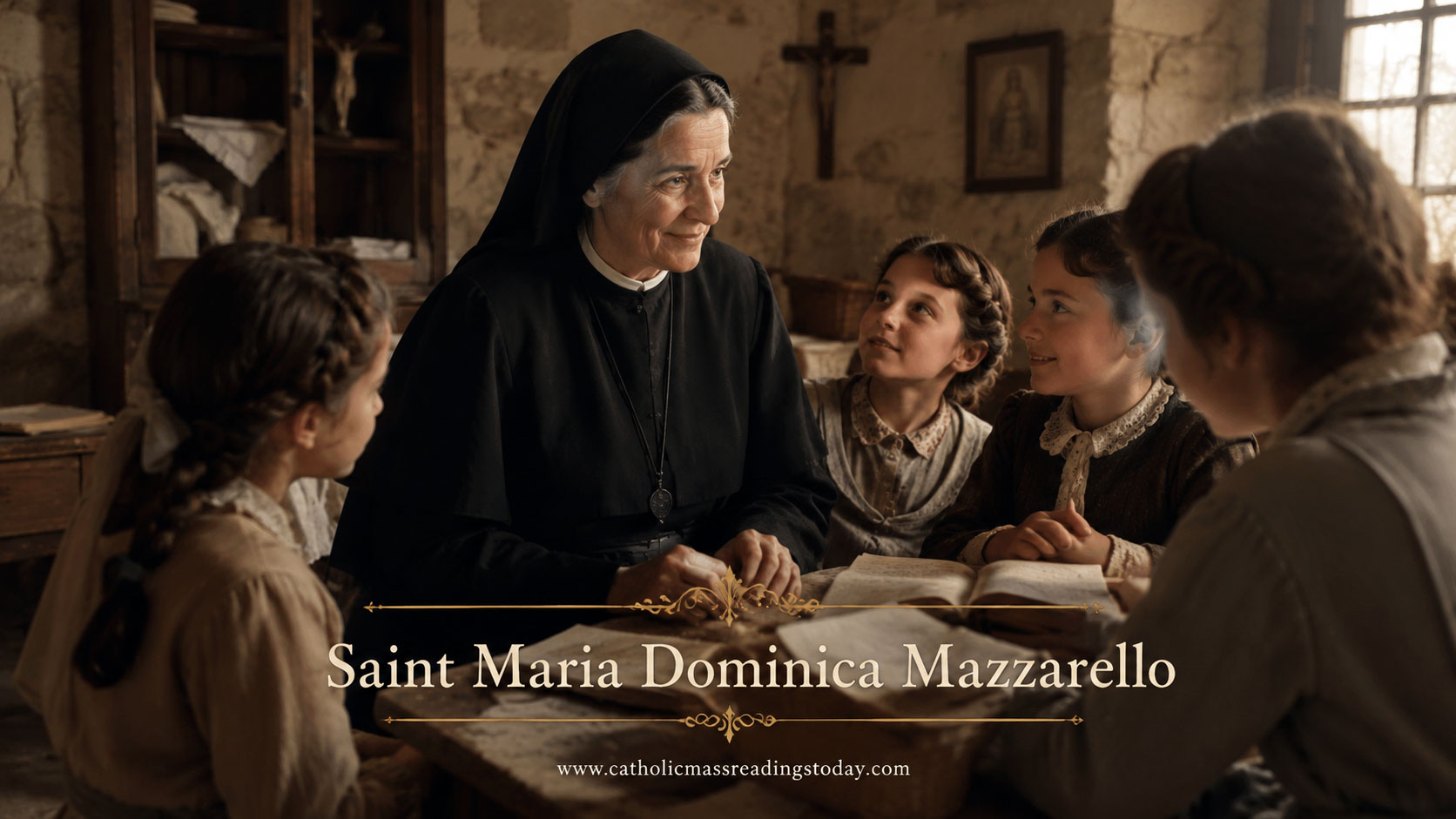
Today, in the Catholic calendar, we remember Saint Maria Dominica Mazzarello, a woman of deep faith, simple humility, and remarkable spiritual strength. Though she never sought attention, her life became a shining witness to what God can do through a soul that is completely given to Him. For anyone searching to understand Saint Maria Dominica Mazzarello, her story is both inspiring and deeply moving.
She is best known as the co-foundress of the Salesian Sisters, formally called the Institute of the Daughters of Mary Help of Christians, founded alongside Saint John Bosco. Yet her greatness was not built on public fame or worldly achievement. It was built on holiness in ordinary life: prayer, hard work, charity, purity of heart, and a quiet but unwavering love for God.
Who Was Saint Maria Dominica Mazzarello?
Saint Maria Dominica Mazzarello was born on May 9, 1837, in Mornese, a small village in northern Italy. She came from a hardworking farming family and grew up in a deeply Christian home. From childhood, she learned discipline, sacrifice, and trust in God. She was not raised in wealth or comfort. Her life was simple, rural, and demanding. But that simplicity became the soil in which holiness grew.
As a young girl, she stood out not because she was loud or ambitious, but because she was serious about God. She had a lively personality, a strong will, and a generous heart. She helped her family in the vineyards and fields, and like many girls of her time, she learned early what it meant to work hard. But alongside this practical life, there was a strong inner life developing in her, a life of prayer, modesty, and spiritual sensitivity.
She loved the Lord deeply, and those around her could sense that she belonged to Him.
Her Early Spiritual Life
One of the striking things about Saint Maria Dominica Mazzarello was that she did not become holy through extraordinary visions or dramatic outward events alone. Her holiness was formed in daily faithfulness. She attended Mass, received the sacraments, prayed sincerely, and tried to do God’s will in the ordinary duties of each day.
As she grew older, she became part of a group of young women dedicated to prayer and works of charity. These were not religious sisters yet, but lay women trying to live their Christian vocation seriously in the world. Maria Dominica was especially drawn to caring for girls, helping others, and living with purity and discipline.
She had a strong and practical spirituality. She was not sentimental. She understood that loving God meant fidelity, sacrifice, and service.
Illness That Changed Her Life
A major turning point came when Maria Dominica contracted a severe illness, most likely typhus, while helping care for people during an epidemic. She survived, but the sickness left her physically weakened for the rest of her life. Before this, she had been strong and active, especially in manual labor. Afterward, she could no longer do the heavy farm work she once had.
This was a painful change. But it became one of the most important moments in her spiritual path.
Instead of turning bitter or discouraged, she allowed God to redirect her life. What she could no longer do physically opened the door to a new mission. She began learning dressmaking with a friend, and together they opened a small workshop. But this workshop was much more than a place to sew. It became a place of Christian formation for girls especially poor girls who needed guidance, education, and moral support.
This was very much in harmony with what would later become the Salesian spirit: helping the young not only materially, but spiritually and humanly.
The Influence of Don Bosco
At the same time, Saint John Bosco had begun his great mission for the salvation and education of the young, especially poor and abandoned boys. His work was spreading, and his vision included not only boys, but also girls who needed Christian formation and loving guidance.
Maria Dominica Mazzarello encountered Don Bosco’s spirit and mission through priests and Catholic circles connected to him. In time, Don Bosco recognized in her something extraordinary: wisdom, humility, leadership, and a soul profoundly open to grace.
What is beautiful here is that the meeting between Don Bosco and Maria Mazzarello was not a clash of strong personalities, but a providential union of two saints serving the same mission. Don Bosco brought his wide apostolic vision and fatherly zeal. Maria Mazzarello brought deep interior life, maternal wisdom, simplicity, and a rare ability to guide girls with gentleness and firmness.
Together, they gave the Church something lasting.
Co-Foundress of the Salesian Sisters
In 1872, the Institute of the Daughters of Mary Help of Christians was officially founded. This new religious congregation would later become widely known as the Salesian Sisters.
Saint Maria Dominica Mazzarello became the first superior of the new institute.
This is one of the most important facts about Saint Maria Dominica Mazzarello: though she remained simple in manner and humble in spirit, she helped establish one of the great women’s religious congregations of the Church, especially devoted to the education and formation of girls.
The institute took shape in Mornese before later expanding outward. Its mission was clear: to care for girls, especially the poor, to educate them, to form them in the faith, and to help them grow into mature Christian women. The spirit of the congregation was deeply Marian, centered on Mary Help of Christians, and strongly shaped by the Salesian style of joy, charity, discipline, and trust in God.
Maria Mazzarello led not as a woman seeking control, but as a mother. Those who knew her saw in her a combination of firmness and kindness. She could correct, but never coldly. She could lead, but never proudly. She had that rare kind of authority that comes from holiness.
Her Character and Personality
One of the reasons Saint Maria Dominica Mazzarello continues to attract people today is because her sanctity feels very human and very accessible.
- She was cheerful without being superficial.
- She was disciplined without being harsh.
- She was humble without being weak.
She had a great love for community life and a strong sense of responsibility. She understood people well. She knew how to guide young girls not only by instruction, but by example. She valued kindness, neatness, honesty, prayer, and hard work. She believed that holiness could grow in daily life, in schoolrooms, in workshops, in chapels, and in simple acts of love.
She also had a deep devotion to Mary. This was not decorative or occasional. It shaped her whole spirit. She trusted Our Lady, relied on her help, and wanted the girls under her care to know Mary as a loving mother.
Her Mission for Girls and Young Women
This is one of the most beautiful parts of her legacy. Saint Maria Dominica Mazzarello lived at a time when many girls had very limited opportunities. Poverty, lack of education, and social vulnerability affected countless young women. She saw that Christian love had to become practical.
She and her sisters taught girls useful skills. They formed them morally. They helped protect their dignity. They prepared them to live as good Christians and upright women. They did not separate education from faith, or discipline from kindness.
This made her mission deeply prophetic.
Even now, the work of the Salesian Sisters across the world continues in her spirit: schools, youth centers, missions, catechesis, vocational training, and loving accompaniment of young people.
In that sense, Saint Maria Dominica Mazzarello was not only a saint for her own century. She remains deeply relevant now.
Her Final Years and Death
Maria Mazzarello’s health was never strong after her early illness. Even while carrying major responsibility, she lived with physical fragility. Yet she continued to serve with generosity, prayer, and total confidence in God.
She died on May 14, 1881, at just 44 years old.
By worldly standards, her life may seem short. But spiritually, it was full. She had already helped lay the foundation for a congregation that would spread across the world. More importantly, she had lived her vocation with real holiness.
She died as she had lived: close to God, faithful to her mission, and full of trust.
Canonization and Legacy
Saint Maria Dominica Mazzarello was later beatified and then canonized by the Church, confirming what many had already recognized: she had lived a life of heroic virtue and was now held up as a model for the faithful.
Her legacy remains alive not only in history books, but in the living work of the Salesian Sisters around the world. Every school, convent, youth center, mission station, and classroom shaped by their spirit carries something of her heart.
She reminds the Church that sanctity does not require fame, wealth, or dramatic public power. It requires openness to grace, faithfulness in duty, love for the young, and a heart willing to let God use even weakness for His glory.
Why Saint Maria Dominica Mazzarello Still Matters Today
There are many reasons why Saint Maria Dominica Mazzarello remains important today.
She shows us that holiness can grow in ordinary life.
She shows us that suffering can become mission.
She shows us that women have played a profound and shaping role in the life of the Church.
She shows us that education, especially Christian education, is a true work of mercy.
And she shows us that gentleness and strength can live beautifully together in one soul.
For young women, she is a model of purity, courage, and purpose.
For religious sisters, she is a model of joyful fidelity.
For educators, she is a model of loving formation.
For all Catholics, she is a reminder that God often builds great things through hidden lives.
Final Reflection
As we keep The Memorial of Saint Maria Dominica Mazzarello, Co-Foundress of the Salesian Sisters, the Church invites us not only to admire her, but to learn from her.
She did not live for herself.
She did not waste her suffering.
She did not seek greatness, yet became truly great in the eyes of God.
Her life tells us that holiness is possible in the ordinary. That love for the young is holy work. That patience, humility, discipline, and joy are not small virtues. And that when a soul says yes to God with sincerity, grace can do far more than the world expects.
Saint Maria Dominica Mazzarello, pray for us.
Help us to love Christ more deeply, serve generously, and remain faithful in the work God has placed in our hands.