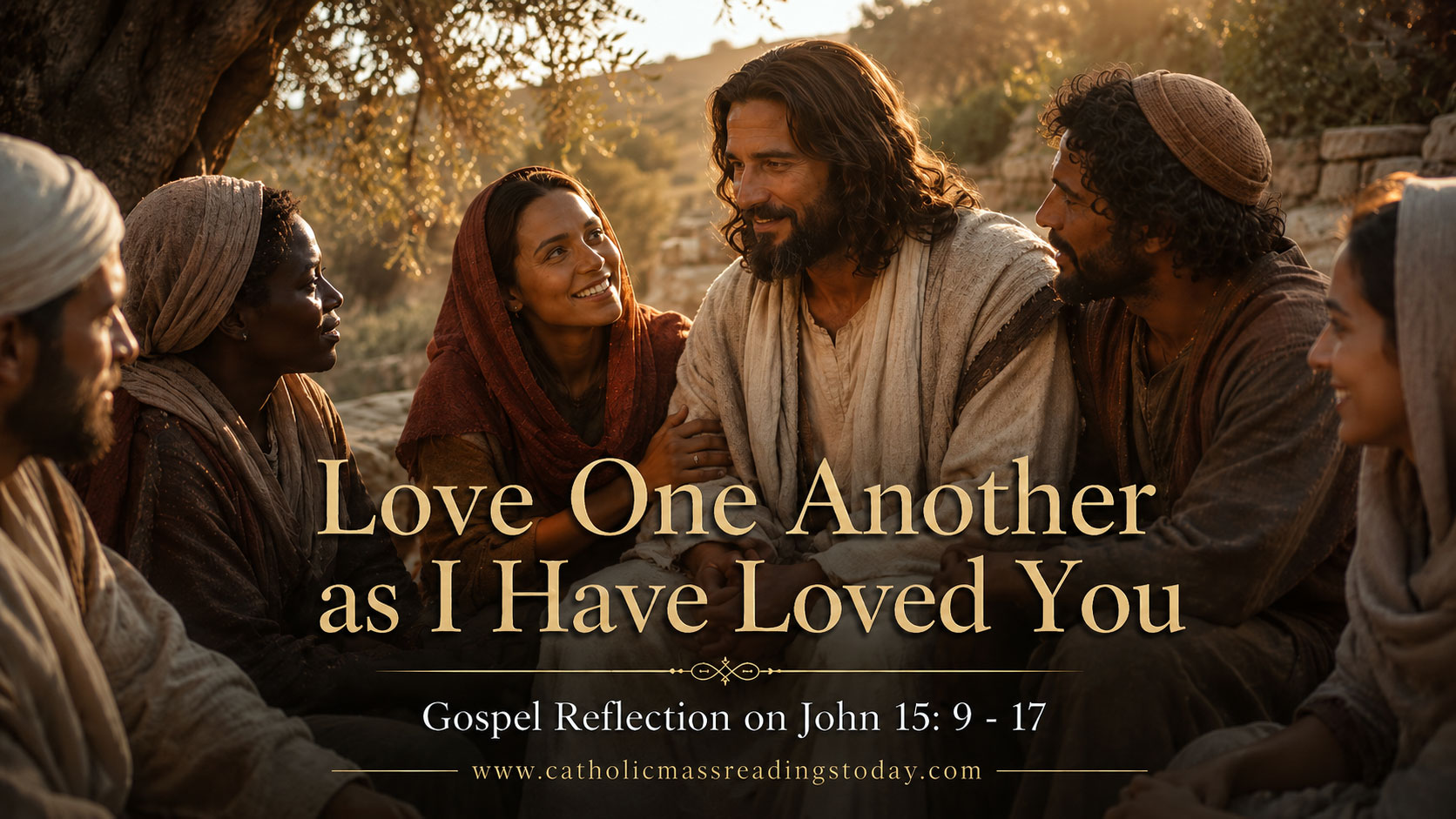
This Gospel is one of the most tender and demanding passages in all of the Lord’s teaching. Jesus speaks here not only as Master, but as One who draws His disciples into the very heart of His relationship with the Father. He says, “As the Father has loved me, so have I loved you; abide in my love.” Those words are extraordinary. The love with which Christ loves us is not small, hesitant, or temporary. It flows from the eternal love between the Father and the Son.
And yet Jesus does not speak of this love as something vague or sentimental. He says, “If you keep my commandments, you will abide in my love.” This is important. In the Christian life, love is never separated from truth, and affection is never separated from obedience. The world often treats love as a feeling that changes with mood or circumstance. But the Lord teaches us that real love remains, endures, and takes shape in fidelity. To abide in His love means to remain in His word, to live according to His commandments, and to let our lives be formed by Him.
This is not a burden placed upon us from outside. It is the path into joy. Jesus says, “These things I have spoken to you, that my joy may be in you, and that your joy may be full.” That line is beautiful. The Lord does not call us to holiness in order to reduce our lives, but to fill them. So many people search for joy in places that cannot sustain it—approval, comfort, success, pleasure, control. But the joy Christ gives is deeper. It is the joy of communion with Him, the joy of living in truth, the joy that does not disappear simply because life becomes difficult.
Then Jesus gives the heart of His commandment: “Love one another as I have loved you.” This is the measure. Not merely love as the world loves. Not love only when it is easy, agreeable, or rewarding. But love as He has loved us. And how has He loved us? Patiently. Faithfully. Mercifully. Sacrificially. To the end.
That is why He says, “Greater love has no man than this, that a man lay down his life for his friends.” These words point toward the Cross. Jesus is not speaking theoretically. He is preparing His disciples for the love He Himself is about to show. He will not save them with words alone, but with His life given for them.
This gives Christian love its unmistakable character. Love in the Gospel is not mere warmth. It is self-gift. It is choosing the good of another even at cost to oneself. It is patience when one is tired, forgiveness when wounded, faithfulness when misunderstood, generosity without counting, and charity that does not seek itself first. In a world that often speaks of love but fears sacrifice, Christ restores love to its true dignity.
Then comes one of the most moving lines in the passage: “No longer do I call you servants… but I have called you friends.” This should never cease to astonish us. The Son of God calls His disciples friends. He does not erase reverence, but He brings them into intimacy. He shares with them what He has heard from the Father. He draws them close.
This is the heart of Christian discipleship. We do not follow a distant figure who merely issues commands. We follow the Lord who has loved us, revealed Himself to us, and invited us into friendship with Him. A faithful Catholic life is not only duty, though it includes duty. It is relationship. It is communion. It is learning to remain close to Christ in prayer, in the sacraments, in obedience, and in love.
And yet Jesus goes even deeper: “You did not choose me, but I chose you.” There is immense comfort in that. Before we ever turned toward Him, He had already looked upon us with love. Before we imagined we could belong to Him, He had already called us. The Christian life begins not with our achievement, but with His grace. We are disciples because we have first been chosen.
That truth should make us humble, grateful, and steady. Humble, because we did not earn His love. Grateful, because He has called us near. Steady, because our vocation rests finally not on our strength, but on His initiative and His faithfulness.
But the Lord chooses us for a purpose: “that you should go and bear fruit and that your fruit should abide.” Grace is never given merely to make us feel secure. It is given so that our lives may become fruitful. The fruit Christ seeks is the fruit of holiness—charity, truth, perseverance, patience, faithfulness, purity of heart, mercy, and witness. Sometimes this fruit is seen clearly; often it grows quietly. But the life truly rooted in Christ never remains barren.
And notice that He says the fruit should abide. So much in the world is temporary. Human applause passes. Success fades. Emotions rise and fall. But the fruit born of grace has eternal value. A soul formed by Christ leaves behind something lasting.
So this Gospel gives us a complete vision of the Christian life: chosen by grace, called into friendship, invited to remain in Christ’s love, commanded to love sacrificially, and sent to bear fruit that lasts.
That is more than a beautiful idea. It is a way of life.
Today, then, the Lord asks each of us:
- Am I abiding in His love, or only speaking of it?
- Am I loving others as He has loved me, or only loving where it costs little?
- Am I bearing fruit, or only remaining busy?
- Am I living as one chosen by Christ?
These are searching questions, but they are filled with hope. Because the One who asks them is the same Lord who first loved us and still calls us His friends.
Let us Pray
Lord Jesus Christ,
You have loved us with a love deeper than we can measure
and called us not only servants, but friends.
Teach us to abide in Your love.
Give us hearts that are faithful to Your commandments
and willing to love others as You have loved us.
Free us from selfishness, from fear, and from all that keeps us from bearing lasting fruit.
Help us to remember that we were chosen by You,
not for comfort alone,
but for holiness, charity, and mission.
May Your joy remain in us.
May our lives reflect Your mercy.
And may the fruit You desire in us
endure for Your glory and for the good of others.
Amen.