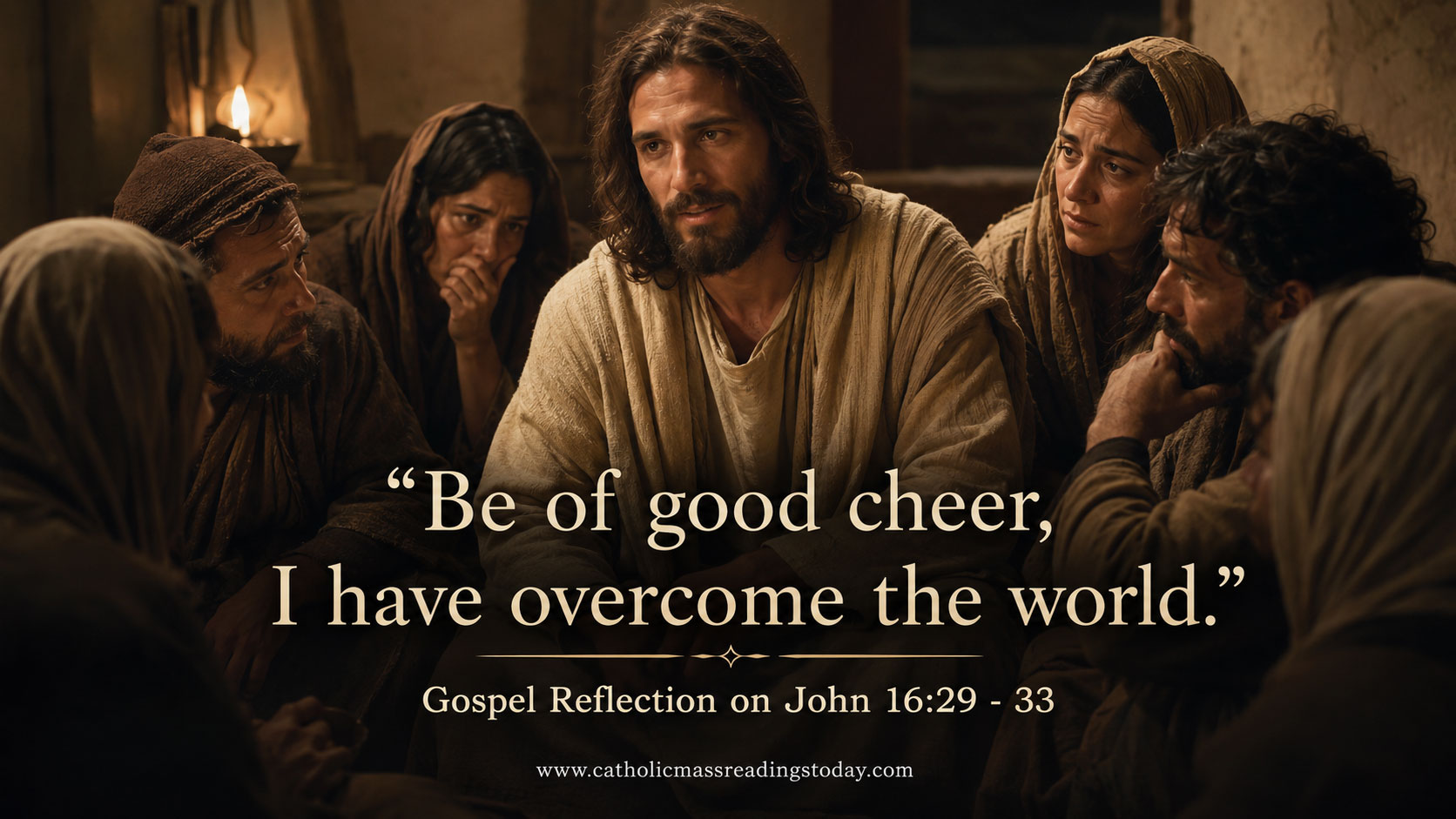
This Gospel speaks with unusual honesty. Jesus does not comfort His disciples by pretending that suffering will not come. He does not tell them that faith will remove every trial, nor does He suggest that love for Him will spare them from fear, weakness, or confusion. Instead, He tells them the truth plainly and because He tells the truth plainly, His consolation is all the more powerful.
The disciples, at the beginning of this passage, feel confident. They say to Jesus that now they understand Him, that now they believe. There is something very human in that moment. We too often think we are stronger than we are. We imagine that because we feel clear in one moment, we will remain steady in every moment. But the Lord, who knows the human heart perfectly, answers them with both tenderness and realism: “Do you now believe? The hour is coming… when you will be scattered.”
Jesus sees their sincerity, but He also sees their fragility.
This is an important lesson for every believer. Faith is real, but it must be purified. Love is real, but it must be tested. Good intentions are not enough on their own. The Christian life is not built merely on emotion, confidence, or a passing moment of spiritual strength. It is built on grace. The disciples will soon discover that they are not as courageous as they imagined. And yet the Lord does not reject them for that. He prepares them for it.
There is mercy in being warned.
Jesus says they will be scattered, each to his own home, and that they will leave Him alone. These are painful words, not only because they reveal the weakness of the disciples, but because they show how lonely the Lord’s Passion will become. Yet immediately Jesus adds: “Yet I am not alone, for the Father is with me.”
This is a deeply beautiful line. Even in the hour of abandonment, Christ remains in communion with the Father. Human companionship will fail Him, but the Father will not. In this, the Lord gives us a glimpse into the deepest source of His strength. He does not stand merely by courage of temperament. He stands in the unbroken love of the Father.
That truth is also a light for our own lives. There are moments when the believer feels misunderstood, abandoned, or left without the support he expected. There are times when others disappoint us, when earthly certainties fall away, and when the path of fidelity feels lonely. In such hours, this Gospel reminds us that the soul united to God is never truly abandoned. Others may fail. The Father does not.
Then Jesus gives the heart of the passage: “I have said this to you, that in me you may have peace.”
Notice carefully: not peace from the world, but peace in Him.
This is one of the great distinctions of Christian life. The peace of Christ is not simply a calm mood or a life free of problems. It is not the peace that comes from favorable conditions, public approval, financial security, or emotional ease. It is deeper. It is the peace that comes from belonging to Him, from being anchored in truth, from knowing that even in trial one is held by the love of God.
That is why Jesus can say, in the same breath, “In the world you have tribulation; but be of good cheer, I have overcome the world.” He does not deny tribulation. He promises victory in the midst of it.
This is the Christian paradox. We are not promised a world without suffering. We are promised Christ within it. We are not told that the road will always be easy. We are told that the Lord has already overcome what seems strongest to us: sin, fear, death, and the false power of the world opposed to God.
The phrase “be of good cheer” is especially striking. It is not shallow optimism. It is not a command to ignore pain. It is a call to courage rooted in Christ’s victory. The Lord does not say, be of good cheer because tribulation is small. He says, in effect, be of good cheer because I am greater than it.
This matters greatly for Catholics today. We live in a world where tribulation takes many forms. There is public confusion about truth. There is pressure to compromise. There is personal suffering, family sorrow, disappointment, illness, fear for the future, and spiritual weariness. Some forms of tribulation are dramatic; others are hidden and carried silently. But the Lord’s words remain unchanged: “In the world you have tribulation.” He understands the human condition perfectly. He does not ask us to pretend.
Yet neither does He leave us there. He says, “I have overcome the world.”
This is the foundation of Christian hope. Not that we are strong enough to conquer everything by ourselves, but that Christ has already won the decisive victory. His Cross looked like defeat, yet it became triumph. His Passion looked like the victory of darkness, yet it became the place where darkness was broken. His Resurrection is not merely a happy ending. It is the revelation that evil does not have the final word.
And because Christ has overcome the world, the Christian can endure with hope. The faithful soul may still suffer, but not without meaning. The Church may still be tested, but not abandoned. The believer may still weep, but not without promise.
This Gospel also gently humbles us. The disciples thought they were ready; they were not. But Jesus did not stop loving them because of that. He knew their coming weakness and still spoke peace to them. This is profoundly consoling. The Lord does not wait until we are perfect before He sustains us. He sees our weakness more clearly than we do, and yet He continues to call us, strengthen us, and lead us forward.
That should produce in us both humility and trust. Humility, because we are more fragile than we often admit. Trust, because His grace is stronger than our fragility.
So the Gospel today leaves us with a clear path.
- Do not be surprised by tribulation.
- Do not place your peace in the world.
- Do not rely too confidently on your own strength.
- Remain in Christ.
- Trust the Father’s presence.
- And take courage from the victory of the Lord.
For the Christian, peace is not the absence of battle. It is the presence of Christ in the battle.
And that is why even now, in a troubled world, the Church can still lift her head. Not because she is blind to suffering, but because she knows her Lord. He has spoken plainly. He has told us the truth. And having told us the truth, He has also given us the reason not to despair:
“Be of good cheer, I have overcome the world.”
Let us Pray
Lord Jesus Christ,
You know the tribulations of this world
and the weakness of our hearts.
When we are afraid, give us courage.
When we are scattered, gather us close to You.
When we are tempted to place our peace in passing things,
teach us to rest in You alone.
Strengthen us in every trial.
Remind us that the Father does not abandon those who trust in Him.
And fix our hearts on Your victory,
so that even in difficulty
we may live with the peace and confidence
that come from belonging to You.
For You have overcome the world,
and in You, we need not lose heart.
Amen.