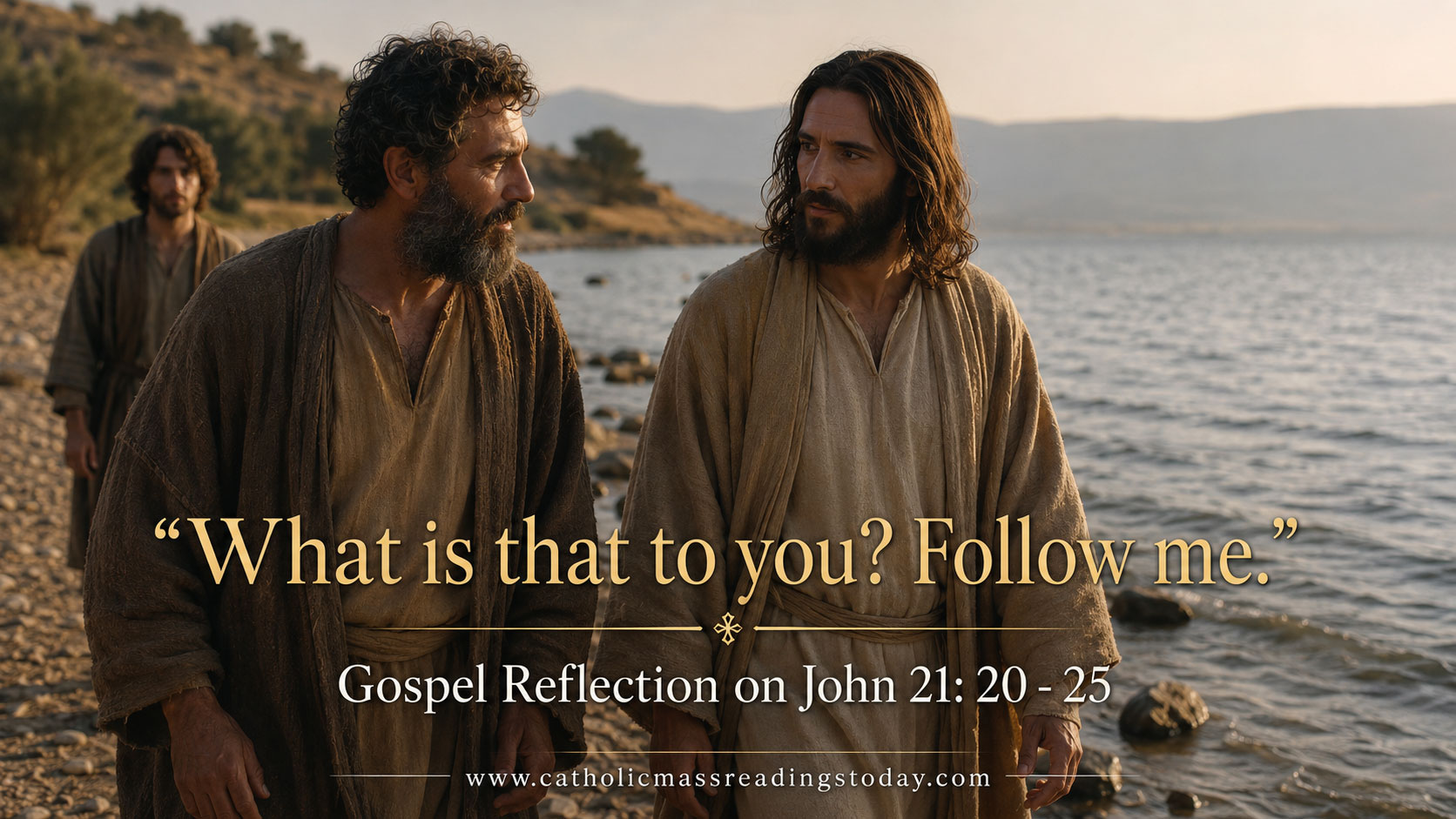
This Gospel is quiet, but it reaches deeply into the heart. After the great exchange between Jesus and Peter “Do you love me?… Feed my sheep” Peter turns and notices the disciple whom Jesus loved. And almost at once, a question rises: “Lord, what about this man?”
It is such a human moment.
Even after receiving a personal call from the Lord, Peter looks sideways. He has just heard something difficult about his own path, and now he wants to know the path of another. In this, the Gospel touches something very familiar in all of us. We want to follow Christ, but we also want to compare. We want to know why another person’s road seems different, why another vocation looks lighter, why another story unfolds in a way not given to us.
And Jesus answers with striking clarity: “If it is my will that he remain until I come, what is that to you? Follow me!”
Those last two words are the heart of the passage.
The Lord does not encourage Peter to measure his life against that of John. He does not explain every difference. He simply calls Peter back to what matters most: Follow me. That is the center of discipleship. Not comparison. Not curiosity about another’s calling. Not anxiety about what has been given to someone else. The Christian life becomes fruitful when the soul stops looking endlessly from side to side and begins to look steadily at Christ.
There is a gentle correction here for every believer. Many spiritual disturbances begin with comparison. We compare gifts, vocations, sufferings, influence, burdens, consolations, even the apparent closeness of others to God. But the Lord does not save us through comparison. He saves us through communion with Himself. Each disciple is called personally. Each path of holiness is real, but not identical. Each life is held within the wisdom of God.
To Peter, the Lord had given the path of shepherding, suffering, and one day glorifying God through martyrdom. To John, another path would unfold. The difference was not a problem. It was providence.
This is important in Catholic life. The Church is one, but within her unity there are different vocations, different missions, different temperaments, different trials, and different forms of fidelity. One is called to hidden sacrifice, another to public witness. One bears suffering in silence, another in service. One leads, another supports. One is asked to endure long years, another to burn brightly in a shorter span. The Lord distributes His gifts with wisdom, not with uniformity.
So the question is not, Why is this person’s life different from mine? The deeper question is, Am I following Christ faithfully in the life He has given me?
Then the Gospel turns toward Saint John himself: “This is the disciple who is bearing witness to these things, and who has written these things; and we know that his testimony is true.” There is something beautiful in that line. The Gospel does not present faith as myth or vague inspiration. It presents witness. The beloved disciple saw, received, remembered, and testified. Christianity is built not on invented stories, but on the living witness of those who knew the Lord.
For the Church, this matters greatly. We are a people who receive testimony, apostolic testimony, guarded and handed on faithfully. The Gospel comes to us through real witnesses, and that is why the Church treasures the apostolic foundation so deeply. Our faith is not untethered feeling. It is rooted in what has been seen, heard, and handed on.
And yet the Gospel ends with a kind of holy overflow: “There are also many other things which Jesus did; were every one of them to be written, I suppose that the world itself could not contain the books.” This is a fitting ending, because it reminds us that the mystery of Christ is greater than any single page can hold. The Gospels are true and sufficient in what they proclaim, but Jesus Himself is inexhaustible. However much has been written, the Lord remains greater still.
There is something very moving in that. We never come to the end of Christ. We can spend a lifetime listening to His word, praying with the Gospel, receiving Him in the sacraments, and still find that there is always more depth, more beauty, more truth, more mercy to discover. The Christian life is not the exhausting attempt to master Him. It is the humble joy of following One whose richness can never be exhausted.
So this Gospel leaves us with two clear invitations.
First: stop living by comparison. The Lord has not asked you to carry another person’s vocation. He has said to you, as He said to Peter: Follow me.
Second: remain close to the witness of the Gospel, because its testimony is true. The more the soul stays near to the words and deeds of Christ, the more it learns what is solid, what is holy, and what truly matters.
And perhaps that is the final grace of this passage: it brings the heart back to simplicity. The road may not be fully explained. The future may not be fully clear. Others may walk differently. But the call remains steady:
“What is that to you? Follow me.“
Let us Pray
Lord Jesus Christ,
keep my heart from restless comparison
and from wandering too far into what is not mine to carry.
Teach me to follow You faithfully
in the path You have chosen for me.
Help me to trust Your wisdom,
to receive Your word with reverence,
and to remain close to the truth handed on by Your Church.
And as I walk with You,
let my life become a quiet witness
to Your goodness, Your truth, and Your love.
Amen.