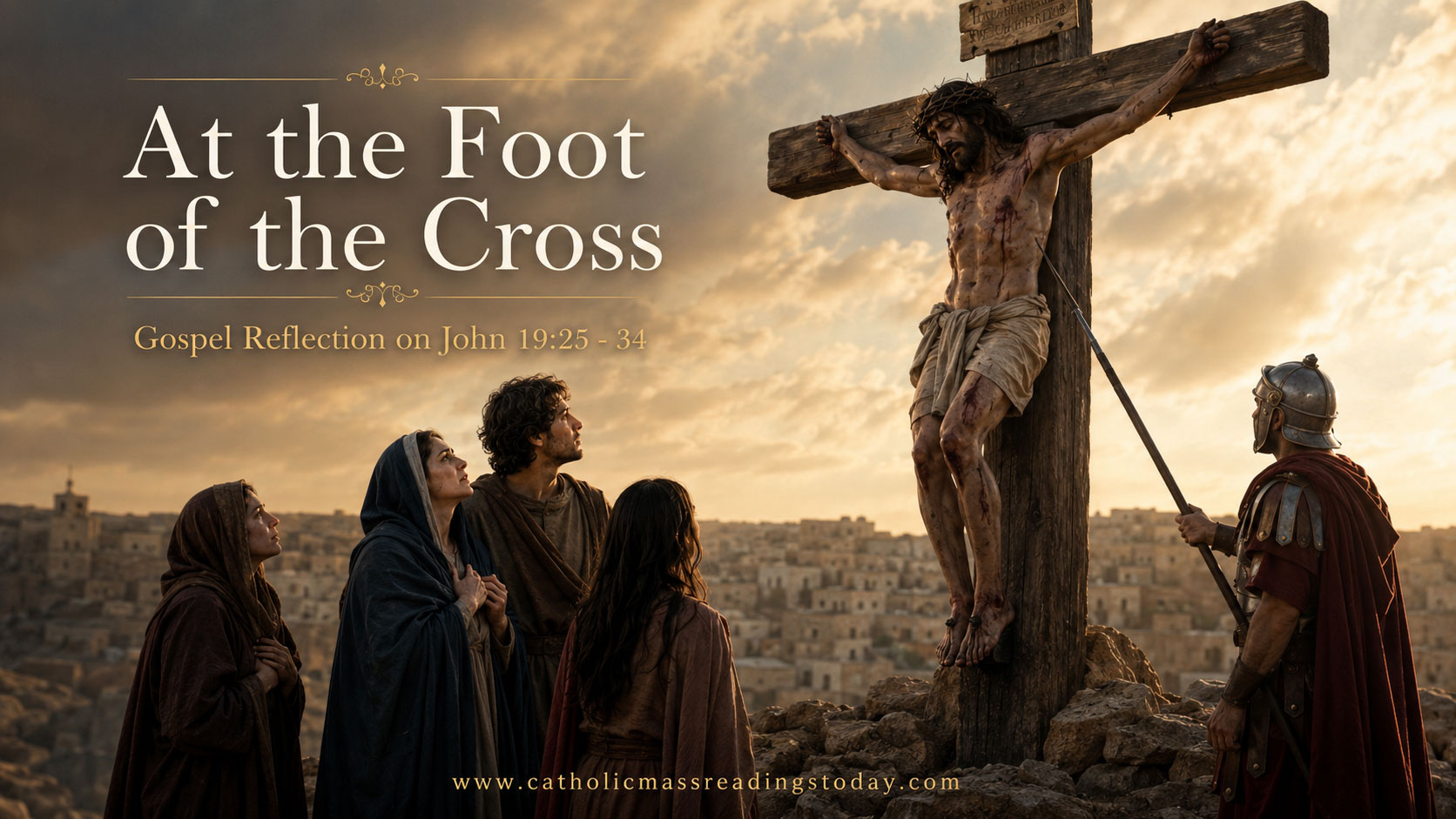
This Gospel draws us to one of the most sacred and painful moments in all of Scripture: the foot of the Cross. Everything is stripped bare here. There is suffering, grief, silence, fidelity, and love carried to its very end. And yet in the middle of such sorrow, the Lord is still giving. Even as He suffers, Jesus is not turned inward. He is still loving, still entrusting, still accomplishing the work the Father gave Him.
We first see Mary standing by the Cross. She does not flee. She does not turn away from the suffering of her Son. She remains. This alone is deeply moving. Her presence is quiet, but it is full of strength. She is not there with power to stop what is happening. She is there with the courage to remain faithful in love.
That is one of the great lessons of this Gospel. There are moments in life when love cannot remove the Cross, but it can remain beside it. Mary teaches the Church how to stand near suffering without losing faith. She shows us that true love is steadfast, even when the heart is pierced.
Then Jesus speaks those unforgettable words: “Woman, behold, your son.” And to the beloved disciple: “Behold, your mother.”
The Church has always seen here more than a private act of care. Of course Jesus is providing for His mother in His final hour, but these words also open something much greater. In the beloved disciple, the Church sees every disciple. And in Mary, the Church receives a mother. At the Cross, Jesus gives His mother to us, and He entrusts us to her.
This is why Catholics lovingly call Mary Mother of the Church. Her motherhood does not end with Jesus alone; by the will of Christ, it extends to all who belong to Him. She is not a distant figure in salvation history. She is given as a real mother in the order of grace — tender, faithful, and near to the life of the Church.
And what does the disciple do? The Gospel says that from that hour he took her into his home. That is not only a historical note. It is also a quiet invitation to every Christian heart. Mary is not meant to be admired from afar only. She is to be welcomed. To take her into our home means to make room for her maternal presence in our life of faith, always knowing that she leads us more deeply to her Son.
Then the Gospel becomes even more solemn. Jesus says, “I thirst.” These are words of real bodily suffering, but the Church has also heard in them the deeper thirst of Christ, His thirst for souls, His thirst that humanity receive the salvation He is pouring out. Even in agony, His heart remains turned toward the fulfillment of the Father’s will.
And then comes the great word: “It is finished.” Not the cry of defeat, but the declaration that the work of redemption has been brought to completion. The mission given by the Father has been fulfilled in obedience, love, and total self-gift. At that moment, Jesus bows His head and hands over His spirit.
There is something profoundly peaceful in that final surrender. The Cross is terrible, but it is not meaningless. Christ is not crushed by suffering as one overcome by darkness. He is offering Himself. He is laying down His life. This is why the Cross stands forever at the center of Catholic faith: because on it, divine love is revealed in its fullest measure.
Finally, the soldier pierces His side, and immediately blood and water flow out. The Church has long contemplated this moment with wonder. The blood and water are not accidental details. They point toward the mystery of the Church and the sacraments flowing from the Heart of Christ especially Baptism and the Eucharist. From the pierced side of the new Adam comes life for the world.
What a striking truth this is: even after death, Christ continues to give. His Heart remains open. Grace continues to pour forth. The Church is born from His sacrifice, nourished by His gift, and cleansed by His mercy.
So this Gospel leaves us with several treasures.
- It teaches us the faithfulness of Mary.
- It teaches us that at the Cross we receive a mother.
- It teaches us that Christ’s suffering is redemptive, not empty.
- It teaches us that salvation comes through His total obedience.
- And it teaches us that from His pierced side the life of the Church flows.
This is not only a Gospel of sorrow. It is a Gospel of love brought to completion. At the foot of the Cross, we see what kind of Lord we have: one who loves to the end, one who gives even in suffering, one who turns death itself into the fountain of life.
And perhaps the most fitting response is not to rush past this scene, but to remain there for a while with Mary, with the beloved disciple, in silence, in gratitude, and in wonder.
Let us Pray
Lord Jesus Christ,
at the foot of Your Cross
teach us to understand the depth of Your love.
Give us the grace to remain near You,
especially in moments of sorrow and trial.
Help us to receive Mary as our mother
and to learn from her faithful, steadfast love.
From Your pierced side,
pour again upon Your Church
the grace of mercy, healing, and new life.
May we never look upon the Cross as defeat,
but always as the triumph of Your saving love.
Amen.