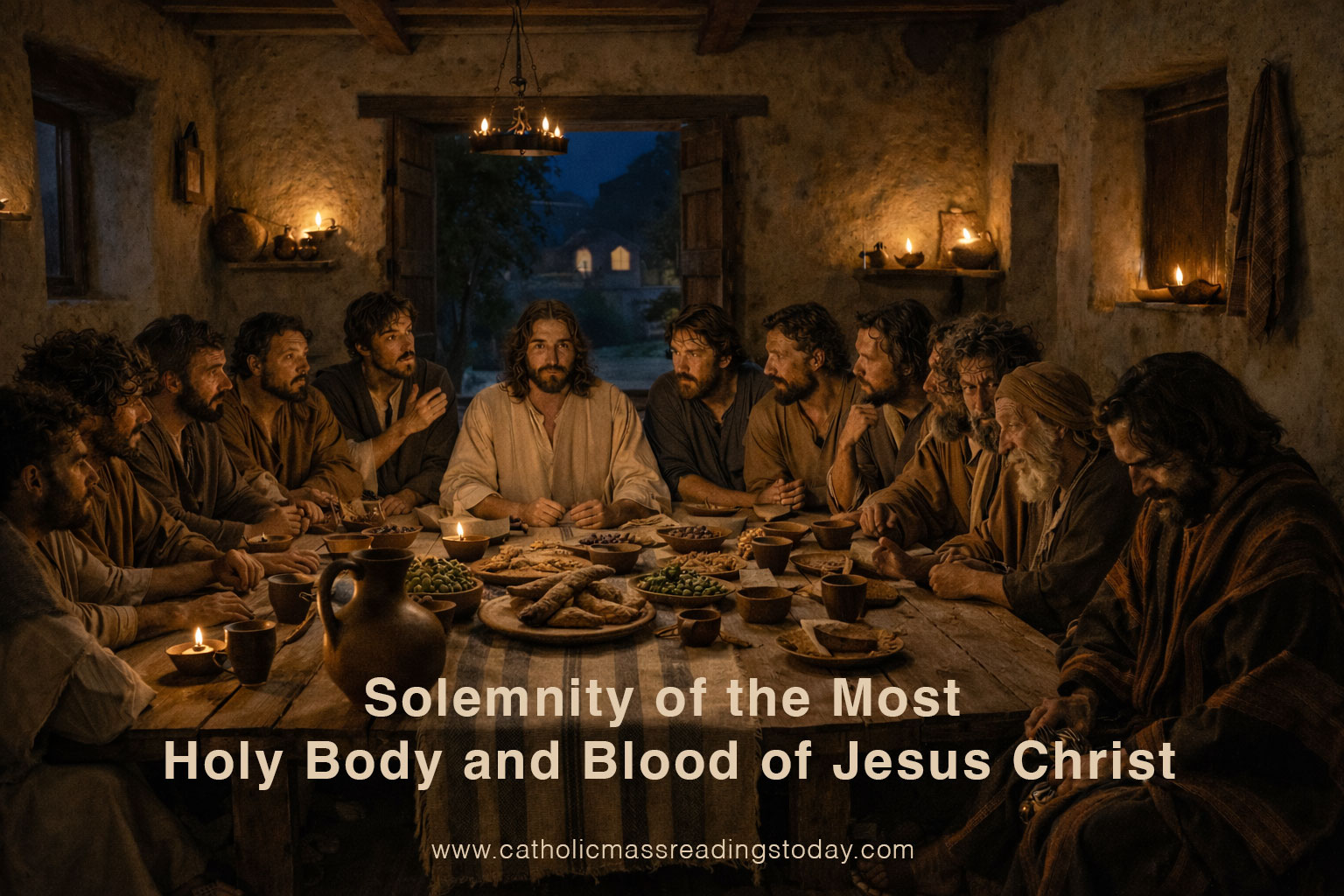
The Solemnity of the Most Holy Body and Blood of Jesus Christ, traditionally known as Corpus Christi (“Body of Christ”), is one of the most beautiful and profound celebrations in the Catholic Church. It is a day when Catholics throughout the world publicly proclaim their faith in the Real Presence of Jesus Christ in the Holy Eucharist.
This solemnity invites the Church not only to remember what Jesus did at the Last Supper but also to adore, celebrate, and give thanks for the extraordinary gift He continues to give His people: His own Body, Blood, Soul, and Divinity in the Blessed Sacrament.
At the heart of this feast lies a simple but life changing truth: God loved the world so much that He chose to remain with His people in the Eucharist until the end of time.
The Biblical Foundation of the Feast
The origins of this solemnity are found in the words of Jesus Himself.
At the Last Supper, on the night before He suffered and died, Jesus took bread, blessed it, broke it, and gave it to His disciples saying:
“Take, eat; this is my body.” (Matthew 26:26)
He then took the cup and said:
“Drink of it, all of you; for this is my blood of the covenant, which is poured out for many for the forgiveness of sins.” (Matthew 26:27-28)
These words are not merely symbolic expressions. From the earliest days of Christianity, the Church has understood them literally. Jesus did not say, “This represents my body.” He said, “This is my body.”
The sixth chapter of the Gospel of John provides even deeper insight into this mystery. Jesus declares:
“I am the living bread which came down from heaven; if any one eats of this bread, he will live for ever; and the bread which I shall give for the life of the world is my flesh.” (John 6:51)
Many listeners found these words difficult and even shocking. Yet Jesus did not withdraw or soften His teaching. Instead, He repeated it with even greater clarity, revealing the reality of the Eucharist that would become the center of Christian worship.
How the Feast of Corpus Christi Began
Although belief in the Eucharist goes back to Christ Himself and the Apostles, the specific feast of Corpus Christi developed centuries later.
In the thirteenth century, a holy Augustinian nun named Saint Juliana of Liège received visions in which she believed the Lord was asking for a special feast dedicated entirely to honoring the Blessed Sacrament.
She spent many years promoting this devotion despite significant opposition and misunderstanding.
A decisive moment came in 1263 when a German priest, struggling with doubts about the Real Presence of Christ in the Eucharist, was celebrating Mass in the Italian town of Bolsena. According to Church tradition, the consecrated Host began to bleed during Mass.
The event, commonly known as the Miracle of Bolsena, deeply moved the Church.
Shortly afterward, Pope Urban IV established the Feast of Corpus Christi for the universal Church in 1264 through the papal bull Transiturus de hoc mundo.
To enrich the liturgical celebration, the Pope asked Saint Thomas Aquinas to compose hymns and prayers for the feast. Some of these, including Pange Lingua, Tantum Ergo, and O Salutaris Hostia, remain among the most beloved Eucharistic hymns in Catholic worship today.
What the Church Celebrates on This Day
The Solemnity of the Most Holy Body and Blood of Jesus Christ celebrates the central mystery of Catholic life: that Jesus Christ is truly, really, and substantially present in the Eucharist.
The Church teaches that during the consecration at Mass, the bread and wine become the Body and Blood of Christ, even though their appearance remains unchanged.
This mystery is known as Transubstantiation.
The Eucharist is not merely a sacred symbol. It is not simply a reminder of Jesus. It is Jesus Himself.
For this reason, Catholics kneel before the Blessed Sacrament, adore Christ present in the tabernacle, and participate in Eucharistic processions.
The Eucharist is the source from which the Church receives her life and the summit toward which all her worship is directed.
Eucharistic Miracles Through History
Throughout the centuries, God has permitted extraordinary signs that have strengthened faith in the Eucharist.
Among the most famous is the Eucharistic Miracle of Lanciano, which occurred in the eighth century. During Mass, a monk who was struggling with doubts reportedly witnessed the consecrated Host become visible flesh and the wine become visible blood.
Modern scientific examinations conducted centuries later found that the flesh consisted of human heart tissue and the blood was human blood.
Other well known Eucharistic miracles have been reported in places such as:
- Bolsena, Italy
- Buenos Aires
- Sokółka
- Legnica
While Catholics do not base their faith solely upon miracles, these events serve as reminders of the profound reality Christ revealed.
Why This Solemnity Matters Today
In today’s fast moving world, many people experience loneliness, anxiety, uncertainty, and spiritual hunger.
The message of Corpus Christi remains as relevant as ever.
The Eucharist reminds us that God has not abandoned His people. He remains present among us.
Every tabernacle contains the living Christ.
Every Mass is an encounter with the Lord who gave His life for the salvation of the world.
Every Holy Communion is an invitation to deeper union with God.
In a culture that often values independence and self-sufficiency, the Eucharist teaches us dependence on divine grace. We are reminded that we cannot save ourselves. We need Christ, and Christ gives Himself to us as food for the journey.
What Is Expected of Catholics on This Day?
This solemnity is not simply a day for theological reflection. It calls for a response.
Catholics are invited to:
Deepen Their Love for the Eucharist
The feast encourages believers to rediscover the gift of the Mass and Holy Communion.
Participate in Eucharistic Adoration
Spending time before the Blessed Sacrament allows us to encounter Christ in silence and prayer.
Attend Mass with Renewed Faith
Corpus Christi is an opportunity to approach the altar with gratitude and reverence.
Live Eucharistic Lives
The Eucharist is not only received; it must be lived. Having received Christ’s love, we are called to become instruments of charity, mercy, forgiveness, and service.
Publicly Witness to the Faith
Many parishes hold Eucharistic processions, bringing Christ into streets and communities. These processions are public acts of faith and evangelization.
The Eucharist and Daily Christian Life
The Eucharist transforms more than one hour on Sunday. It shapes every aspect of Christian living.
When we receive Christ worthily, we are strengthened to carry our crosses, resist temptation, forgive others, and persevere in faith.
The Eucharist teaches humility because God comes to us under the appearance of ordinary bread and wine.
It teaches sacrifice because it makes present the one sacrifice of Christ on Calvary.
It teaches love because it is the greatest expression of divine self-giving ever offered to humanity.
The saints understood this deeply. Many spent hours before the Blessed Sacrament because they recognized that the Eucharist is not a thing but a Person.
A Feast of Gratitude
Ultimately, the Solemnity of the Most Holy Body and Blood of Jesus Christ is a feast of thanksgiving.
The word “Eucharist” itself comes from a Greek word meaning “thanksgiving.”
On this day, the Church gives thanks for the gift of Christ’s abiding presence.
We thank Him for remaining with His people.
We thank Him for feeding us with the Bread of Life.
We thank Him for drawing us into communion with Himself.
And we thank Him for the promise He gives:
“He who eats my flesh and drinks my blood has eternal life, and I will raise him up at the last day.” (John 6:54)
Heaven touches earth
The Solemnity of the Most Holy Body and Blood of Jesus Christ stands at the very center of Catholic faith and devotion. It celebrates the greatest gift Jesus left His Church: Himself.
In the Eucharist, Heaven touches earth.
In the Eucharist, Christ remains among His people.
In the Eucharist, the faithful receive strength for the journey and a foretaste of eternal life.
As we celebrate Corpus Christi, may our hearts be filled with wonder, gratitude, and renewed faith in the Lord who continues to fulfill His promise:
“And behold, I am with you always, to the close of the age.” (Matthew 28:20)
O Sacrament Most Holy, O Sacrament Divine, all praise and all thanksgiving be every moment Thine.