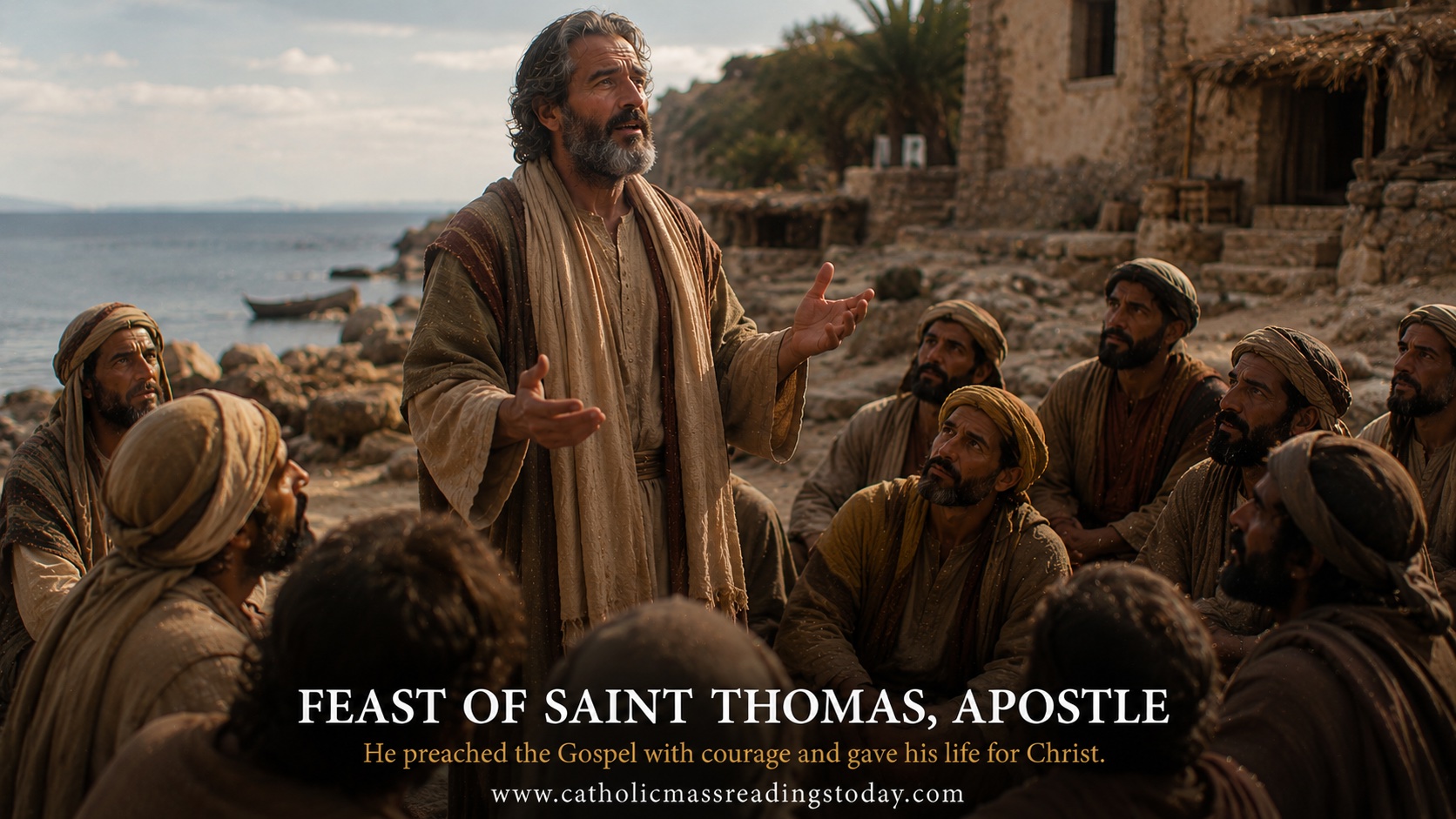
Discovering the Faith, Mission, and Lasting Legacy of the Apostle Who Proclaimed,
“My Lord and My God!”
Every year on 3rd July, the Catholic Church joyfully celebrates the Feast of Saint Thomas, Apostle, one of the Twelve chosen by Jesus Christ. While many people remember Thomas as the apostle who doubted the Resurrection, the Church remembers him for something much greater, his sincere search for the truth, his courageous profession of faith, and his extraordinary missionary work that carried the Gospel far beyond the borders of the Roman Empire.
Saint Thomas teaches us that God does not reject those who sincerely seek Him. Instead, Christ meets honest questions with mercy, transforms doubt into unwavering faith, and sends ordinary people to accomplish extraordinary missions.
His life remains an encouragement to Christians today, especially those who have struggled with questions, disappointment, or moments when faith seemed difficult. Thomas reminds us that faith is not the absence of questions; it is the willingness to continue seeking Christ until we encounter Him personally.
Who Was Saint Thomas?
Saint Thomas was one of the Twelve Apostles personally chosen by Jesus during His public ministry. The Gospel of John identifies him as Thomas, called Didymus, a name that means “the Twin.” Scripture never tells us who his twin was, leaving that detail hidden from history.
Although Thomas appears less frequently in the Gospels than Peter or John, every time he speaks, his words reveal a man of remarkable honesty and deep conviction.
Unlike those who simply followed the crowd, Thomas wanted certainty. He was thoughtful, practical, and unwilling to pretend he understood what he did not.
Far from being a weakness, these qualities would later become one of his greatest strengths.
A Courageous Disciple Long Before the Resurrection
Thomas is often remembered only because of his doubts after Christ’s Resurrection. Yet long before that event, the Gospel shows another side of his character.
When Jesus decided to return to Judea after Lazarus had died, the disciples feared that the religious leaders would kill Him. Many hesitated.
Thomas did not.
He courageously said to the other disciples:
“Let us also go, that we may die with Him.” (John 11:16)
These are not the words of a coward.
They reveal a disciple willing to risk his own life out of loyalty to Christ.
Even though Thomas did not yet understand everything about Jesus’ mission, he was prepared to stand beside Him, whatever the cost.
This quiet act of courage often receives little attention, yet it tells us much about the kind of man Thomas truly was.
“Lord, We Do Not Know the Way”
Another memorable moment comes during the Last Supper.
As Jesus prepared His disciples for His Passion, He told them:
“You know the way where I am going.”
Thomas immediately responded:
“Lord, we do not know where you are going; how can we know the way?” (John 14:5)
Once again, Thomas spoke honestly.
He refused to pretend that he understood. His sincere question became the occasion for one of the most beautiful declarations in the Gospel.
Jesus answered:
“I am the way, and the truth, and the life.”
Had Thomas remained silent, these words may never have been spoken in that moment.
Sometimes the honest questions of a believer become the doorway through which God reveals even greater truth.
For this reason, Thomas continues to inspire Christians who sincerely seek understanding rather than superficial answers.
Thomas and the Risen Christ
The event that forever shaped Thomas’ place in Christian history occurred after the Resurrection.
When Jesus first appeared to the disciples, Thomas was absent. The others joyfully told him,
“We have seen the Lord.”
But Thomas struggled to believe. He replied:
“Unless I see in His hands the print of the nails, and place my finger into the mark of the nails, and place my hand into His side, I will not believe.”
These words have earned him the title “Doubting Thomas.”
Yet the Church has always understood that Thomas’ struggle was not born from rebellion but from a sincere desire for certainty.
Eight days later, Jesus returned. He did not ignore Thomas. He did not shame him instead, He invited him:
“Put your finger here… Do not be faithless, but believing.”
At that moment, Thomas made one of the greatest professions of faith in all Sacred Scripture:
“My Lord and my God!”
These five words are among the clearest declarations of Christ’s divinity found anywhere in the New Testament. The disciple who once doubted became the apostle who proclaimed the truth most clearly.
A Lesson for Every Christian
Thomas teaches that God is not afraid of our honest questions. He invites us to bring them to Him.
Faith grows not by pretending we have no struggles, but by allowing Christ to meet us in them.
The risen Lord transformed Thomas’ uncertainty into conviction. He desires to do the same for us.
Whether our doubts arise from suffering, unanswered prayers, or life’s uncertainties, Christ continues to say:
“Peace be with you… Do not be faithless, but believing.”
The Christian journey is not about having every answer. t is about trusting the One who is Himself the Truth.
Saint Thomas’ Mission to the East and His Extraordinary Legacy
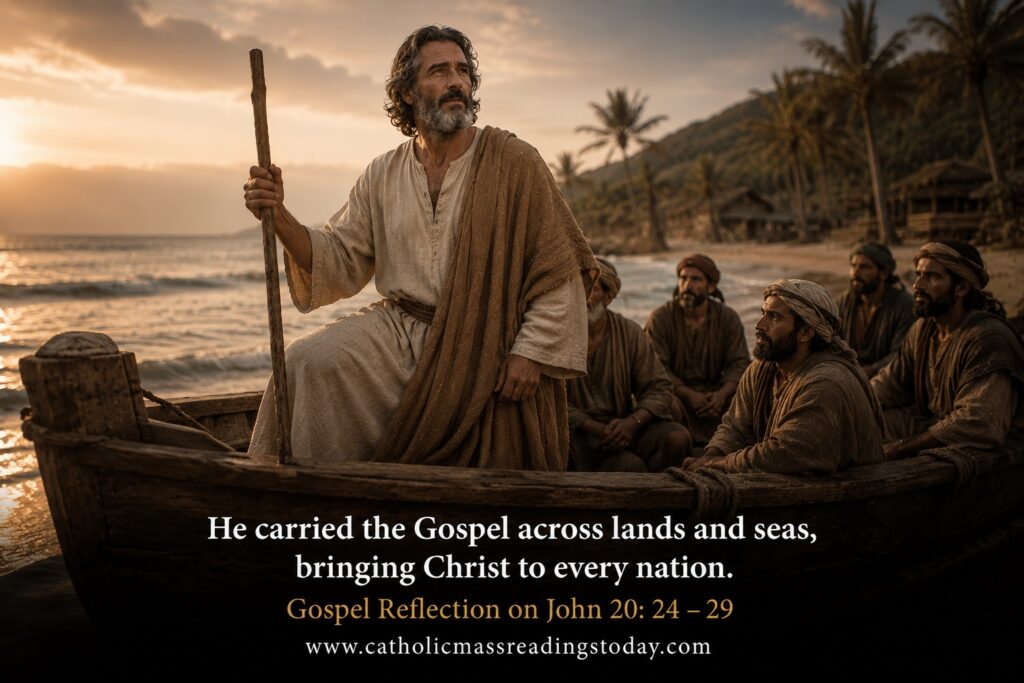
The Resurrection changed Thomas forever.
The man who had once asked for proof became one of the boldest missionaries the Church has ever known. Having encountered the risen Christ, Thomas no longer hesitated. The words, “My Lord and my God!”, became more than a profession of faith, they became the foundation of his entire life.
After Pentecost, when the Holy Spirit descended upon the apostles, Thomas joined the others in proclaiming the Gospel fearlessly. The same disciple who had once struggled to believe now possessed an unshakable conviction that Jesus Christ had conquered sin and death. Nothing, not distance, hardship, persecution, or even the threat of martyrdom would silence the message entrusted to him.
The Missionary to the East
Ancient Christian tradition consistently holds that Saint Thomas carried the Gospel farther east than any of the other apostles. While Peter preached in Rome and Paul journeyed throughout the Mediterranean world, Thomas travelled through lands that were then considered distant and unfamiliar to the Roman Empire.
Early Christian writers, including Origen, Saint Ephrem the Syrian, Saint Gregory of Nazianzus, and Eusebius of Caesarea, all preserve the tradition that Thomas evangelized the East, particularly Parthia and eventually India.
Although every detail of his travels cannot be historically verified, the continuous witness of the ancient Church gives remarkable weight to this tradition. For nearly two thousand years, Christians in India have preserved the memory of Saint Thomas as the apostle who first brought them the Gospel.
This enduring tradition is one of the oldest missionary traditions in Christianity.
The Apostle of India
According to long standing tradition, Saint Thomas arrived on the Malabar Coast of southwestern India around A.D. 52.
There he encountered Jewish communities who had settled along the trade routes, as well as local populations eager to hear the Good News of Jesus Christ.
Thomas did not establish merely a group of followers. He established communities of faith.
Tradition credits him with founding what later became known as the Seven and a Half Churches of India, early Christian communities that continued to flourish long after his death.
These churches became the foundation of what is today known as the Saint Thomas Christians, one of the oldest continuous Christian communities in the world.
Their history stands as a remarkable testimony to the apostle’s missionary zeal.
A Builder of Communities
Thomas understood that preaching alone was not enough.
- He taught converts the Scriptures.
- He celebrated the breaking of bread.
- He baptized new believers.
- He formed families in the Christian faith.
- He ordained leaders who could continue the mission after his departure.
- His ministry reflected the pattern established by Christ Himself: making disciples who would, in turn, make more disciples.
Wherever Thomas travelled, he left behind communities rooted in prayer, charity, and fidelity to the Gospel.
The Church was never built around his personality. It was built upon Christ.
Miracles Attributed to Saint Thomas
Like the other apostles, Saint Thomas was remembered not only as a preacher but also as a worker of miracles through the power of Christ.
Ancient Christian traditions recount numerous healings associated with his ministry.
The sick were restored. Those suffering found hope.
Many were converted after witnessing signs that confirmed the Gospel he preached.
Whether through miraculous events or the quiet witness of holy living, Thomas always directed attention away from himself and toward Jesus Christ.
He understood that every miracle served one purpose—to lead people to faith in the risen Lord.
A Witness Who Crossed Cultures
One of the remarkable features of Thomas’ ministry was his willingness to proclaim Christ among people whose language, customs, and culture were entirely different from his own.
He did not remain where life was comfortable or familiar. He crossed oceans, entered foreign lands, and shared the Gospel with humility and courage. In this, Thomas became a model for every missionary who would follow.
His example reminds the Church that the Gospel belongs to every nation and every people.
From the very beginning, Christianity was never meant to remain within one culture or one region. Christ commissioned His apostles to preach to the ends of the earth, and Thomas embraced that mission with extraordinary generosity.
What Saint Thomas Teaches the Church Today
The witness of Saint Thomas remains deeply relevant.
Many people today search for meaning, wrestle with difficult questions, or feel uncertain about faith. Thomas understands those struggles because he experienced them himself.
Yet he also reminds us that honest searching should always lead us closer to Christ rather than away from Him.
His life teaches us:
- Faith grows through a personal encounter with Jesus.
- Questions can become the beginning of deeper belief when brought before the Lord.
- Every Christian is called to share the Gospel, not only by words but by the witness of a holy life.
- The Church continues to flourish whenever believers courageously bring Christ to others, regardless of cultural or geographical boundaries.
The apostle who once sought proof became one of history’s greatest examples of missionary courage.
His journey is a reminder that God’s grace can transform uncertainty into conviction and ordinary disciples into fearless witnesses of the Gospel.
The Martyrdom, Legacy, and Lasting Witness of Saint Thomas
Saint Thomas spent the final years of his life doing exactly what Christ had commanded him to do, proclaiming the Gospel without fear. Wherever he travelled, he preached not himself, but the crucified and risen Lord. His words were strengthened by the example of a life completely surrendered to God, and many embraced Christianity through his witness.
Like the other apostles, however, Thomas soon discovered that proclaiming the truth often comes at a great cost. The Gospel challenged established beliefs and called people to a new way of life rooted in Christ. While many welcomed this message with joy, others resisted it.
Thomas knew the danger that accompanied his mission, but he never abandoned the work entrusted to him.
The Martyrdom of Saint Thomas
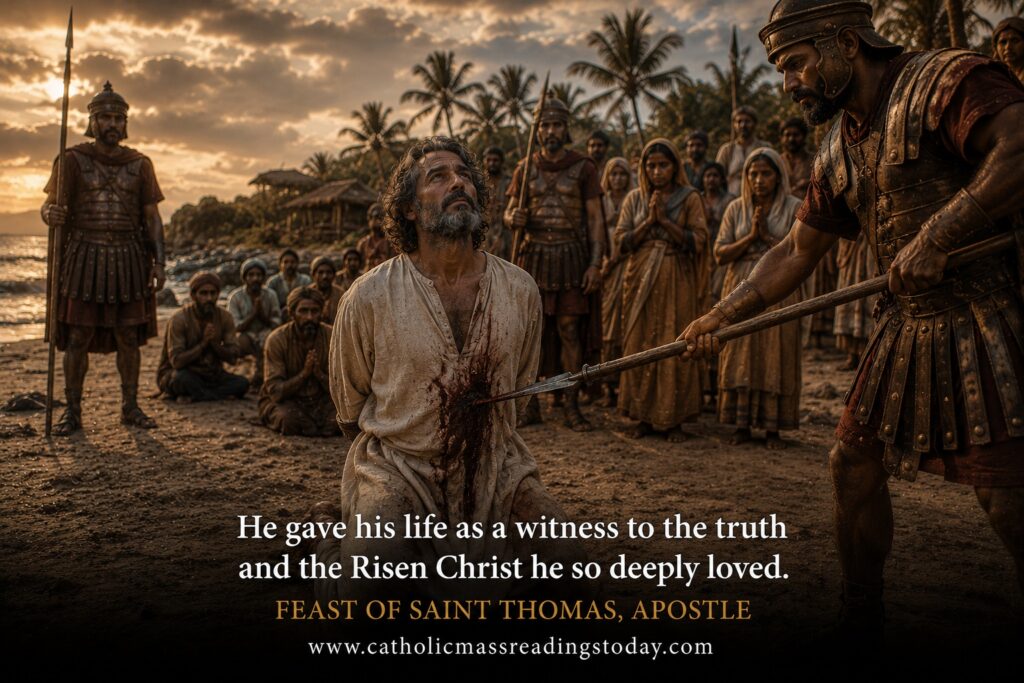
According to the ancient and widely accepted tradition of the Church, Saint Thomas suffered martyrdom near Mylapore, in present day Chennai, India, around A.D. 72.
Tradition tells us that opposition to his preaching grew as more people accepted the Christian faith. His fearless proclamation of Christ angered influential leaders who opposed the spread of the Gospel.
Rather than denying Christ or abandoning his mission, Thomas remained faithful.
He was ultimately killed by soldiers who pierced him with spears while he was at prayer.
The disciple who once desired to touch the wounds of the risen Lord would now offer his own life in imitation of the Master he had come to love so deeply.
His martyrdom completed the remarkable journey that began in the Upper Room with the words:
“My Lord and my God!”
Those words were no longer simply a profession of faith. They had become the very foundation upon which Thomas gave his life.
His Tomb and Christian Pilgrimage
For centuries, Christians have honoured the traditional burial place of Saint Thomas in Mylapore, where the San Thome Basilica now stands.
It remains one of the few churches in the world built over the tomb of an apostle.
Pilgrims from every continent continue to visit this sacred place, praying where one of Christ’s chosen apostles faithfully completed his earthly mission.
His tomb serves as a reminder that the Gospel reached distant lands from the earliest days of the Church and that Christ’s command to “go into all the world” was embraced with extraordinary courage by His apostles.
Patron Saint of Those Who Seek Faith
Because of his honest struggle before professing his faith in Christ, Saint Thomas has become a patron for those who wrestle with doubt or seek a deeper relationship with God.
His example offers great consolation. The Church does not remember Thomas because he doubted.
She remembers him because he allowed Christ to transform his doubt into unwavering faith.
Every believer experiences moments when questions arise. Saint Thomas teaches us that such moments need not separate us from God. When we continue seeking Christ with sincerity, He never fails to reveal Himself in the way that best leads us to deeper faith.
Why Saint Thomas Still Matters Today
In today’s world, many people search for certainty amid confusion. Information is abundant, yet genuine wisdom often seems difficult to find. Saint Thomas reminds us that faith and reason are not enemies. God invites us to seek Him with both our minds and our hearts.
His life also challenges modern Christians to become courageous witnesses.
Thomas travelled thousands of kilometres without modern transportation, technology, or comfort because he believed that every person deserved to hear the Good News of Jesus Christ.
His missionary spirit continues to inspire priests, religious, missionaries, catechists, parents, teachers, and every Catholic who shares the faith through word and example.
The Gospel still spreads through ordinary people who are willing to say “yes” to God.
Lessons We Can Learn from Saint Thomas
The life of Saint Thomas leaves us with timeless lessons that remain relevant for every generation:
- Bring your questions to Christ, not away from Him. Honest searching can become the beginning of a stronger faith.
- Do not allow doubt to have the final word. God’s grace is able to transform uncertainty into joyful conviction.
- Remain close to the Church. Thomas encountered the risen Lord while gathered with the other apostles. Our faith also grows within the communion of the Church.
- Live as a missionary wherever God has placed you. Every Christian is called to proclaim Christ through acts of charity, integrity, and hope.
- Trust even when you cannot see. The Lord’s words remain a blessing for every believer: “Blessed are those who have not seen and yet believe.”
A Saint for Every Believer
The Feast of Saint Thomas is not merely a remembrance of an apostle from the first century. It is a celebration of God’s patient love for every person who sincerely seeks Him.
Thomas teaches us that Christ does not reject those who struggle. Instead, He comes into our fears with His peace, into our questions with His truth, and into our hearts with His mercy.
His life proves that a person once remembered for doubt can become one of history’s greatest missionaries.
May his example encourage us to trust more deeply, love Christ more faithfully, and proclaim the Gospel more courageously in our own homes, workplaces, and communities.
And may his beautiful profession of faith become the daily prayer of every Christian:
“My Lord and my God!”
Prayer to Saint Thomas, Apostle
O glorious Saint Thomas,
you sought the truth with an honest heart and found it in the risen Christ.
Pray for us, that our faith may grow stronger each day. Help us to trust the Lord even when we cannot see His plans, and obtain for us the grace to remain faithful in every trial.
Teach us to proclaim Jesus Christ with courage, to love His Church with devotion, and to become joyful witnesses of the Gospel wherever He sends us.
May we one day join you and all the saints in praising God forever in His heavenly kingdom.
Through Christ our Lord.
Amen.