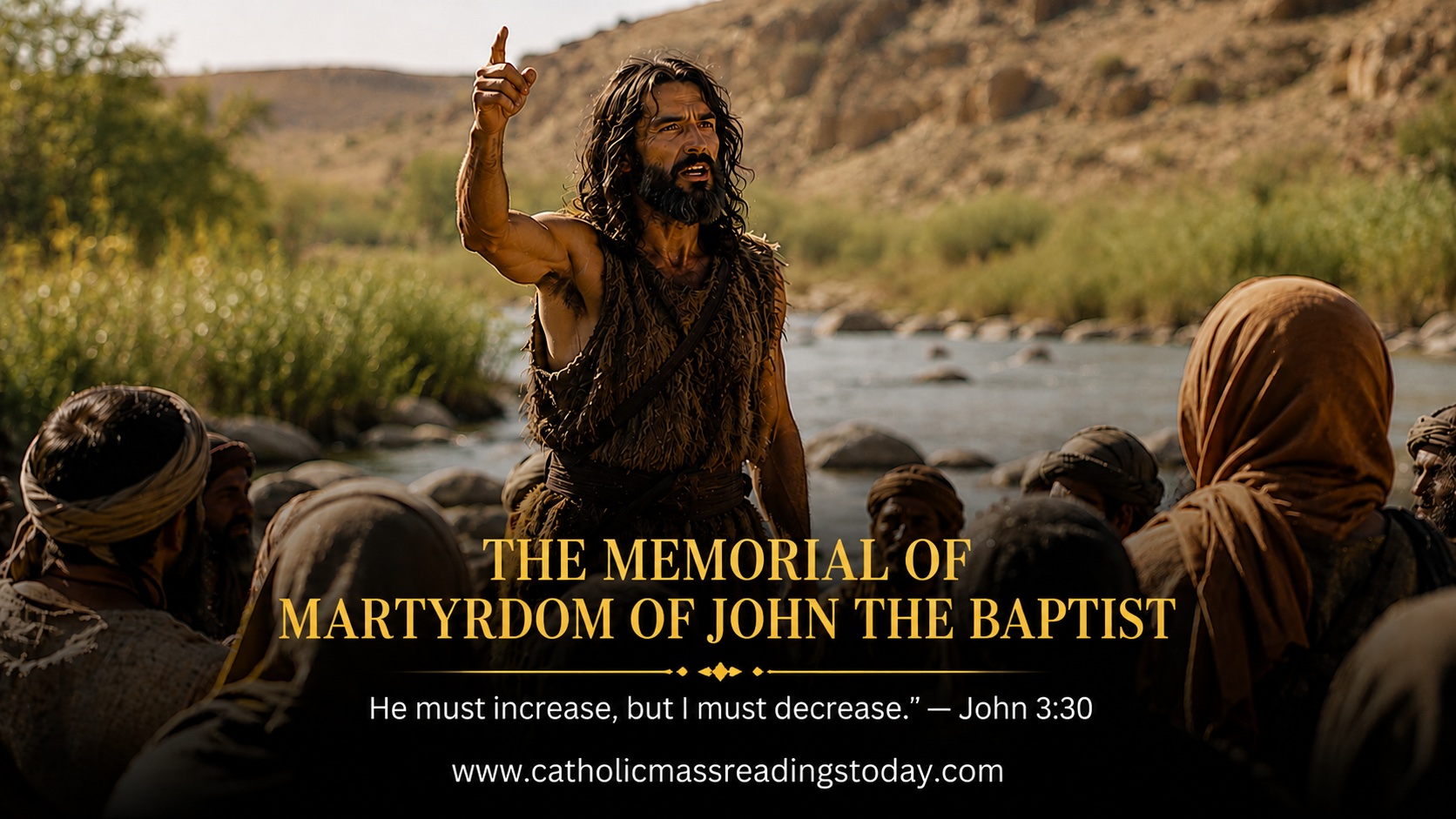
Every year on August 29, the Catholic Church remembers one of the most solemn and courageous witnesses in the history of salvation: the martyrdom, or Passion, of Saint John the Baptist. The Church’s official liturgical observance is commonly titled the Memorial of the Passion of Saint John the Baptist, and it complements the Solemnity of his Nativity celebrated on June 24. The memorial is ancient: evidence places its observance in France by the fifth century and in Rome by the following century.
John’s death cannot be understood apart from his life. He was born for a mission that began before he could speak, spent his adulthood preparing others for Someone greater than himself, and finally surrendered his life rather than silence the truth. From his miraculous conception to the darkness of Herod’s prison, the story of John the Baptist is the story of a man who understood that his life belonged entirely to God.
His greatness did not lie in wealth, political influence or earthly achievement. It lay in his willingness to disappear so that Christ might be seen.
“He must increase, but I must decrease.” Those words capture the whole direction of his life.
A Child Promised Before His Birth
The story begins with an elderly Jewish priest named Zechariah and his wife Elizabeth. Saint Luke describes them as righteous before God, yet they carried a sorrow that had followed them into old age: they had no child.
While Zechariah was carrying out his priestly service in the Temple, the angel Gabriel appeared to him. The message was astonishing. Elizabeth would bear a son, and the child was to be named John.
This would be no ordinary birth. The angel announced that the child would be great before the Lord and would be filled with the Holy Spirit even from his mother’s womb. His mission would be to turn hearts back to God and prepare a people ready for the coming of the Lord.
Zechariah struggled to believe what he heard. He and Elizabeth were already advanced in years. Because of his unbelief, he was left unable to speak until the promise was fulfilled.
Elizabeth nevertheless conceived. The same divine plan would soon bring another extraordinary visitor to her home.
John Leaps Before the Unborn Christ
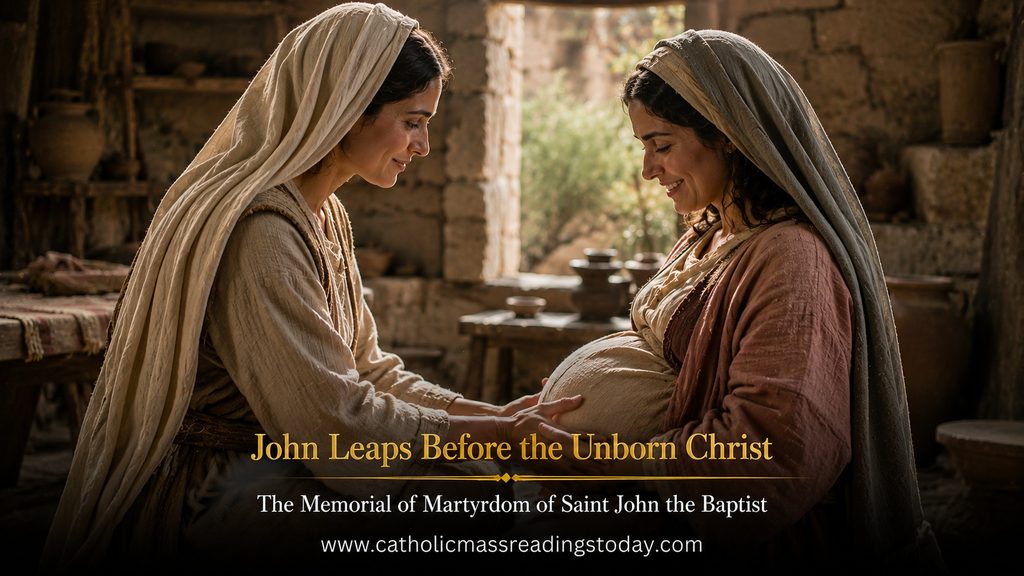
Six months into Elizabeth’s pregnancy, the Blessed Virgin Mary came to visit her.
Mary herself had just received Gabriel’s announcement that she would become the Mother of Jesus. When Mary’s greeting reached Elizabeth, the child within Elizabeth’s womb leaped.
For Catholic tradition, this meeting is profoundly significant. Even before his birth, John’s life is already directed toward Christ. The unborn forerunner encounters the unborn Messiah, and Elizabeth, filled with the Holy Spirit, recognizes the extraordinary grace unfolding before her.
Vatican sources note that John’s birth occurred approximately six months before the birth of Christ, which is reflected liturgically in the Church’s celebration of John’s Nativity on June 24, six months before Christmas.
The scene also reveals something essential about the Christian understanding of human life. John is not presented in Scripture as insignificant because he has not yet been born. Already in his mother’s womb, he belongs within God’s saving plan.
His mission has begun before the world has seen his face.
“John Is His Name”
When Elizabeth eventually gave birth, relatives and neighbours rejoiced with the family. On the eighth day, when the child was circumcised, those present expected him to be named after his father.
Elizabeth insisted that he should be called John. The family objected because the name was not customary among their relatives. They turned to Zechariah, who asked for a writing tablet and wrote:
“John is his name.”
Immediately, Zechariah’s speech returned, and he began praising God.
The Benedictus, the great canticle spoken by Zechariah, looks beyond the happiness of finally having a son. Zechariah recognizes that this child belongs to a divine mission. John will be called a prophet of the Most High. He will go before the Lord to prepare His ways.
John’s life therefore begins with a paradox that will remain until his death: he is extraordinarily important precisely because his mission is to point away from himself.
He has come to prepare the road for Another.
The Voice Crying in the Wilderness
The Gospels tell us little about John’s childhood and early adulthood. Eventually he emerges from the wilderness with a force that captures the attention of an entire region.
His appearance is austere. His life is disciplined. His preaching is uncompromising.
John does not establish himself in a palace or seek the approval of the religious and political elite. He preaches in the wilderness and calls people to repentance.
His message is urgent because something immense is approaching.
“Repent, for the kingdom of heaven is at hand.”
Crowds begin coming to him from Jerusalem, Judea and the surrounding countryside. John baptizes people in the Jordan as a sign connected with repentance and preparation. His ministry becomes so influential that people begin wondering whether John himself might be the expected Messiah.
John refuses the honour. He understands exactly who he is and, equally importantly, who he is not.
He tells the people that someone mightier is coming after him. John’s baptism with water is preparatory; the One coming after him will baptize with the Holy Spirit. Historical Catholic commentary emphasizes that John consistently defined himself as the forerunner rather than allowing the crowds to mistake him for the Christ.
This humility is central to John’s holiness. He possesses enormous spiritual influence but refuses to make himself the centre of it.
For Christians living in an age where visibility, recognition and personal influence can easily become measures of success, John remains an uncomfortable and necessary witness. His question is not, “How can people notice me?” His entire life asks instead, “How can I help people recognize Christ?”
John Baptizes Jesus
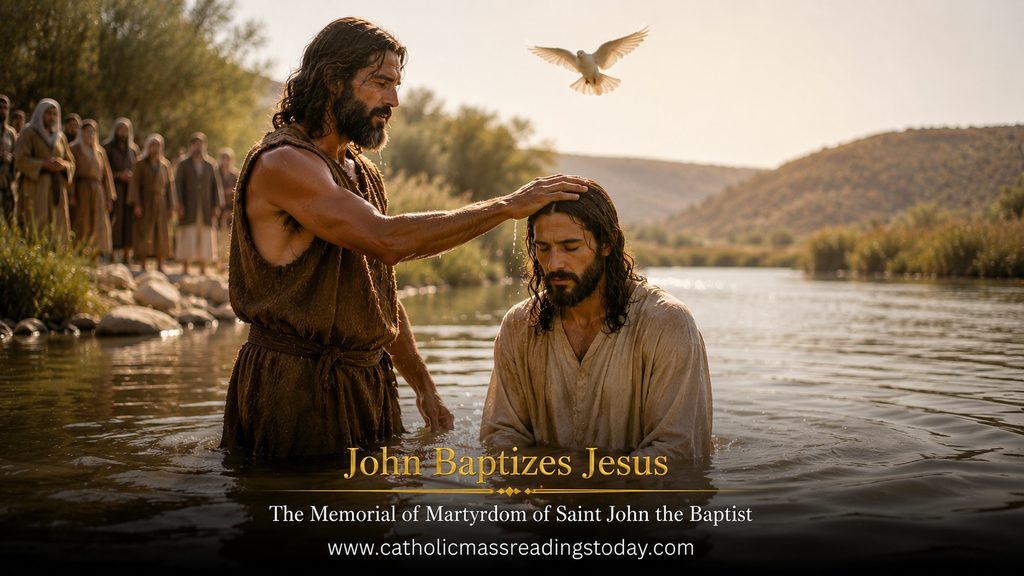
Then comes the encounter toward which John’s entire ministry has been moving.
Jesus comes to the Jordan. John recognizes the profound reversal of what is taking place. He protests that he himself needs to be baptized by Jesus, yet Jesus asks him to permit it.
John obeys. Jesus enters the waters, and at His baptism the Holy Spirit descends and the Father’s voice reveals the identity of His beloved Son.
For John, the moment confirms what his whole life has been preparing him to announce.
The Messiah has come.
John will later identify Jesus to others as the Lamb of God. Some of John’s own disciples begin following Christ.
A lesser man might have been threatened by this. John rejoices. His mission was never to gather disciples permanently around himself. It was to lead them to Jesus.
That is the greatness of authentic Christian ministry. A priest, parent, catechist, teacher, evangelist or Christian leader does not ultimately succeed by making others dependent upon himself. Christian service reaches its purpose when it helps another person encounter Christ.
John understands this perfectly.
“He must increase, but I must decrease.”
Few sentences in Scripture reveal so clearly the interior freedom of a saint.
The Prophet Who Would Not Be Bought
John’s ministry eventually brings him into conflict with political power.
Herod Antipas, a son of Herod the Great and ruler of Galilee, had entered a relationship with Herodias, associated in the Gospel account with his brother Philip. John publicly confronted the unlawfulness of the union. Both the New Testament and the ancient Jewish historian Josephus preserve traditions concerning Herod Antipas, Herodias and John’s death, although their accounts emphasize different aspects of the story.
John could have remained silent. He knew whom he was confronting. Herod possessed soldiers, prisons and political authority. John possessed none of these but the prophet understood that moral truth does not change according to the status of the person standing before it.
What was wrong for the ordinary person did not suddenly become right because a ruler desired it. So John spoke. “It is not lawful for you to have your brother’s wife.”
Those words would eventually cost him his life, yet they reveal something essential about his character. John was not a prophet who adjusted God’s message according to the preferences of his audience. He had already called ordinary people to repentance. He had challenged religious leaders. Now he spoke truth to a ruler.
John’s courage was not hatred of Herod. A genuine call to repentance is ultimately a call toward life. John wanted conversion, not destruction.
But Herodias heard the prophet differently. She developed a bitter resentment against him.
John the Baptist in Prison
Herod had John arrested, bound and imprisoned.
Tradition strongly associates John’s imprisonment and execution with Machaerus, Herod’s fortress east of the Dead Sea in present-day Jordan. Archaeological investigation there has reconstructed significant elements of the Herodian palace complex and strengthened understanding of the setting associated with the Gospel account.
The contrast between John and Herod becomes especially striking during this period.
John is physically imprisoned but morally free. Herod on the other hand is politically powerful but inwardly divided.
Saint Mark tells us that Herod knew John to be “a righteous and holy man.” He feared him and protected him. More remarkably, Herod listened to him and was perplexed by what he heard, yet he still liked to listen.
This is one of the most psychologically revealing details in the entire account.
Herod recognizes something holy in John. His conscience has not completely disappeared. He can hear the truth. What he cannot bring himself to do is obey it.
The tragedy of Herod is therefore not ignorance. It is compromise. He hears the call to change but continues living as before.
There is a warning here for every Christian. It is possible to enjoy hearing the Word of God without allowing it to transform us. We can listen to Scripture, admire saints, attend Mass and appreciate a moving homily while carefully protecting the very areas of life that Christ is asking us to surrender.
John’s prison becomes the place where Herod repeatedly encounters the possibility of conversion but he does not take it.
A Birthday Banquet and a Fatal Promise
Then came Herod’s birthday. A great banquet was arranged for his courtiers, military officers and prominent men of Galilee. It was an occasion designed to display status and power.
During the celebration, the daughter of Herodias danced before Herod and his guests. Pleased by her performance, Herod made an extravagant promise. He would give her whatever she requested.
The girl went to her mother and asked what she should request. Herodias had been waiting for her opportunity. She wanted the head of John the Baptist. The girl returned and made the demand before the king:
“I want you to give me at once the head of John the Baptist on a platter.”
Saint Mark tells us that Herod was deeply distressed. That detail matters enormously.
Herod knows this is wrong, he knows John is righteous, he also does not actually want to kill him yet he has made his promise publicly, and his guests are watching.
Herod now faces a choice between conscience and reputation. He chooses reputation because of his oaths and those sitting with him, he refuses to withdraw his reckless promise.
The ruler who possesses the power to command armies proves incapable of saying a simple word:
No.
The Martyrdom of John the Baptist
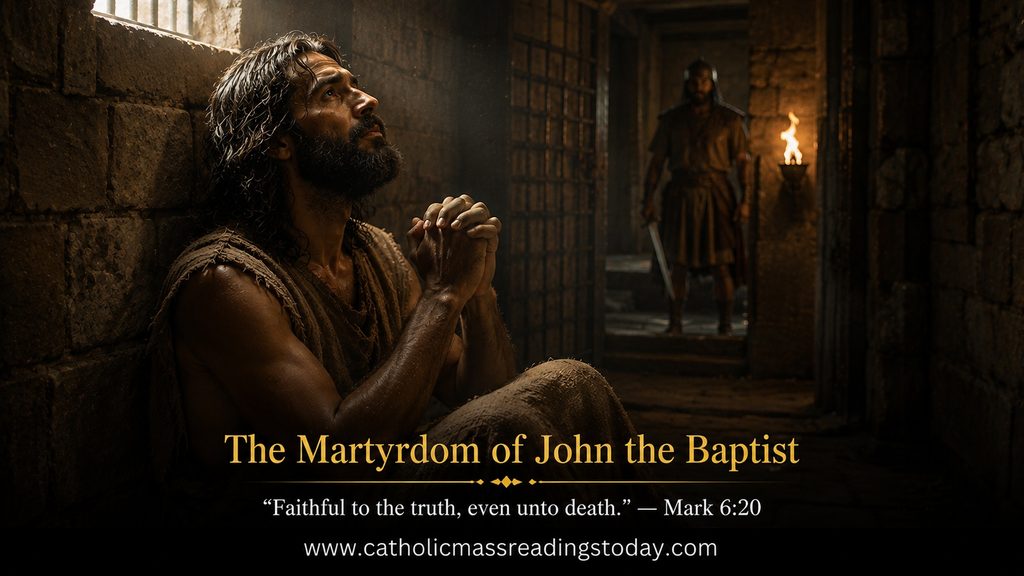
Herod sends an executioner into the prison. There, away from the celebration and far from the admiration of the crowds who once gathered around the Jordan, John’s earthly life comes to an end.
He is beheaded.
His head is brought on a platter and given to the girl, who gives it to her mother. John’s disciples later come, take his body and place it in a tomb.
The Church traditionally places his martyrdom around AD 31 to 32, while the August 29 observance itself has ancient liturgical roots. Vatican sources connect its development with early veneration associated with Sebaste in Samaria and note its presence in the Western Church from the early centuries.
From the perspective of Herod’s banquet, it appears that John has lost.
The prophet is dead, Herod still sits on his throne, Herodias has achieved what she wanted and the banquet continues but history has judged that evening very differently.
Herod’s palace eventually fell silent, hHis guests disappeared, his political authority vanished and his kingdom became history.
Yet John still speaks.
Nearly two thousand years later, his words are proclaimed from Catholic churches throughout the world. Christians continue to hear his call to repentance. Pilgrims remember the places associated with his ministry. The Church celebrates both his birth and his martyrdom.
The ruler who ordered John’s execution is remembered largely because of the prophet he could not silence.
A Martyr for the Truth
John’s martyrdom occupies a distinctive place in Catholic spirituality.
He was not executed because someone ordered him explicitly to deny God. He died because fidelity to God required him to speak a moral truth that powerful people did not want to hear.
For this reason, Catholic reflection has often described John as a martyr for truth. Vatican teaching on today’s memorial similarly emphasizes that he was a righteous and holy man who died because he spoke freely and remained faithful to his vocation.
His martyrdom therefore speaks powerfully to every generation. Truth cannot become false because it is unpopular, wrong cannot become right because the powerful approve it, the dignity of the human person cannot depend upon convenience and conscience cannot safely be surrendered to the opinion of the crowd.
John did not die because he lacked wisdom about how the world worked. He died because there are moments when preserving one’s earthly security at the cost of fidelity to God would mean losing something greater.
He chose fidelity.
John the Baptist and Jesus Christ
John’s death also points unmistakably toward the Passion of Jesus.
The parallels are striking.
John is an innocent man condemned despite the ruler’s awareness that he is righteous. Jesus is innocent, and Pilate recognizes that no crime deserving death has been established against Him.
Herod is influenced by the people around him.
Pilate is pressured by the crowd.
Both rulers possess authority, yet neither possesses the moral courage to use that authority justly.
John’s body is eventually taken by his disciples and buried.
Jesus’ body will likewise be taken down and placed in a tomb.
Once again, John prepares the way.
Yet there is an infinite distinction between them. John is the witness; Christ is the One to whom he bears witness. John calls people to repentance; Christ forgives sins by divine authority. John baptizes with water in preparation; Christ gives the Holy Spirit. John gives his life in fidelity to truth; Jesus gives His life for the redemption of the world.
John’s greatness therefore always points beyond John.
He is the voice.
Christ is the Word.
He is the lamp.
Christ is the Light.
He is the friend of the Bridegroom.
Christ is the Bridegroom.
The whole beauty of John’s life lies in knowing this distinction and rejoicing in it.
Why the Catholic Church Celebrates Both John’s Birth and His Death
Saint John the Baptist holds an exceptional place in the Church’s liturgical life.
The Church celebrates his Nativity on June 24 and commemorates his Passion on August 29. Vatican News notes the unusual prominence given to both the beginning and end of his earthly life, reflecting his unique role in salvation history.
Jesus Himself gives the clearest explanation of John’s greatness when He speaks of him as uniquely great among those born of women.
John stands at the threshold between the Old Covenant and the fulfilment revealed in Christ. He belongs to the prophetic tradition of Israel and yet receives the extraordinary privilege of physically pointing to the Messiah whose coming the prophets had announced.
Isaiah had spoken of a voice crying in the wilderness.
John became that voice.
Generations had awaited the Messiah.
John saw Him.
Prophets had announced His coming.
John pointed toward Him and identified Him.
And when John’s own disciples began following Jesus, he did not try to call them back.
His joy was complete because the Bridegroom had arrived.
What Saint John the Baptist Means for Catholics Today
The world surrounding John was different from ours, but the human weaknesses revealed in his martyrdom have not disappeared.
Herod’s concern about the opinion of his guests still exists whenever someone betrays conscience to gain approval.
Herodias’ resentment still exists whenever a person allows correction to become hatred rather than an invitation to self-examination.
The atmosphere of the banquet still exists wherever pleasure, prestige or social acceptance becomes more important than what is right.
And John’s courage is still needed wherever truth becomes costly.
Most Catholics will never face martyrdom in the literal sense. But every Christian faces moments when fidelity requires sacrifice.
There may be a relationship that must be made right, dishonesty that must end, an apology that pride resists, a vulnerable person who needs defending, an injustice that should not be ignored, a temptation that must finally be confronted or a return to the Sacrament of Reconciliation that has been postponed for years.
These moments may appear ordinary, but they reveal the same fundamental question that stood behind the doors of John’s prison:
Will I belong to God when belonging to God costs me something?
Christian courage does not mean becoming argumentative or harsh. John the Baptist should never be used as an excuse for cruelty in the name of religion. Truth and charity belong together. The Catholic witness must defend what is true while recognizing the God-given dignity of the person standing before us.
The goal is never to defeat another person.
The goal is fidelity to Christ and, whenever possible, the conversion and salvation of souls.
“He Must Increase, but I Must Decrease”
If one sentence could summarize the spiritual life of John the Baptist, it would surely be:
“He must increase, but I must decrease.”
John’s greatness is found precisely in his willingness to become smaller once Christ appears.
He does not cling to influence.
He does not become jealous when people leave him to follow Jesus.
He does not turn his ministry into a monument to himself.
He understands that everything he has received exists for the mission God entrusted to him.
This makes John particularly relevant in an age obsessed with self-promotion. Much of modern culture encourages us to be seen, noticed, followed, praised and remembered.
John offers another measure of greatness.
The question is not how many people notice us.
The question is whether people can encounter Christ through us.
A parent lives this when a child learns to love God through the faith practised at home. A priest lives it when his ministry directs people toward Christ rather than himself. A teacher lives it when truth matters more than personal recognition. A Christian lives it whenever his or her actions quietly reveal mercy, integrity, humility and love.
The Christian life is not about making ourselves disappear because we have no value. It is about discovering that our deepest value is found in belonging to Christ.
John knew who he was because he knew whose he was.
The Prisoner Who Was Freer Than the King
Perhaps the most striking image to carry from this memorial is the contrast between two men.
One sits on a throne.
The other sits in a prison.
One has soldiers.
The other has chains.
One controls a kingdom.
The other cannot even control when the prison door opens.
Yet John is free.
Herod is not.
John can obey his conscience.
Herod cannot overcome his fear of his guests.
John can speak the truth.
Herod can recognize the truth but lacks the courage to follow it.
John loses his earthly life but remains faithful to God.
Herod preserves his reputation for the evening but becomes remembered for an act he himself knew was wrong.
This is Christian freedom.
Freedom is not simply the ability to do whatever we want. Genuine freedom is the capacity, strengthened by grace, to choose what is good.
That is why the saints can remain free even inside prison cells, while powerful people can become slaves to ambition, lust, resentment, pride or fear.
John’s chains could restrain his hands.
They could not possess his soul.
John’s Voice Has Never Been Silenced
The executioner entered John’s prison and ended his earthly voice. But what he failed to end was John’s witness.
The message that once echoed along the Jordan still reaches the Church:
- Prepare the way of the Lord.
- Repent.
- Bear good fruit.
- Do not confuse yourself with Christ.
- Point others toward Him.
- Tell the truth.
- Remain faithful.
And when Christ comes, step aside joyfully and allow Him to increase.
This is why the Memorial of the Martyrdom of John the Baptist is more than the remembrance of a terrible death. It is the celebration of a life that reached its proper fulfilment because it remained faithful to its purpose.
John’s life began with a miracle in the home of Zechariah and Elizabeth. Before his birth he leaped at the presence of Christ. He grew into the prophet of the wilderness. He called sinners to repentance. He baptized in the Jordan. He prepared Israel for the Messiah. He baptized Jesus. He pointed his disciples toward the Lamb of God. He confronted wrongdoing even when it reached into a royal palace. He endured imprisonment. And finally, he gave his life rather than betray the truth entrusted to him.
The Church remembers him because the world still needs what John represented.
- We need consciences that cannot be purchased.
- We need humility that does not crave applause.
- We need courage that does not become hatred.
- We need truth spoken with love.
Above all, we need men and women willing to point beyond themselves toward Jesus Christ.
Herod’s banquet ended long ago.
But the voice from the wilderness is still speaking.
And on this memorial, it speaks once more to each of us:
Prepare the way of the Lord.
Prayer for the Memorial of the Martyrdom of Saint John the Baptist
Almighty and eternal God,
You called Saint John the Baptist
from his mother’s womb
to prepare the way for Your beloved Son.
You filled him with courage
to proclaim repentance,
with humility to point others toward Christ,
and with fidelity to bear witness to the truth
even unto death.
Through his intercession,
strengthen our faith
and form our consciences according to Your Word.
Give us courage when truth is difficult to speak,
humility when we are praised,
patience when we are misunderstood,
and charity toward those who oppose us.
Keep resentment and hatred far from our hearts.
Deliver us from the desire for human approval
when it leads us away from You.
When we fall into sin,
grant us the grace of sincere repentance
and lead us back to You
through the Sacrament of Reconciliation.
Teach us, like Saint John the Baptist,
to decrease so that Christ may increase within us,
to seek Your glory rather than our own,
and to use every gift You have given us
in the service of Your Kingdom.
May our lives faithfully point others toward Jesus,
the Lamb of God who takes away the sins of the world,
so that when our earthly journey is complete,
we may join Saint John the Baptist,
the Blessed Virgin Mary
and all the saints
in praising You forever in Heaven.
Through Christ our Lord.
Amen.
Saint John the Baptist, pray for us.