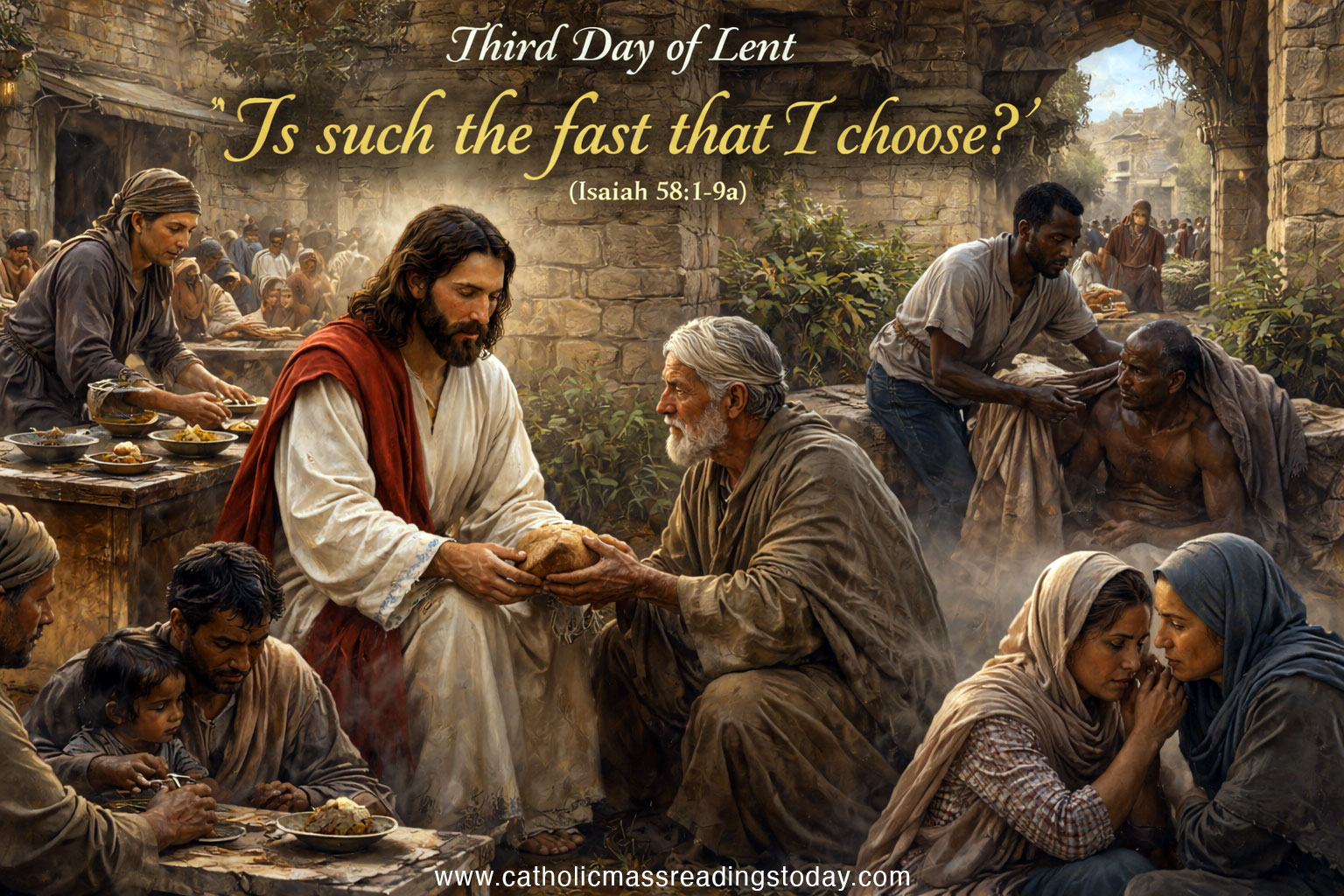
My dear brothers and sisters, today being the third day of our Lenten journey the Word of God confronts us gently but firmly. Through the prophet Isaiah, the Lord spoke to the people who had returned from exile. They were rebuilding their nation, rebuilding their worship, rebuilding their religious practices. They were fasting, praying and going through the external motions of faith and yet, something was wrong.
While they fasted, they were mistreating their workers, as they prayed, they were oppressing the vulnerable and while they humbled themselves outwardly, their hearts remained hardened toward one another.
So God asks them a piercing question: “Is such the fast that I choose?”
1. Fasting Is more than denying ourselves food
Today we focus on fasting. Many of us have begun our Lenten sacrifices perhaps skipping meals, reducing portions, giving up certain comforts. But Isaiah reminds us that fasting is not simply about denying ourselves a meal. If we fast from food but feast on anger, if we abstain from meat but consume gossips, if we deny ourselves bread yet deny justice to others then we are not truly fasting.
The Lord makes it clear: You cannot fast and at the same time mistreat others.
When we do that, we discredit fasting and reduce it to a ritual. True fasting is never only about the body it is about the heart.
2. True fasting restores relationships
“My brothers and sisters, true fasting is about restoration.” God says the fast He chooses is this:
- To loose the bonds of wickedness
- To undo oppression
- To let the oppressed go free
- To share your bread with the hungry
- To welcome the homeless
- To clothe the naked
- Not to hide yourself from your own flesh
Notice something powerful here: The fast God desires is relational.
Fasting is a discipline that trains us and equips us to treat others well. If during this holy season you are not speaking to your brother, your sister, your spouse, your neighbor and you make no effort to reconcile then what exactly are you fasting for?
If we fail to treat our workers with dignity, if we ignore the poor, if we close our hearts to the suffering, Isaiah says plainly: that is not fasting at all.
There must be a change in how we relate to others when we enter the fasting period.
3. A lesson in dedication
Look at our Muslim brothers and sisters during their fasting season. We must admit their dedication. During their fast, many become extremely intentional about kindness, generosity, hospitality, and prayer. They take their discipline seriously. They follow their teachings with commitment.
That example should challenge us not to compete, but to reflect: Are we taking our Lenten fasting seriously? Is it transforming us? Is it softening our hearts?
4. Forty Three Days to become different
Being the third day of Lent, we still have thirty seven days plus six Sundays, forty three days including Sundays ahead of us.
Forty three days to care.
Forty three days to love.
Forty three days to forgive.
Forty three days to rebuild broken relationships.
How are you going to live during this period? These changes are not meant to be a show. Lent is not spiritual performance. Jesus Himself warns us not to fast in order to be noticed. Fasting is between you and your God. We fast because we want to deepen our relationship with Him.
But here is the truth Isaiah teaches us: To better our relationship with God, we must show goodness to others.
5. Start at home
Let us begin where it matters most, at home.
- If you are not talking to your spouse, begin the conversation.
- If there is bitterness between siblings, forgive.
- If there is distance between parents and children, close the gap.
- Be available to your wife.
- Be present to your husband.
- Be attentive to your children.
During this fasting period, do not hide yourself from your loved ones. Then extend it outward:
- Be kind to your workers.
- Treat employees with fairness and dignity.
- Feed the hungry.
- Welcome the lonely.
- Help someone you have never helped before.
True fasting stretches us beyond our comfort and beyond our usual circle.
6. The promise of God
So what what happens when we fast this way? Isaiah gives us a beautiful promise:
“Then shall your light break forth like the dawn…
Your healing shall spring up speedily…
Then you shall call, and the Lord will answer;
You shall cry, and He will say, ‘Here I am.’”
Notice the order.
First: restore relationships.
First: care for others.
First: loosen the bonds of injustice.
Then: light breaks forth.
Then: healing comes.
Then: God answers.
When we fast the way God desires, heaven responds.
7. Lent as a way of life
These forty days are not meant to be temporary adjustments. They are meant to reshape us permanently. By intentionally practicing prayer, fasting, and almsgiving, we allow God to mold us into people of compassion, justice, and mercy. If we live Lent well, it should not end on Easter Sunday but become our Christian way of life. When we change our lives as per the teachings of the Lord during this lenten period, everyone around us will be positively affected in a Godly way.
My dear brothers and sisters, today lets us ask ourselves honestly:
- Who do I need to forgive?
- Whom have I mistreated?
- Where must I restore justice?
- How can I make my fasting real?
May our fasting not be empty ritual.
May it become restoration.
May it become mercy.
May it become love.
And when we cry out to the Lord, may He say to us with tenderness,
“Here I am.”
Amen.