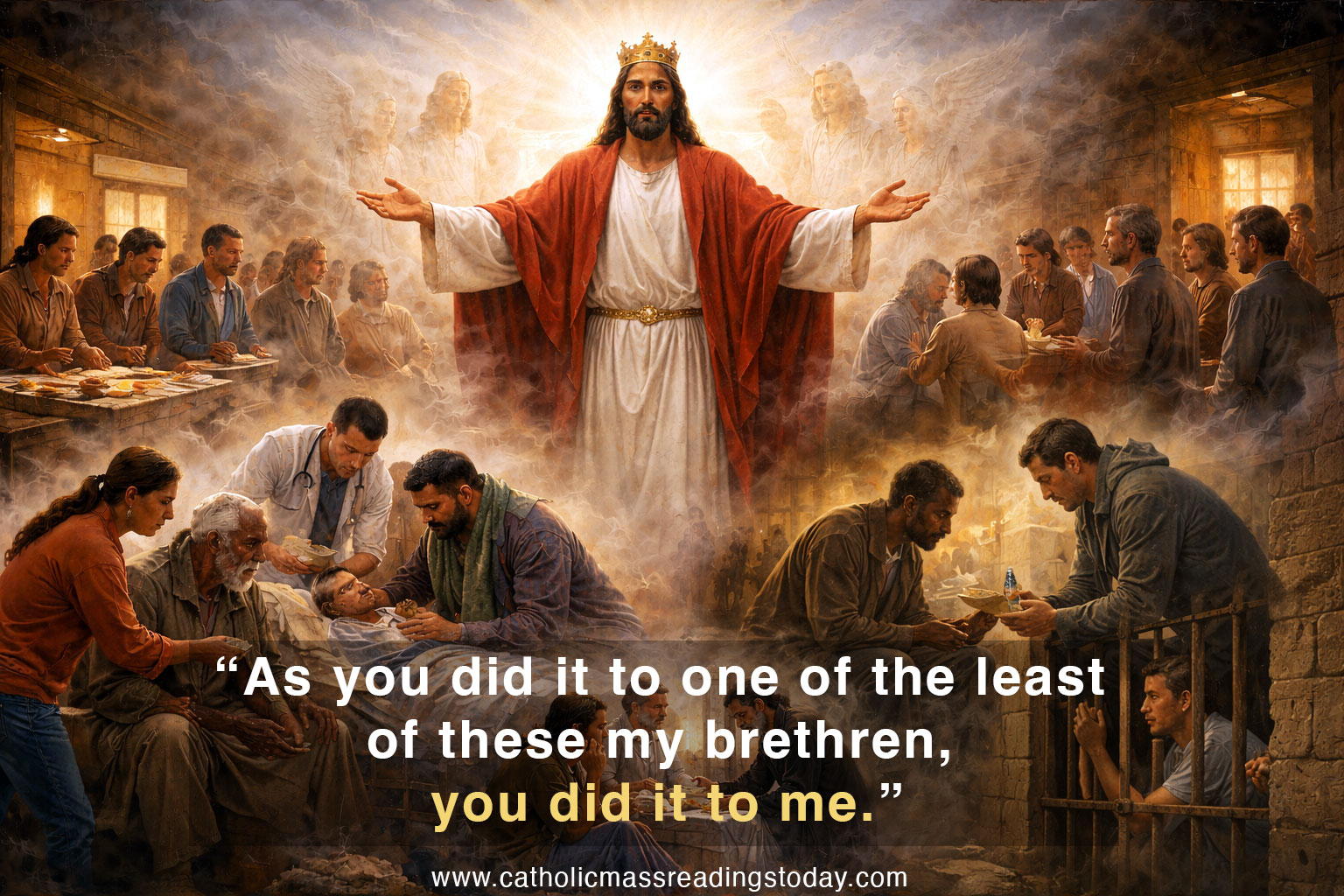
“As you did it to one of the least of these my brethren, you did it to me.”
Dear brothers and sisters in Christ, at the very beginning of this holy season of Lent, the Church places before us a Gospel that is both consoling and sobering. It is consoling because it reveals the tenderness of God and sobering because it shows us the seriousness of our response or lack of to that tenderness. In this passage from the Gospel according to Saint Matthew, our Lord unveils the final horizon of history. This is the coming of the Son of Man in glory, the gathering of all nations, and the judgment that flows not from arbitrary decree, but from love either embraced or refused.
1. The King who identifies with the poor
Notice first the amazing claim of Christ:
“As you did it to one of the least of these my brethren, you did it to me.”
The Judge is not distant, neither is the King not friendly. He has so united Himself with humanity especially with the poor, the suffering, the forgotten that our treatment of them becomes our treatment of Him.
This is not a poetic exaggeration but words that flows from the mystery of the Incarnation. The eternal Son of God truly became man, He hungered, He thirsted, He was a stranger in Egypt, He was stripped of His garments, He was imprisoned and condemned. Therefore, when we encounter the hungry, the migrant, the sick, the prisoner, we encounter not a “problem” to solve but a Person to have deep respect for and this Christ tells us it is Himself.
The Fathers of the Church often reminded us; if we wish to find Christ, we will find Him in the Eucharist and in the poor. The altar and the street are not opposed. The love we profess before the tabernacle must become the love we practice in daily life and especially during this lenten period.
2. The criteria of judgment: Love in action
It is striking that in this scene of judgment, our Lord does not speak of extraordinary feats, theological brilliance, or public acclaim. He speaks of simple acts of true love:
- Feeding the hungry
- Giving drink to the thirsty
- Welcoming the stranger
- Clothing the naked
- Visiting the sick
- Visiting the imprisoned
These are what the Church calls the corporal works of mercy. These are not optional devotions, they are concrete expressions of charity “caritas” which is the very life of God poured into our hearts. What condemns the goats is not that they committed spectacular crimes but that they failed to love. They saw suffering and remained unmoved. Their sin was omission. Lent is therefore a privileged time to examine not only what evil we have done, but what good we have failed to do.
How many opportunities for mercy pass before us unnoticed? How often do we say, “Someone else will help”? Yet Christ says: “You did not do it to me.”
3. Lent: A season of reordering Love
In this first week of Lent, Holy Mother Church calls us to prayer, fasting, and alms giving. This Gospel illuminates especially the meaning of alms giving.
Alms giving is not merely giving from surplus; it is giving from love. It is allowing our heart to be stretched. Fasting without charity becomes a self centered discipline. Prayer without mercy becomes empty piety. But when fasting frees resources for the poor, and prayer opens our eyes to Christ in others, Lent becomes fruitful.
The ashes we have received remind us: “You are dust.” This means we are not self sufficient, we stand in need of mercy and precisely because we need mercy, we must also give mercy.
4. The universality of the judgment
“All the nations” will be gathered before Him with no culture, no language and no people are excluded. The Gospel transcends every boundary. In the end, what will matter is not our nationality, status, or achievements, but whether we loved by giving food to the hungry, giving a drink to the thirsty, welcoming the stranger, clothing the naked, visiting the sick and visiting the imprisoned.
This is profoundly Catholic universal, the Church proclaims the dignity of every human person because each one is created in the image of God and redeemed by Christ. When we serve the poor, we affirm that dignity and when we ignore them, we deny in practice what we profess in the Apostles’ Creed.
5. Eternal consequences
The holy Gospel according to Matthew 25: 31 – 46 concludes with words that we may find difficult:
“Eternal punishment… eternal life.” Christ speaks of eternal realities because our choices have eternal weight. God does not coerce love but invites it. Heaven is the fullness of communion with Love; hell is the tragic refusal of it.
Lent is therefore not a minor spiritual exercise but a season of decision. Each act of charity shapes our soul for heaven while each persistent refusal of love hardens the heart.
6. We are called to
Let us not read this Gospel with fear alone, but with hope. The King who judges is the same Lord who died for us. He desires that all be saved and gives us this teaching not to paralyze us, but to awaken us.
This week, let each one of us ask:
- Who around me is hungry, and not only for food, but for attention?
- Who is thirsty, and not only for water, but for kindness?
- Who feels like a stranger in my workplace, parish, or family?
- Who is sick, burdened, or forgotten?
We may not solve the world’s suffering though we can love the person placed before us today.
If we begin with one act of mercy at a time, then when God comes in His glory, we shall not be strangers to Him. We will recognize in His face the same Christ we served in the poor.
And perhaps, by grace, we shall hear those blessed words:
“Come, O blessed of my Father, inherit the kingdom prepared for you.”
May this holy Lent purify our hearts, enlarge our charity, and teach us to recognize Christ in the least of our brothers and sisters.
Amen.