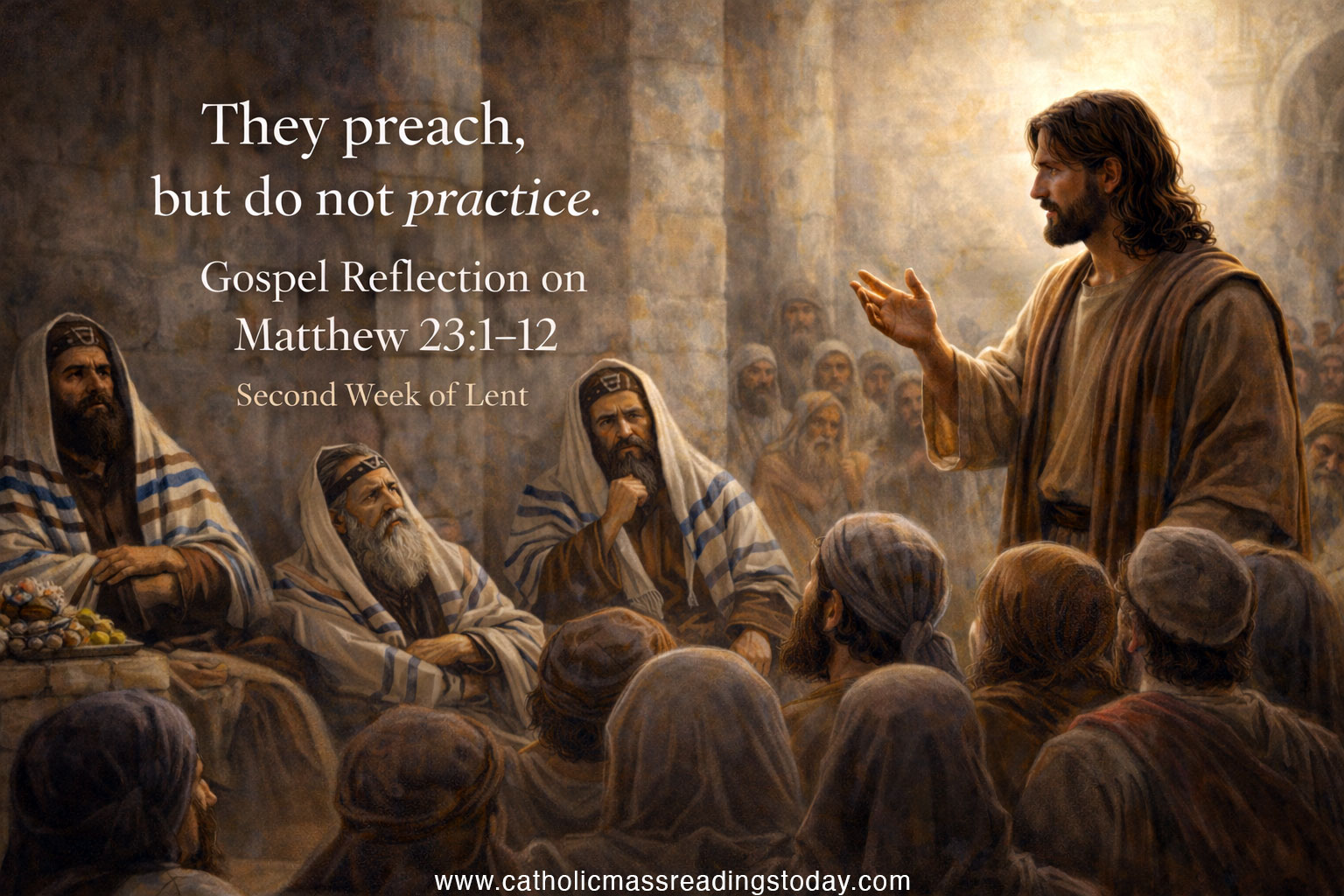
“They preach, but do not practice.”
Second Week of Lent
As we move deeper into this sacred season of Lent, the Gospel places before us a difficult but necessary mirror. In Matthew 23:1-12, Jesus speaks plainly about the scribes and the Pharisees. He acknowledges that they “sit on Moses’ seat” meaning they have legitimate authority to teach the Law. Yet He warns the people: “Practice and observe whatever they tell you, but not what they do; for they preach, but do not practice.”
This is not simply a criticism of a religious group in the first century Israel but a warning addressed to every generation including ours.
Listening to the Word and Living It
At the heart of this Gospel is a simple but demanding truth: it is not enough to know the Word of God, we must also live it.
Jesus is not dismissing the Law, He is not rejecting authority. In fact, He affirms the importance of listening to what is true and faithful to God’s command. He exposes the danger of hypocrisy of appearing righteous while remaining unchanged within.
The scribes and Pharisees “bind heavy burdens” on others but refuse to lift a finger on themselves. They love recognition, titles, and places of honour. Their religion becomes performance rather than conversion and this is where the Gospel becomes personal.
Lent is not about appearances. It is not about looking prayerful, fasting publicly, or speaking profound religious devotion. Lent is about interior transformation and allowing the Word of God to purify our motives, correct our pride, and soften our hearts.
Isaiah’s Prophetic Warning: Sodom and Gomorrah
The first reading from Isaiah 1:10, 16-20 deepens this reflection. The prophet Isaiah boldly addressed the rulers of Jerusalem as “rulers of Sodom” and the people as “people of Gomorrah.” This comparison was striking. Sodom and Gomorrah had been destroyed centuries earlier, in the time traditionally associated with Abraham. Yet Isaiah used those names not to recall history, but to describe the moral decay he saw before him.
Sodom and Gomorrah had become symbols of grave immorality, injustice, and corruption. Isaiah was not merely condemning individual sins; he was confronting a society where leaders abused power and citizens tolerated wrong doing.
Interestingly, during Isaiah’s time, the king himself was striving for reform. Yet those around him, the officials, judges, and influential leaders acted unjustly. The rot was not only political; it was moral and spiritual.
Does this not speak to our own time?
We often blame national leaders, ministers, or those in authority for corruption and injustice. And at times, that criticism may be justified. But Isaiah’s message was not limited to rulers. He also called the people to conversion: “Wash yourselves; make yourselves clean; cease to do evil, learn to do good.”
During the time of Lent, we are reminded to ask ourselves uncomfortable questions:
- In what ways do I resemble the people of Gomorrah?
- In what ways do I resemble the rulers of Sodom?
- Do I condemn corruption while quietly participating in dishonesty?
- Do I demand moral leadership while neglecting my own conversion?
National transformation begins with personal repentance and our homes will be renewed when our hearts are renewed.
The Pharisee Within
Jesus’ words about the Pharisees are not an attack on priests or civil leaders alone but a warning to every baptized person.
“You may also be a Pharisee.” That is a hard truth, but an honest one.
Whenever we:
- Speak about forgiveness but hold grudges,
- Preach honesty but cut corners,
- Quote Scripture but fail to love,
- Seek recognition for our religious acts,
we fall into the same trap.
The Word of God addresses all of us by reminding us that it is not enough to attend Mass, listen to readings, or share spiritual messages without also practicing what the word of God teaches us, we must ask:
- Am I living what I hear?
- Has the Word changed the way I speak to my spouse, my children, my colleagues?
- Do I treat others with dignity when no one is watching?
Lent is a season of truth, a time to examine not only what we believe, but how we live.
One Teacher, One Father
Jesus concludes with a profound reminder:
“You have one teacher… one Father… one master, the Christ.”
This is not a rejection of legitimate authority in the Church or society. Rather, it is a call to humility. All authority is accountable to God. All wisdom flows from Christ. All fatherhood reflects the Father in heaven.
The greatest among us, Jesus says, must be a servant.
In a world that measures success by status and visibility, Christ measures greatness by humility and service. The one who exalts himself will be humbled; the one who humbles himself will be exalted.
This is the Lenten path:
- Not self promotion, but self emptying.
- Not titles, but service.
- Not outward show, but inward conversion.
A Time for Reflection
This second week of Lent invites us into deeper reflection, not condemnation but honest reflection.
How can we use this season to:
- Make our homes more peaceful?
- Make our workplaces more just?
- Make our nation more compassionate?
- Make our Church more credible by living what we profess?
The transformation of society begins with the transformation of conscience.
Let us not merely listen to the Word. Let us become doers of the Word. Let us allow Christ, our one Teacher, to shape our minds and purify our hearts.
Only humility will save us. Only sincerity will renew us. Only lived faith will bear fruit.
Let us Pray
Heavenly Father,
You alone are holy. You alone are our true Teacher and guide.
In this Lenten season, free us from hypocrisy and pride.
Help us not merely to hear Your Word, but to live it with sincerity and courage.
If we have acted like the rulers of Sodom through injustice or misuse of responsibility, forgive us.
If we have resembled the people of Gomorrah through indifference or compromise, cleanse us.
Wash our hearts from hidden sin.
Teach us humility.
Make us servants in our homes, our communities, and our nation.
Lord Jesus, transform our faith from appearance into authenticity.
May this Lent not pass us by unchanged.
Renew us, convert us, and lead us into the joy of true righteousness.
We ask this in Your Holy Name.
Amen.