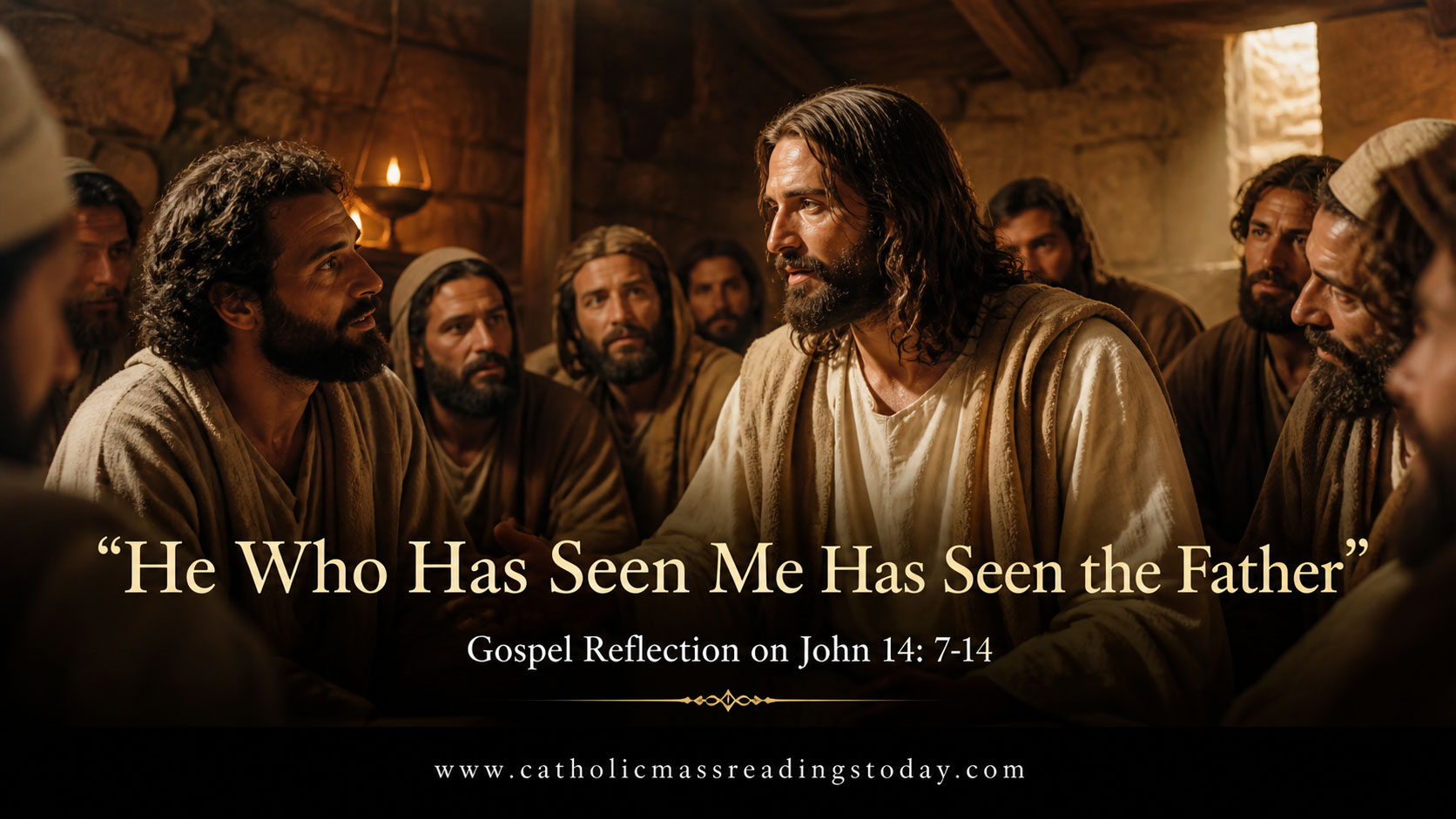
In this Gospel, the Lord Jesus leads His disciples into one of the deepest mysteries of our faith: the mystery of His union with the Father. The conversation begins with a desire that is profoundly human and profoundly religious. Philip says, “Lord, show us the Father, and we shall be satisfied.” In those few words, he gives voice to the longing of every human heart.
Man is not made to live on earthly things alone. Beneath every ambition, every search, every sorrow, every question, there remains this hidden thirst: to see God, to know Him, to be near Him, to rest in Him. That longing is not weakness. It is the mark of our creation. We were made by God and for God, and until we return to Him, something in us remains incomplete.
Philip asks for what every soul desires. But the Lord’s answer is at once gentle and astonishing: “Have I been with you so long, and yet you do not know me, Philip? He who has seen me has seen the Father.”
These words stand at the center of Christian faith. Jesus does not merely speak about God. He does not simply point in God’s direction. He reveals Him. To look upon Christ in faith is to encounter the living God made visible. In His mercy, His truth, His words, His works, His compassion, His authority, His obedience, and ultimately His Cross, the Father is made known.
This is one of the great treasures of the Gospel: God is no longer distant, hidden behind abstraction, or left to human speculation. In Jesus Christ, the invisible God has drawn near. He has taken a human face. He has entered our history. He has spoken our language. He has carried our sorrows. He has revealed not only that God exists, but what God is like.
And what do we see in Christ? We see a God who loves. A God who seeks the lost. A God who forgives sinners. A God who lifts up the poor. A God who washes feet. A God who gives Himself completely.
This is why the Christian life cannot be reduced to ethics, custom, or vague spirituality. At its heart is a relationship with the Person of Jesus Christ. For in Him, the Father is known. Outside Him, man gropes in darkness, even when he speaks much about religion. In Him, the face of God shines with clarity.
The Lord continues: “Do you not believe that I am in the Father and the Father is in me?” Here we are brought into the mystery of divine communion. The Son is not separate from the Father, nor merely an emissary speaking on His own. He lives in perfect unity with the Father. His words are the Father’s words. His works are the Father’s works. To reject Him is to reject the Father. To receive Him is to receive the Father.
For the Church, this truth is not optional. It belongs to the very heart of revelation. Jesus is not one teacher among others. He is not a moral guide placed alongside great religious figures of history. He is the eternal Son, consubstantial with the Father, true God and true man. This is why His words carry absolute authority, and why His presence alone can satisfy the deepest hunger of the soul.
There is also a challenge in this Gospel, and it is a challenge for believers in every age. Jesus says to Philip, in effect: You have been with me, and still you do not know me. This question reaches us too. We may be near sacred things and still remain superficial in faith. We may hear the Gospel often, pray certain prayers, attend the liturgy, and yet fail to gaze deeply enough upon Christ. Familiarity can sometimes dull wonder. We think we know Him because His name is often on our lips. But do we truly know Him? Do we contemplate His face? Do we allow His words to judge us, heal us, and transform us?
This Gospel calls the Church not only to believe in Christ intellectually, but to remain in living communion with Him. We know the Father not through private invention, but by dwelling with the Son through Scripture, prayer, the sacraments, and the life of grace. Above all, we know Him in the Eucharist, where the same Lord who spoke to Philip gives Himself to us as living bread. The more we remain in Christ, the more our image of God is purified. We no longer imagine God in our own likeness. We begin to know Him as He has truly revealed Himself in His Son.
Then the Lord says something extraordinary: “He who believes in me will also do the works that I do; and greater works than these will he do, because I go to the Father.”
These words should fill us with both humility and courage. Humility, because any good work done by the Church is not her own achievement but the fruit of Christ acting in her. Courage, because the Lord entrusts His mission to His disciples. He does not merely save us from afar; He draws us into His work.
The “greater works” do not mean greater in holiness than the works of Christ, as though the disciple could surpass the Master. Rather, they speak of the astonishing fruitfulness of Christ’s glorified life working through His Church in history. After His death, resurrection, and ascension, the Gospel goes out to the nations. Hearts are converted. The sacraments are celebrated. The poor are served. The sick are comforted. Sins are forgiven. The dead are commended to God. Through the power of the Holy Spirit, Christ continues His work across the centuries through those who believe in Him.
This means that the Christian is never called to passive admiration. Faith is active. It bears fruit. The one who truly believes does not merely speak about Christ, but allows Christ to act through him. In a wounded world, every authentic work of mercy, every defense of truth, every act of forgiveness, every service offered in humility, every life given in love becomes a participation in the works of Christ.
How important this is today. We live in a time where many people are weary of words. They want to know whether faith is real, whether the Gospel truly changes anything, whether Christ is alive in His people. The answer the Church must give is not first argumentative, but luminous: holiness, charity, fidelity, sacrifice, joy, courage, purity, and compassion. When the believer lives truly in Christ, the Father’s works still become visible in the world.
The Gospel concludes with the Lord’s promise concerning prayer: “Whatever you ask in my name, I will do it, that the Father may be glorified in the Son.”
These words must be understood with reverence. To ask in the name of Jesus is not to place a sacred formula at the end of our own private desires. It is to pray in union with Him, in conformity with His heart, under the movement of grace, and for the glory of the Father. Christian prayer is not magic. It is communion. The more we abide in Christ, the more our desires are purified, and the more our prayer begins to seek what He seeks.
This is why prayer remains central to the life of the Church. A Church that acts without prayer becomes restless and self-referential. A Christian who serves without prayer grows tired and inwardly poor. But when prayer is real, work becomes fruitful, love becomes steadfast, suffering becomes an offering, and the Father is glorified in the Son.
This Gospel therefore leaves us with both consolation and mission.
It consoles us because it tells us that God has made Himself known in Christ. We are not abandoned to guesswork or distance. In Jesus, the face of the Father is before us.
It sends us forth because faith in Christ must become visible in works, in witness, and in prayer that opens the world to the action of grace.
Philip said, “Show us the Father, and we shall be satisfied.” The Christian answer is clear and beautiful: Look at Christ. Remain with Him. Learn His heart. Follow His way. And let your own life become transparent enough that others may begin, through grace, to glimpse something of the Father in you.
Let us Pray
Lord Jesus Christ,
You are the image of the invisible Father
and the perfect revelation of His love.
When our hearts grow restless, draw us closer to You.
When our minds are clouded, teach us to look upon You with faith.
When our lives become divided, unite us more deeply to Yourself.
Grant that in knowing You,
we may know the Father more truly.
Grant that in loving You,
we may live more faithfully as children of God.
Make our faith fruitful in works of mercy,
our prayer steadfast in trust,
and our lives transparent to Your presence.
May all that we say and do
give glory to the Father in You,
who live and reign forever and ever.
Amen.