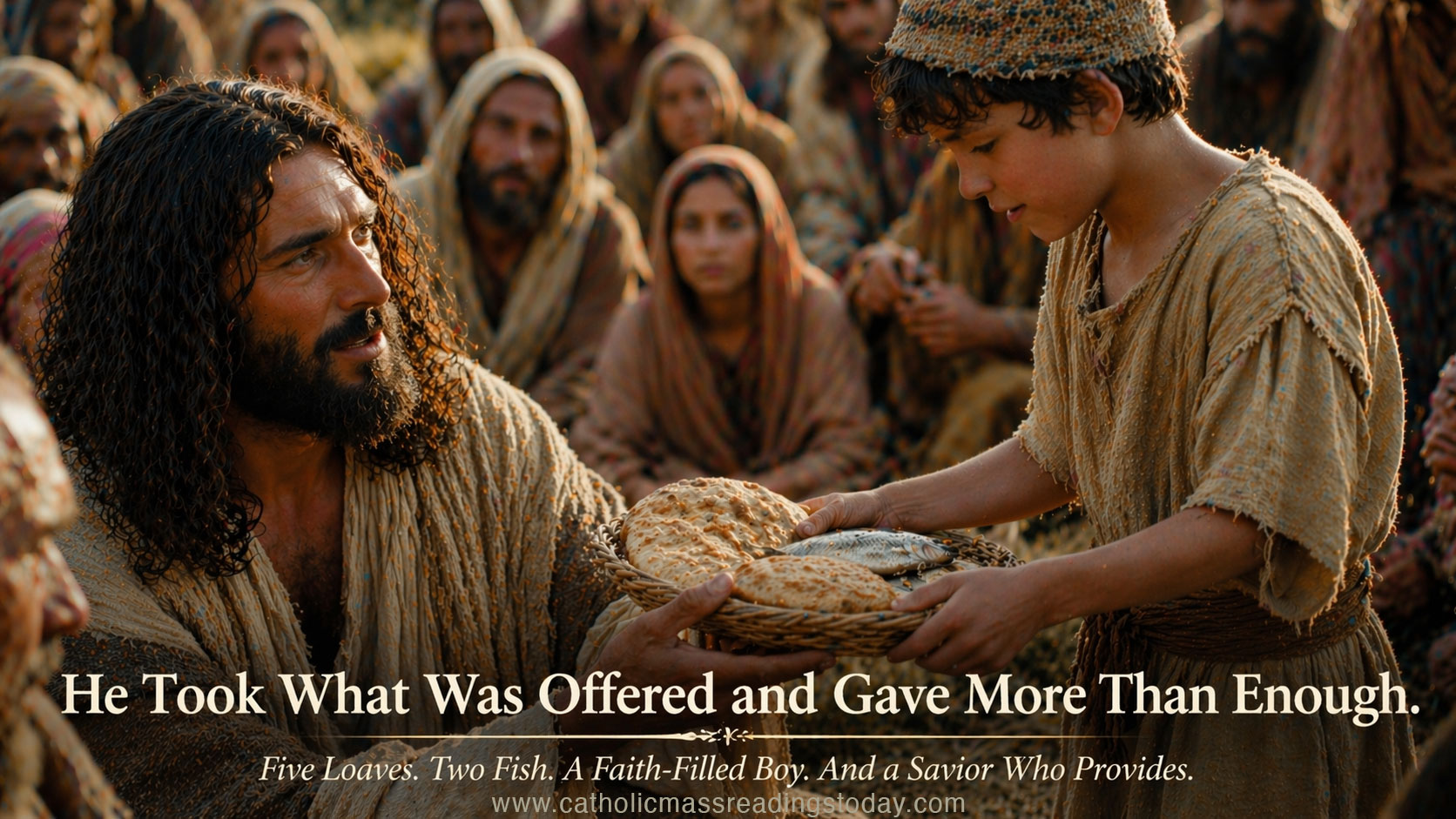
A crowd gathers, hungry in more ways than one, drawn to Jesus because they have seen Him heal, because something in them senses that He has what they are searching for. And in the midst of this scene, we see a simple, almost ordinary problem arise: there is not enough food.
Philip looks at the situation practically. He calculates, measures, and quickly realizes the impossibility. Andrew does something slightly different, he notices the small offering of a boy: five loaves and two fish. But even he cannot help but add, almost apologetically, “what are they among so many?”
And this is where the heart of the Gospel begins to open.
God does not start with abundance. He starts with what is given.
That small offering, insufficient in human terms is placed in the hands of Christ. And in His hands, it becomes more than enough. This is not just a miracle of multiplication; it is a revelation of how God works. He does not ask us to bring greatness. He asks us to bring what we have.
In the Catholic life, this speaks deeply to the way grace operates. We often feel that what we can offer, our time, our faith, our efforts is too small to matter. We compare ourselves, we hesitate, we hold back. But this Gospel gently reminds us that nothing offered to Christ is ever wasted. In His hands, even the smallest act of faith can bear fruit beyond what we can imagine.
Then there is a detail that should not be overlooked: “when he had given thanks…” before distributing the bread. This moment points us directly to the Eucharist. The Church has always seen in this miracle a foreshadowing of the Holy Mass, where Christ takes what is offered, gives thanks, and gives Himself as food for the world.
The crowd receives bread and fish “as much as they wanted,” but this satisfaction points toward something even greater, the hunger of the human heart that only Christ Himself can fill. The Eucharist is not just a symbol of provision; it is the fulfillment of it. In every Mass, we are fed not only physically or emotionally, but spiritually and with the very life of Christ.
And yet, after such a powerful sign, the people misunderstand. They want to make Him king, not because they have grasped who He truly is, but because they have seen what He can provide. They are drawn to the gift, but not yet to the Giver.
This is a quiet warning for us.
It is easy to seek God for what He can do, His blessings, His help, His provision. But the deeper call of discipleship is to seek Him for who He is. Jesus withdraws from the crowd because His mission is not to fulfill earthly expectations, but to lead us to eternal life.
In our world today, where so many are striving, worrying, and searching for security, this Gospel speaks with quiet strength. It reminds us that God sees our needs, even before we fully express them. It invites us to trust that He can provide, even when the situation seems impossible. And it calls us to place what we have… however small into His hands.
Perhaps the question this Gospel leaves us with is simple:
What am I holding back, thinking it is too little?
And what might happen if I entrusted it fully to Christ?
Because in the end, the miracle does not begin with abundance.
It begins with offering.
Let us Pray
Lord Jesus,
You who fed the crowd with so little,
teach me to trust in Your providence.
Help me to offer You what I have,
even when it seems small or insufficient.
Multiply my faith,
strengthen my trust,
and open my heart to receive You more deeply,
especially in the Eucharist.
Keep me from seeking only Your gifts,
and lead me to seek You above all things.
May my life, placed in Your hands,
become a blessing to others.
Amen.