There is something almost painfully honest in the way the crowd speaks to Jesus in this Gospel. They are not hostile. They are not rejecting Him. They are simply asking for proof “What sign do you do, that we may see, and believe you?”
It’s a question that still echoes in our own hearts today.
We want something we can see, something we can measure, something that removes all doubt. Like the Israelites in the wilderness, we often look back at what God has done before and quietly ask, “Can you do it again for me now?” We want assurance, something tangible, something that fits within our understanding.
But Jesus gently shifts their focus, and ours.
He tells them that it was not Moses who gave the manna, but the Father. And more importantly, that the manna itself was never the final gift. It was only a sign, a preparation. The real gift is not something that falls from heaven, it is Someone who comes from heaven.
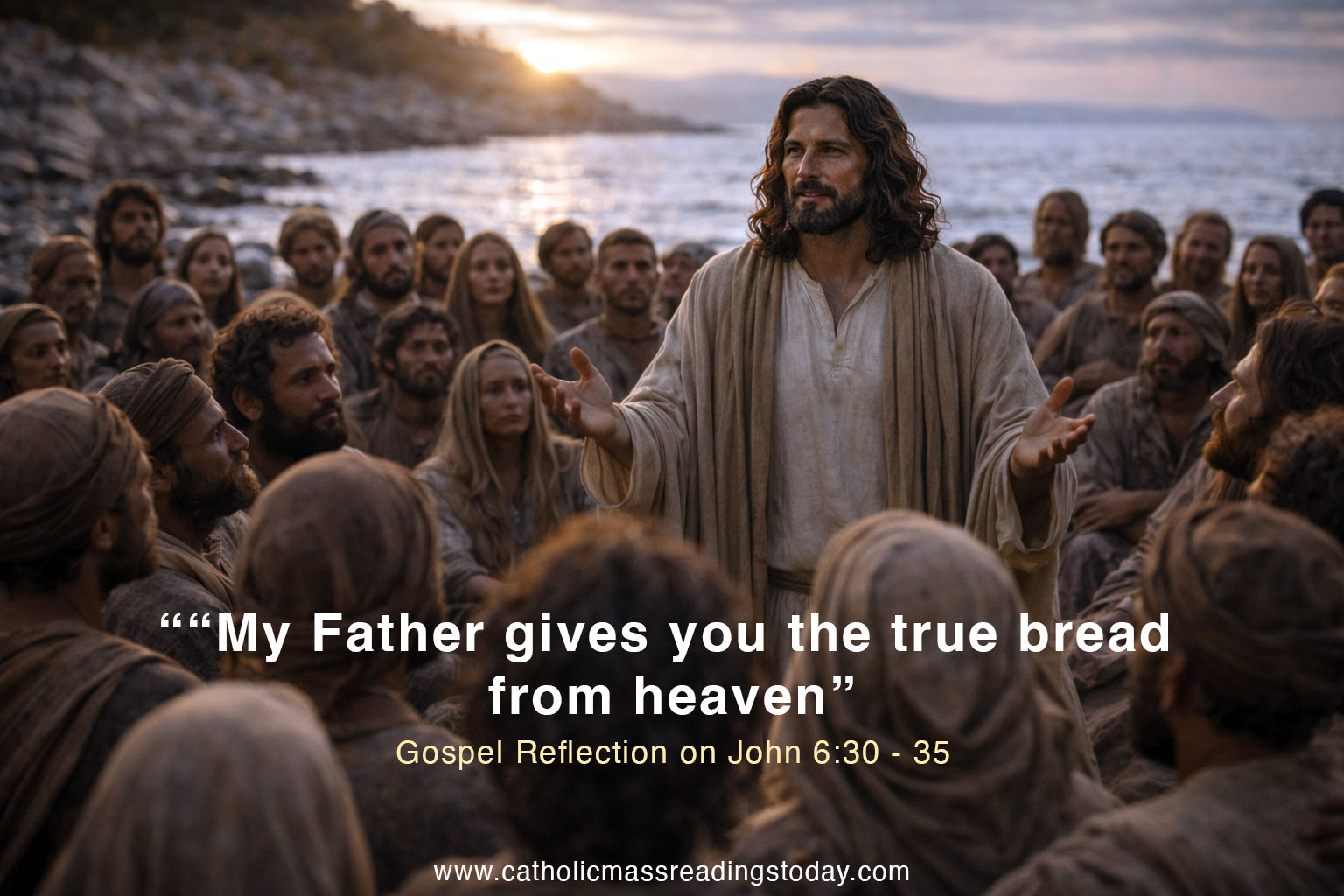
“My Father gives you the true bread from heaven… the bread of God is that which comes down from heaven, and gives life to the world.”
In Catholic teaching, this moment is deeply significant. It is not just a teaching, it is a revelation. Jesus is leading them, step by step, toward the mystery of the Eucharist, where He will give not just bread, but His very Body as the true Bread of Life.
And yet, the crowd still doesn’t fully understand. They respond with a simple, almost childlike request: “Lord, give us this bread always.”
There is something beautiful in that. Even without full understanding, there is desire. A longing for something more, something lasting.
And Jesus meets that desire with one of the most powerful declarations in all of Scripture:
“I am the bread of life.”
Not I will give you bread.
Not I will show you where to find it.
But I am.
This changes everything.
Because it means that what we are searching for is not found in things, or even in experiences, but in a relationship with Christ Himself. He is the one who satisfies the deepest hunger of the human heart, the hunger for meaning, for love, for forgiveness, for peace.
And yet, we often try to fill that hunger elsewhere.
We look for fulfillment in success, in relationships, in comfort, in control. None of these are wrong in themselves, but they are not enough. They cannot sustain us. They are, in the end, like manna, temporary, passing, unable to give lasting life.
Jesus is inviting us beyond that.
To come to Him, not occasionally, not only in times of need but consistently, faithfully. In prayer. In Scripture. Most especially in the Eucharist, where the Bread of Life is not just spoken about, but truly given.
“He who comes to me shall not hunger, and he who believes in me shall never thirst.”
This is not a promise of a life without struggle. It is a promise of a life that is no longer empty. A life rooted in something deeper, stronger, and eternal.
And perhaps the quiet challenge in this Gospel is this:
Do I truly believe that Christ is enough?
Or am I still searching for other “bread” to fill what only He can satisfy?
Because the truth is, until we begin to receive Him not just as a teacher or a miracle-worker, but as our daily Bread, our source of life, our hearts will always remain restless.
But when we do… something changes. Not always outwardly, but deeply within. There is a peace that begins to settle, a strength that quietly grows, and a sense that, even in the midst of life’s uncertainties, we are being sustained.
Let us Pray
Lord Jesus,
You are the Bread of Life,
the One who comes down from heaven to feed our hungry hearts.
So often we search for fulfillment in things that do not last,
and we forget to come to You.
Draw us back to Yourself.
Teach us to hunger for what truly gives life.
Deepen our faith, that we may believe in You fully
and receive You with trust and love.
Nourish us, Lord—
in Your Word, in Your presence, and in the Eucharist.
And let our lives be rooted in You,
now and always.
Amen.