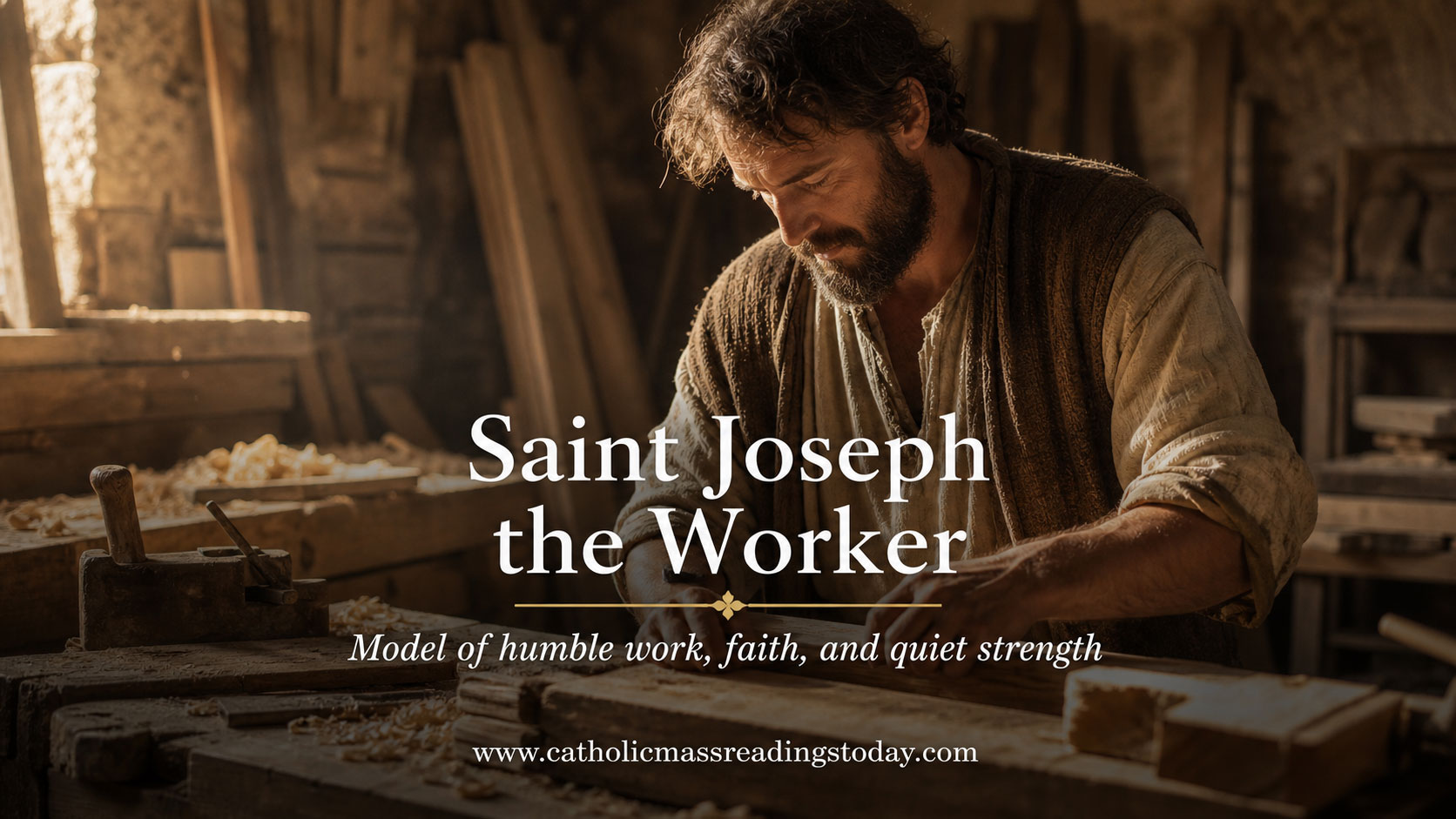
Every year on May 1, the Church celebrates Saint Joseph the Worker, a title that is at once simple and profound. It turns our attention to a man who did not preach in the streets, did not write books, did not perform miracles in the public eye, and yet was entrusted with one of the greatest missions in salvation history: to care for Jesus and Mary in the hidden life of Nazareth.
For many Catholics, Saint Joseph is already familiar as the spouse of the Blessed Virgin Mary and the foster father of Our Lord. But under the title Saint Joseph the Worker, the Church invites us to look at another dimension of his holiness: his daily labor, his quiet faithfulness, and the dignity of ordinary work offered to God.
In a world that often measures success by wealth, attention, or influence, Saint Joseph stands as a corrective. He reminds us that holiness is often found not in public achievement, but in obedience, responsibility, sacrifice, and the quiet offering of one’s life in love.
This is why the feast of Saint Joseph the Worker matters so deeply, not only for laborers, tradesmen, and workers in the practical sense, but for every Christian who seeks to live faithfully in the responsibilities of ordinary life.
Who Is Saint Joseph the Worker?
Saint Joseph the Worker is Saint Joseph under the aspect of his daily labor and humble service. The Gospels do not record many words about him, and in fact, they do not preserve a single spoken sentence from his lips. Yet what they reveal is enough to show his greatness.
Joseph was a just man. He was obedient to God. He protected Mary. He guarded the child Jesus. He acted with courage and tenderness. And he worked with his hands to provide for the Holy Family.
Tradition has long held that Joseph was a carpenter, though the Greek term used in Scripture can also suggest a craftsman or builder. In any case, Joseph was a working man. He knew fatigue. He knew responsibility. He knew what it was to labor in order to sustain a home.
This matters because it means the life of the Holy Family was not removed from the reality of human work. Jesus grew up in a household where labor was part of daily life. The Son of God was raised in a home shaped by the discipline, simplicity, and dignity of honest work.
So when the Church honors Saint Joseph the Worker, she is not creating a secondary devotion. She is drawing attention to a truth that has always been there: human work, when done with integrity and offered to God, can be a path to holiness.
Why the Church Celebrates Saint Joseph the Worker on May 1
The feast of Saint Joseph the Worker was established by Pope Pius XII in 1955. He placed it on May 1, the date widely associated with workers and labor movements around the world.
This was a deeply meaningful choice. The Church was not simply adding another feast to the calendar. She was offering a Christian vision of labor at a time when the dignity of workers was a major social concern and when many ideologies were trying to define the meaning of work apart from God.
By establishing the feast of Saint Joseph the Worker on May 1, the Church affirmed that the worker is not just an economic unit. A worker is a person made in the image of God. Labor is not merely production. It is part of human vocation, part of family life, and part of the moral order.
Pope Pius XII wanted workers to know that the Church stood with them, not only in defending just conditions, but in honoring the spiritual value of their labor. He presented Saint Joseph as the model and protector of all workers.
That is why this feast continues to speak powerfully today. In every age, the temptation exists to treat work as either everything or nothing: either as an idol that consumes life, or as a burden stripped of meaning. Saint Joseph shows another way. He teaches us that work has dignity, but only when it remains ordered to God, family, and the human person.
The Biblical Foundations of Saint Joseph the Worker
Although the Gospels are quiet about Joseph, they reveal a great deal through their silence and simplicity.
In Matthew 13:55, Jesus is referred to as “the carpenter’s son.” In Mark 6:3, Jesus Himself is called “the carpenter.” These small details are full of meaning. They tell us that Christ was known in connection with the trade and household of Joseph. The hidden years of Nazareth were not wasted years. They were years of formation, prayer, family life, and labor.
Joseph did not merely live beside Jesus; he formed the human environment in which Jesus grew. He provided a home, stability, example, and protection. He taught through action, through presence, and through the daily faithfulness of work done well.
This gives enormous dignity to hidden labor. The world may overlook the work of a father, mother, craftsman, farmer, cleaner, builder, teacher, nurse, mechanic, or clerk. But God does not. In the home of Nazareth, ordinary labor became the setting of extraordinary holiness.
The Bible presents Joseph above all as a man who listened and obeyed. When the angel spoke, Joseph acted. When danger arose, Joseph protected. When his family needed provision, Joseph worked.
That is the pattern of true masculinity, true fatherhood, and true Christian responsibility: not noise, not self-importance, but steady fidelity.
The Dignity of Work in Catholic Teaching
To understand Saint Joseph the Worker, we must understand what the Church teaches about work itself.
The Catholic vision of labor begins with the truth that human beings are made in the image of God. Because of this, work is not beneath us. It belongs to our calling. In the Book of Genesis, man is placed in the garden to cultivate and care for it. Work is part of humanity’s participation in God’s creative design.
But the Church is equally clear that the dignity of work comes from the dignity of the worker.
This is crucial.
Work has value because the person performing it has value. The human being is never just a tool of production. He or she is not meant to be used up for profit, reduced to output, or stripped of rest and family life in the name of efficiency.
This truth runs through Catholic social teaching, especially in documents like Rerum Novarum and later teachings on labor, justice, wages, and the rights of workers. The Church defends the worker not merely because hardship is unfortunate, but because exploitation is morally wrong.
Saint Joseph stands at the heart of this teaching in a quiet but powerful way. He sanctifies labor by embodying it rightly: work done in humility, for the sake of love, in obedience to God, and in service of family.
What Saint Joseph the Worker Teaches Us Today
The title Saint Joseph the Worker remains deeply relevant because the world still struggles to understand work correctly.
Some people are crushed by overwork. Others are denied decent work. Some work without fair wages. Some are trapped in unsafe conditions. Many feel their labor is invisible, unappreciated, or reduced to numbers on a screen. Others are burdened by stress, instability, or burnout.
Into all of this, Saint Joseph speaks without speaking.
He teaches us that work is honorable, but it is not everything. A person’s worth does not come from income, title, or productivity. Work should support life, not consume it. It should build the home, not destroy it. It should develop the person, not crush the soul.
He also teaches us reverence for hidden labor. Much of what holds the world together is unseen. Meals prepared, floors cleaned, tools repaired, children raised, elderly parents cared for, buildings maintained, roads built, machines fixed, patients comforted, these things rarely make headlines. Yet without them, society falls apart.
Saint Joseph’s life gives a special dignity to those whose faithfulness is rarely praised by the world.
He also teaches us that holiness does not require a dramatic platform. A workshop can become a place of prayer. Responsibility can become a form of love. Labor, when joined to God, can become an offering.
Saint Joseph the Worker and Family Life
One of the most beautiful things about Saint Joseph is that his labor was never separated from love. He did not work for work’s sake alone. He worked for Mary. He worked for Jesus. He worked to guard the life entrusted to him.
That is an important lesson today.
Work should never be treated as an idol that displaces family, prayer, rest, and the moral life. Saint Joseph does not represent endless busyness. He represents rightly ordered responsibility.
He labored, but he also listened to God.
He protected his family, but he also trusted divine providence.
He was active, but not restless.
He was strong, but not proud.
This balance is one of the reasons why devotion to Saint Joseph remains so powerful. Men especially can look to him as a model of responsibility and integrity, but really every Christian can learn from his example of humble fidelity.
The home of Nazareth was not rich in worldly terms. But it was rich in what truly matters: presence, obedience, purity, work, prayer, and love.
Saint Joseph the Worker as Patron of Workers
The Church rightly honors Saint Joseph as a patron of workers.
This means he is someone to whom workers can turn in prayer. He understands labor not from theory, but from experience. He knows the weight of daily duty. He knows what it means to carry responsibility quietly. He knows what it is to work not for applause, but because others depend on you.
Workers today can ask Saint Joseph for many things:
- for perseverance in difficult jobs
- for honesty in labor
- for protection from exploitation
- for strength when work is tiring
- for patience in uncertainty
- for humility in success
- and for trust when employment is unstable or lacking
He is also a powerful intercessor for those seeking work, those supporting families, and those trying to remain faithful in ordinary duty.
Why Saint Joseph the Worker Matters for Our Time
There is a reason the Church continues to hold Saint Joseph before us. Modern life often fragments the human person. It separates work from faith, productivity from dignity, ambition from morality, and success from peace.
Saint Joseph brings these things back into order.
He reminds us that:
- work is good, but God comes first
- labor has dignity, but the worker has greater dignity
- responsibility is holy when rooted in love
- silence can be strong
- hidden faithfulness matters
- and ordinary life can be the place where sanctity is formed
He is especially important in a culture that often misunderstands both manhood and fatherhood. Joseph’s strength is quiet, but unmistakable. He does not dominate; he protects. He does not seek attention; he seeks fidelity. He does not speak much; he obeys much.
That kind of witness is rare, and badly needed.
How Catholics Can Honor Saint Joseph the Worker
Catholics can honor Saint Joseph the Worker in ways that are simple but meaningful.
They can:
- attend Mass on May 1 if possible
- pray for workers, especially the poor and exploited
- ask Saint Joseph’s intercession for employment and strength
- reflect on the role of work in their own vocation
- thank God for the gift of labor
- and examine whether their own work life is rightly ordered
This feast can also be a moment to revisit how we treat those who work for us, serve us, or make our daily lives possible. Respect for workers should never be abstract. It should show up in justice, gratitude, and charity.
A Final Reflection on Saint Joseph the Worker
The greatness of Saint Joseph the Worker is not the greatness the world usually celebrates. It is the greatness of a faithful man who accepted an ordinary life and lived it extraordinarily well.
He built with wood, but he also built a home.
He labored with his hands, but he also guarded a mystery.
He lived in silence, but his witness still speaks.
In honoring Saint Joseph the Worker, the Church honors every honest laborer and also reminds the world of a truth it desperately needs: work is sacred when the worker is treated with dignity and when labor is offered in love.
So on this feast, we do not look only at what Joseph did. We look at who he was: a just man, a faithful husband, a devoted father, and a humble worker whose hidden life became one of the most beautiful examples of holiness the Church has ever known.
May Saint Joseph the Worker pray for all who labor.
May he protect families.
May he strengthen the weary.
May he guide those seeking work.
And may he teach us all to sanctify the ordinary duties of life.
Saint Joseph the Worker, pray for us.